
243 Ways to Win vs 20 Paylines: How Slot Games Count Symbols
What does 243 ways to win mean in slot games, and how is it different from 20 paylines? Understand reel combinations, symbol positions, ways-to-win calculations, RTP, and common slot game misunderstandings with clear examples.
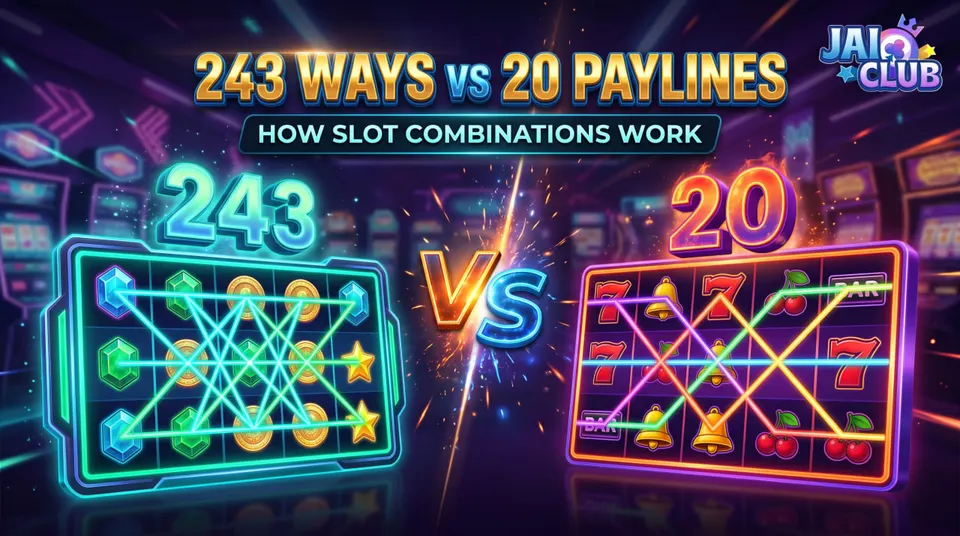
In this article
- What Is the Difference Between 243 Ways and 20 Paylines?
- A Simple Explanation
- What Does 243 Ways to Win Mean?
- Why Is the Number 243?
- Does Every Five-Reel Slot Have 243 Ways?
- What Are 20 Paylines in Slot Games?
- Example of a Straight Payline
- Example of a Zigzag Payline
- Are All 20 Paylines Always Active?
- 243 Ways vs 20 Paylines: Quick Comparison
- How Matching Symbols Work in a 243-Ways Slot
- Why Does the Number of Matching Symbols Matter?
- What Happens if a Reel Has No Matching Symbol?
- How Matching Symbols Work in a 20-Payline Slot
- Why Can a Matching Symbol Be Ignored?
- Can More Than One Payline Qualify?
- Does 243 Ways Mean 243 Chances to Win?
- Position Paths Are Not Independent Prizes
- Why the Word "Ways" Causes Confusion
- Are 243 Ways Better Than 20 Paylines?
- What Does RTP Mean?
- What Does Volatility Mean?
- Does Having More Paylines Increase the Winning Probability?
- Example: 10 Lines vs 20 Lines
- Why Game Design Matters
- What Does a 5-Reel, 3-Row Slot Mean?
- Reels vs Rows
- Reels vs Ways
- Reels vs Paylines
- What Do 1,024 Ways and 4,096 Ways Mean?
- Does 4,096 Mean More Than 243 Winning Outcomes?
- Why Bigger Numbers Are Not Enough
- What Is the Difference Between Ways to Win and Megaways?
- Fixed Ways
- Variable Ways
- Does a Larger Maximum Mean Better Results?
- How Do Wild Symbols Affect Ways-to-Win Games?
- Can Wilds Increase Qualifying Combinations?
- Does Every Wild Replace Every Symbol?
- How Do Scatter Symbols Work With Paylines and Ways?
- Are Scatters Included in the 243 Ways Calculation?
- Can a Scatter Trigger a Feature?
- How to Identify the Winning System in a Slot Game
- Step 1: Find the Rules or Paytable
- Step 2: Check the Combination Method
- Step 3: Check the Direction
- Step 4: Check the Minimum Matching Requirement
- Step 5: Review Wild and Scatter Rules
- Step 6: Check RTP and Other Technical Information
- How This Relates to Jai Club Slots
- Common Mistakes When Comparing 243 Ways and 20 Paylines
- Mistake 1: Thinking 243 Ways Means 243 Guaranteed Wins
- Mistake 2: Believing More Ways Always Means Higher RTP
- Mistake 3: Counting Every Matching Symbol as a Win
- Mistake 4: Confusing Reels With Paylines
- Mistake 5: Assuming All Five-Reel Games Use 243 Ways
- Mistake 6: Ignoring the Paytable
- Mistake 7: Comparing Games Only by Headline Numbers
- Quick Comparison Checklist
- Frequently Asked Questions
- 1. What does 243 ways to win mean in slots?
- 2. How are 243 ways calculated?
- 3. Does 243 ways mean 243 chances to win?
- 4. What does 20 paylines mean?
- 5. Is 243 ways better than 20 paylines?
- 6. Do more paylines increase RTP?
- 7. Can matching symbols on different rows count in 243 ways?
- 8. Can matching symbols on different rows count in 20 paylines?
- 9. What is the difference between 243 and 1,024 ways?
- 10. Are ways to win the same as paylines?
- 11. Can Wild symbols count in 243-ways games?
- 12. Are Scatter symbols evaluated through paylines?
- 13. Does a higher ways count guarantee more frequent wins?
- 14. Are all Jai Club Slots based on 243 ways?
- Final Thoughts
You may have seen slot games displaying terms such as "20 Paylines", "243 Ways to Win" or even "1,024 Ways". These numbers look impressive, but what do they actually mean?
A common misunderstanding is that 243 ways means a player gets 243 separate chances to win on every spin. That is not how the system works.
The number usually describes the different symbol-position combinations that a game can evaluate. It does not promise 243 winning outcomes.
Similarly, 20 paylines means that a slot checks up to 20 predefined symbol patterns according to its rules. It does not mean that 20 combinations will necessarily appear.
This guide explains 243 ways vs 20 paylines in simple English, using illustrative reel diagrams, practical calculations and clear comparisons.
It is part of our wider coverage of slot mechanics and game features on Jai Club Game.
What Is the Difference Between 243 Ways and 20 Paylines?
The main difference is how a slot game recognises symbol combinations.
A 20-payline slot uses 20 predefined routes across the reels.
A 243-ways slot typically checks matching symbols across consecutive reels without requiring one particular fixed line.
Both systems evaluate symbol arrangements, but they use different methods.
A Simple Explanation
Imagine a slot with five reels and three visible symbol positions on each reel.
In a payline game, a matching combination must follow one of the selected line patterns.
In a ways-to-win game, the matching symbols may appear at different vertical positions on consecutive reels.
For example, a symbol could appear on the top row of reel one, the bottom row of reel two and the middle row of reel three.
A traditional payline system counts that arrangement only if it follows an active line and satisfies the game's rules.
A qualifying ways-to-win system may recognise the combination without requiring that particular row pattern.
That is the central distinction.
What Does 243 Ways to Win Mean?
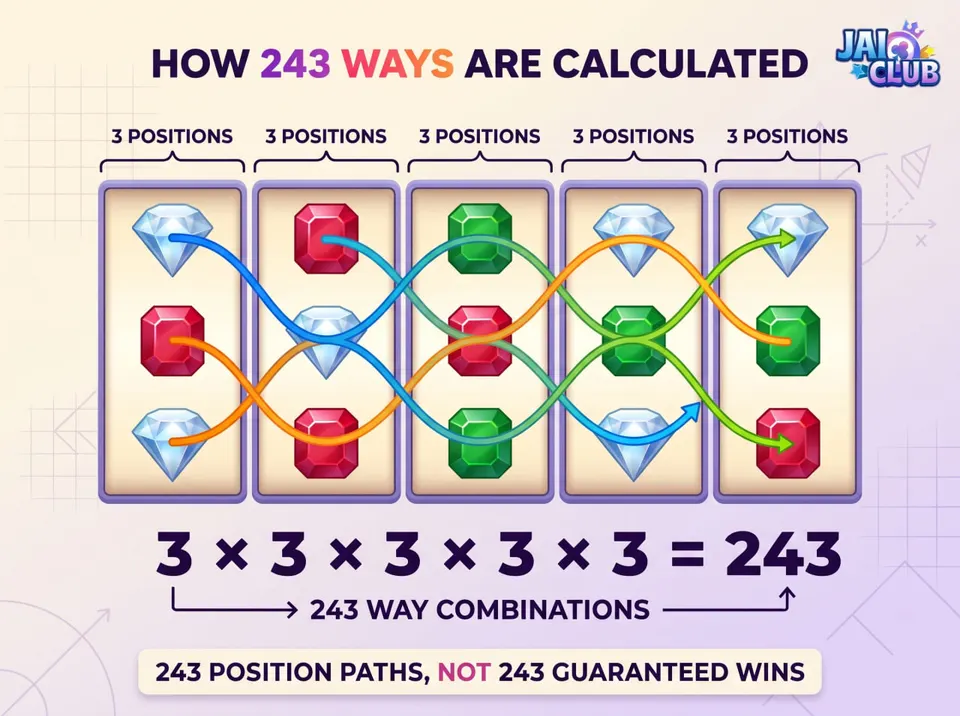
A common 243-ways slot format uses five reels with three visible positions on each reel.
Each reel has three possible symbol positions.
The total number of full-length position paths is calculated as:
3 × 3 × 3 × 3 × 3 = 243
This produces 243 possible position paths across five reels.
However, those paths are not necessarily 243 prizes, 243 spins or 243 winning chances.
They simply describe the possible ways of selecting one position from each reel.
Why Is the Number 243?
The calculation follows the multiplication principle.
If you can select one of three positions from the first reel and one of three positions from the second reel, there are:
3 × 3 = 9 possible pairs of positions.
Adding the third reel gives:
3 × 3 × 3 = 27 position paths.
Adding a fourth reel gives:
3 × 3 × 3 × 3 = 81.
With five reels, the total becomes:
3 × 3 × 3 × 3 × 3 = 243.
This is why 243 appears in many five-reel, three-row slot layouts.
Does Every Five-Reel Slot Have 243 Ways?
No.
A five-reel slot could use fixed paylines, ways-to-win arrangements, cluster rules or another evaluation system.
The visible grid does not automatically establish the payment structure.
Always check the game information or paytable.
What Are 20 Paylines in Slot Games?
A payline is a predefined route that connects symbol positions across the reels.
Some paylines are straight.
Others form diagonal, zigzag or other patterns.
A 20-payline slot has 20 specified routes that can be evaluated according to the game's rules.
Example of a Straight Payline
Imagine a five-reel slot with three visible rows.
The middle row contains five matching symbols.
If the game has an active horizontal middle payline and the combination meets the paytable requirements, the symbols may qualify for an award.
Example of a Zigzag Payline
Another payline may pass through the top position of reel one, middle position of reel two, bottom position of reel three and other predefined positions.
The symbols must follow that route to qualify under that line.
Are All 20 Paylines Always Active?
Not necessarily.
Some games use fixed paylines that remain active.
Others allow the user to select a number of lines.
The exact stake calculation and rules vary.
If a game uses selectable paylines, changing the number of active lines may also affect the total stake, depending on its configuration.
243 Ways vs 20 Paylines: Quick Comparison
| Feature | 243 Ways | 20 Paylines |
|---|---|---|
| Combination system | Eligible reel-position paths | Predefined line patterns |
| Typical layout | Five reels, three positions each | Varies by game |
| Exact line required | Usually no | Yes |
| Position flexibility | Matching symbols may occupy different rows | Symbols must follow active lines |
| Number displayed | 243 position paths | 20 line patterns |
| Guaranteed outcome | No | No |
| RTP determined by count alone | No | No |
| Main reference | Game rules and paytable | Payline diagram and paytable |
Neither structure is automatically better.
The actual game mathematics, symbol distribution and award rules determine how the system behaves.
How Matching Symbols Work in a 243-Ways Slot
Consider a hypothetical five-reel game in which matching symbols are evaluated from left to right.
A particular symbol appears in the following positions:
Reel 1: Two matching symbols
Reel 2: One matching symbol
Reel 3: Three matching symbols
The number of possible matching paths across these three reels is:
2 × 1 × 3 = 6
Under an eligible ways-to-win evaluation, there could be six qualifying position paths involving that symbol across the first three reels.
However, the game still needs to apply its actual paytable, starting-reel requirements, minimum combination length and other rules.
The calculation alone does not establish an award.
Why Does the Number of Matching Symbols Matter?
Ways-to-win systems commonly consider how many eligible matching symbols appear on each consecutive reel.
If more than one qualifying symbol appears on a reel, several symbol-position paths may be formed.
The game evaluates those paths according to its rules.
What Happens if a Reel Has No Matching Symbol?
In a typical left-to-right ways system, the sequence may stop when the next required reel has no eligible matching symbol.
But some games have different evaluation methods, including special symbols and alternative directions.
That is why the game-specific paytable matters.
How Matching Symbols Work in a 20-Payline Slot
Now consider the same five-reel display under a fixed-payline system.
The game checks only the predefined active lines.
Imagine three matching symbols appearing on different rows.
The symbols may look connected visually, but that does not necessarily mean they form a qualifying combination.
If no active payline follows those positions, the combination may not count under the ordinary line rules.
Why Can a Matching Symbol Be Ignored?
Because the symbol is outside the specific pattern being evaluated.
A payline system is not simply counting all matching symbols anywhere on the screen.
It checks whether the symbols satisfy one or more defined routes.
Can More Than One Payline Qualify?
Yes, depending on the game's layout and rules.
A displayed outcome may satisfy more than one active line.
However, the number of eligible lines and how overlapping combinations are handled must be explained by the game.
Does 243 Ways Mean 243 Chances to Win?
No.
This is one of the most important distinctions.
The phrase "243 Ways to Win" describes a structural feature of the game.
It does not mean that every spin creates 243 independently guaranteed opportunities.
It also does not mean that 243 different prizes will be awarded.
A particular outcome may contain no qualifying combination.
Another outcome may contain one or more combinations recognised by the game's rules.
Position Paths Are Not Independent Prizes
The 243 figure comes from the number of possible position paths.
Those paths are part of the game's evaluation structure.
The actual symbol distribution determines which paths, if any, form qualifying combinations.
Why the Word "Ways" Causes Confusion
In ordinary English, more ways can sound like more opportunities or better results.
But in slot terminology, the word has a specific mathematical meaning.
It describes possible arrangements of eligible positions.
It does not promise an advantage.
Are 243 Ways Better Than 20 Paylines?
Neither format is inherently better.
A larger number of ways does not automatically establish a higher theoretical return or a greater likelihood of a qualifying outcome.
Other factors matter, including:
- Symbol frequency
- Reel configuration
- Paytable values
- Bonus feature rules
- Theoretical RTP
- Volatility
- Total stake structure
- Game-specific evaluation conditions
Two slot titles can have different ways or payline counts while sharing a similar theoretical RTP.
They may also have very different outcome distributions.
What Does RTP Mean?
RTP stands for Return to Player.
It is a theoretical long-run return percentage calculated under a particular mathematical configuration.
An RTP percentage is not a promise about the result of an individual spin or session.
What Does Volatility Mean?
Volatility describes variation in the size and distribution of outcomes.
Two games can have a similar RTP but different volatility characteristics.
Therefore, comparing 243 ways with 20 paylines does not reveal the complete mathematical design.
Does Having More Paylines Increase the Winning Probability?
Not necessarily in the way people often assume.
More active lines may allow additional symbol arrangements to qualify within a particular game.
However, the overall effect depends on the symbol probabilities, payment rules and stake structure.
It is incorrect to conclude that more paylines automatically produce better mathematical value.
Example: 10 Lines vs 20 Lines
Imagine a game allowing selectable paylines.
With 10 active lines, the game checks a defined selection of 10 patterns.
With 20 active lines, it checks 20 patterns.
But if the total stake changes with the number of lines, comparing the two settings becomes more complicated.
A larger collection of eligible line patterns does not by itself establish better returns relative to the amount used.
Why Game Design Matters
The game developer defines the mathematical relationship between outcomes and awards.
Payline count is only one part of that design.
What Does a 5-Reel, 3-Row Slot Mean?
A five-reel, three-row slot displays five vertical reels with three visible positions each.
The grid therefore contains:
5 × 3 = 15 visible symbol positions.
However, 15 visible positions do not mean 15 paylines.
Nor do they mean 15 possible outcomes.
Reels vs Rows
Reels are the vertical columns.
Rows are the horizontal levels.
A five-reel slot with three visible rows has 15 displayed positions.
Reels vs Ways
Ways refer to eligible position paths or arrangements under a particular evaluation system.
The number of ways depends on the layout and the game rules.
Reels vs Paylines
Paylines are specifically defined routes.
A grid can contain 15 positions and still use 20 or more paylines because different line patterns can share positions.
What Do 1,024 Ways and 4,096 Ways Mean?
The same basic multiplication principle can explain other common formats.
A five-reel game with four eligible visible positions on each reel has:
4 × 4 × 4 × 4 × 4 = 1,024
That gives 1,024 full-length position paths.
A six-reel game with four eligible positions on each reel has:
4 × 4 × 4 × 4 × 4 × 4 = 4,096
That gives 4,096 full-length position paths.
Again, the figures describe position arrangements, not guaranteed awards.
Does 4,096 Mean More Than 243 Winning Outcomes?
It means the illustrative grid has more full-length position paths.
It does not tell us how frequently qualifying symbol combinations appear.
Why Bigger Numbers Are Not Enough
The complete mathematical model determines the outcome distribution.
The number of ways is only one part of the structure.
What Is the Difference Between Ways to Win and Megaways?
Ways-to-win is a broad method for evaluating eligible symbol arrangements.
Megaways is a particular variable-reel structure associated with changing numbers of visible positions.
In some variable-height games, each reel can display a different number of eligible positions.
The total number of position paths can therefore change between rounds.
Fixed Ways
A traditional 243-ways game often maintains the same number of visible positions.
Variable Ways
A variable-height game may display different reel heights.
The number of possible paths is calculated using the number of eligible positions on each reel.
Does a Larger Maximum Mean Better Results?
No.
A maximum ways figure describes a possible grid configuration.
It does not guarantee that the maximum is active on every round or that a particular outcome will occur.
How Do Wild Symbols Affect Ways-to-Win Games?
Wild symbols can substitute for eligible regular symbols, depending on the game's rules.
In a ways-to-win game, a Wild may participate in symbol paths across consecutive reels.
However, its exact effect depends on its position and substitution restrictions.
Can Wilds Increase Qualifying Combinations?
They can contribute to additional eligible symbol paths in some designs.
That does not establish how frequently they will appear.
Does Every Wild Replace Every Symbol?
No.
Wilds commonly have restrictions involving Scatter, Bonus or other special symbols.
For a more detailed explanation of general Jai Club game terminology, explore our Jai Club game features guide.
How Do Scatter Symbols Work With Paylines and Ways?
Scatter symbols may follow separate rules from ordinary line or ways combinations.
Some games count Scatters across eligible reel positions without requiring them to form a traditional payline.
Others have specific reel restrictions or bonus conditions.
Are Scatters Included in the 243 Ways Calculation?
The 243 figure describes possible position paths within the grid.
It does not mean every symbol is evaluated according to the same rules.
Special symbols may be handled separately.
Can a Scatter Trigger a Feature?
In some titles, yes.
But the required number of Scatters, eligible positions and available features depend on the particular game.
How to Identify the Winning System in a Slot Game
Do not rely only on the appearance of the slot machine.
Two games can have very similar reels while using different evaluation methods.
The game information screen is the appropriate place to look.
Step 1: Find the Rules or Paytable
Look for a Help, Information, Rules or Paytable section.
Step 2: Check the Combination Method
Identify whether the game uses fixed paylines, adjustable paylines, ways to win or another system.
Step 3: Check the Direction
Find out whether combinations are evaluated from left to right, right to left, both ways or through a different method.
Step 4: Check the Minimum Matching Requirement
A game may require a particular number of symbols on consecutive reels.
The requirement varies by title.
Step 5: Review Wild and Scatter Rules
Special symbols may change how combinations are evaluated.
Step 6: Check RTP and Other Technical Information
Use the verified game information rather than unsupported claims from unrelated websites.
How This Relates to Jai Club Slots
Readers searching for Jai Club Slots may encounter titles and interfaces with different reel layouts or symbol systems.
Some slot-related websites use terms such as paylines, ways to win, Wild, Scatter and Bonus.
However, the availability of a particular format should not be assumed across every service associated with the Jai Club name.
This article explains general slot mechanics rather than claiming that a specific 243-ways or 20-payline title is currently available on Jai Club.
For related articles, visit the Jai Club Game homepage and browse the available game categories.
Common Mistakes When Comparing 243 Ways and 20 Paylines
Mistake 1: Thinking 243 Ways Means 243 Guaranteed Wins
The number describes possible position paths.
Mistake 2: Believing More Ways Always Means Higher RTP
Ways and RTP measure different aspects of a game.
Mistake 3: Counting Every Matching Symbol as a Win
The symbols must satisfy the game's evaluation rules.
Mistake 4: Confusing Reels With Paylines
Reels are display columns. Paylines are defined patterns.
Mistake 5: Assuming All Five-Reel Games Use 243 Ways
The same visible grid can support different winning systems.
Mistake 6: Ignoring the Paytable
A game's information screen provides the rules needed to interpret its result.
Mistake 7: Comparing Games Only by Headline Numbers
A figure such as 243, 1,024 or 4,096 does not describe the entire mathematical design.
Quick Comparison Checklist
When reading a new slot game's interface, check the following:
- How many reels are visible?
- How many symbol positions appear on each reel?
- Does the game use paylines or ways?
- Are the paylines fixed or selectable?
- Where must matching combinations begin?
- What is the minimum number of matching symbols?
- How are Wilds evaluated?
- Do Scatters have separate rules?
- What does the paytable say?
- Does the game provide verified RTP information?
- Is the maximum number of ways always active?
- Does the game use variable reel heights?
This checklist helps explain the interface without treating structural numbers as predictions.
Frequently Asked Questions
1. What does 243 ways to win mean in slots?
It commonly describes 243 possible full-length symbol-position paths in a five-reel grid with three eligible positions per reel.
2. How are 243 ways calculated?
Multiply the three available positions across five reels: 3 × 3 × 3 × 3 × 3 = 243.
3. Does 243 ways mean 243 chances to win?
No. It describes possible position paths, not guaranteed wins or separate independent prizes.
4. What does 20 paylines mean?
A 20-payline slot has 20 predefined line patterns that can be evaluated according to the game's rules.
5. Is 243 ways better than 20 paylines?
Neither format is automatically better. They use different combination-evaluation systems, and their mathematical returns depend on the full game design.
6. Do more paylines increase RTP?
Not automatically. RTP depends on the game's mathematical configuration, not merely the number of lines.
7. Can matching symbols on different rows count in 243 ways?
They may count if they satisfy the game's adjacent-reel combination rules. Exact row alignment is usually not required in a traditional ways system.
8. Can matching symbols on different rows count in 20 paylines?
Only if they follow an active payline or meet another qualifying rule defined by the game.
9. What is the difference between 243 and 1,024 ways?
A common 243-ways grid uses five reels with three eligible positions each. A common 1,024-ways grid uses five reels with four eligible positions each.
10. Are ways to win the same as paylines?
No. Paylines use predefined routes, while ways systems generally evaluate matching symbols across consecutive reels without requiring one specific line.
11. Can Wild symbols count in 243-ways games?
They can contribute to eligible combinations if the game's rules permit substitution.
12. Are Scatter symbols evaluated through paylines?
Not always. Scatters may follow separate rules, including eligibility across different reel positions.
13. Does a higher ways count guarantee more frequent wins?
No. The ways count does not independently determine win frequency, RTP or volatility.
14. Are all Jai Club Slots based on 243 ways?
That cannot be assumed. Slot formats vary, and current game availability must be verified for the relevant service.
Final Thoughts
The difference between 243 ways and 20 paylines is mainly about how matching symbol positions are recognised.
A 20-payline game follows predefined line patterns.
A traditional 243-ways game evaluates eligible combinations across a five-reel, three-position grid without relying on one specific fixed payline.
Neither format guarantees a particular outcome, and a larger number does not automatically indicate better mathematical value.
The most useful way to understand a game is to examine its reel layout, paytable, special symbols and combination rules.
For further information about game features and related topics, visit our Jai Club guides.
Understanding what the numbers actually represent is more valuable than assuming that a large ways-to-win figure guarantees a better result.