
Jai Colour Trading Result Chart: How to Read Numbers, Colours & History
Learn how to read a Jai Colour Trading result chart, including the commonly used 0–9 number mapping, Red, Green and Violet labels, Big/Small classifications, period IDs and result history.
In this article
- Jai Colour Trading Result Chart: How to Read Numbers, Colours & History
- What Is a Jai Colour Trading Result Chart?
- Jai Colour Trading Number Chart From 0 to 9
- Red, Green and Violet Colour Meaning
- What Does Red Mean?
- What Does Green Mean?
- What Does Violet Mean?
- Why Do Numbers 0 and 5 Have Two Colours?
- Jai Colour Trading Big and Small Explained
- How to Read Jai Colour Trading Results Step by Step
- Step 1: Identify the Period Number
- Step 2: Read the Result Digit
- Step 3: Match the Colour
- Step 4: Check Big or Small
- Step 5: Confirm the Round Status
- Example of a Colour Trading Result History
- Jai Colour Trading Result History vs Live Results
- What Do Chart Dots, Streaks and Trend Lines Mean?
- Can a Colour Trading Chart Predict the Next Number?
- Colour Trading Chart vs Hack and Prediction Tools
- Common Mistakes When Reading a Jai Colour Trading Chart
- Frequently Asked Questions
- What is a Jai Colour Trading chart?
- Which numbers are Red in the common colour chart?
- Which numbers are Green?
- What does Violet mean?
- What is the Jai Colour Trading number range?
- What do Big and Small mean?
- How do I read a Jai Colour Trading result history?
- What is the difference between a period number and a result number?
- Are Jai Colour Trading results today available on this page?
- Can historical colour patterns predict future rounds?
- Is a colour trading chart the same as a hack tool?
- Are all Jai Club colour trading charts identical?
- Final Thoughts
Jai Colour Trading Result Chart: How to Read Numbers, Colours & History
A Jai Colour Trading result chart helps readers understand how numbered outcomes, colour labels and game periods are displayed in colour-based game interfaces. A chart may appear simple at first, but its different columns can create confusion when the same round contains a number, a colour, a Big or Small label and a period identifier.
People searching for Jai Colour Trading results often want to understand what the latest numbers mean or why a particular colour appears alongside a digit. In commonly used WinGo-style formats, a result may be a single number from 0 to 9, with additional labels derived from that number. However, different platforms can use different rules, so the applicable game's information screen remains the authority for its exact mapping.
This guide explains how to read a colour trading result chart, interpret number-to-colour relationships, recognise the special cases involving 0 and 5, understand historical records and avoid confusing previous results with reliable forecasts.
What Is a Jai Colour Trading Result Chart?
A Jai Colour Trading result chart is a visual reference showing information about completed rounds in a colour-based game. Depending on the interface, it may display a period number, result digit, colour indicator, Big or Small classification and a history of previous outcomes.
The chart's main purpose is to make recorded information easier to read. It should not be confused with a live prediction system or a guarantee about what will appear in an upcoming round. A result chart describes information that has already been published, while a future outcome remains subject to the game's rules.
For general background, our existing Jai Club Colour Trading guide explains common game terms, including colour categories, round periods, countdown timers and historical records. This article goes further by focusing on how to read a chart row by row.
Jai Colour Trading Number Chart From 0 to 9
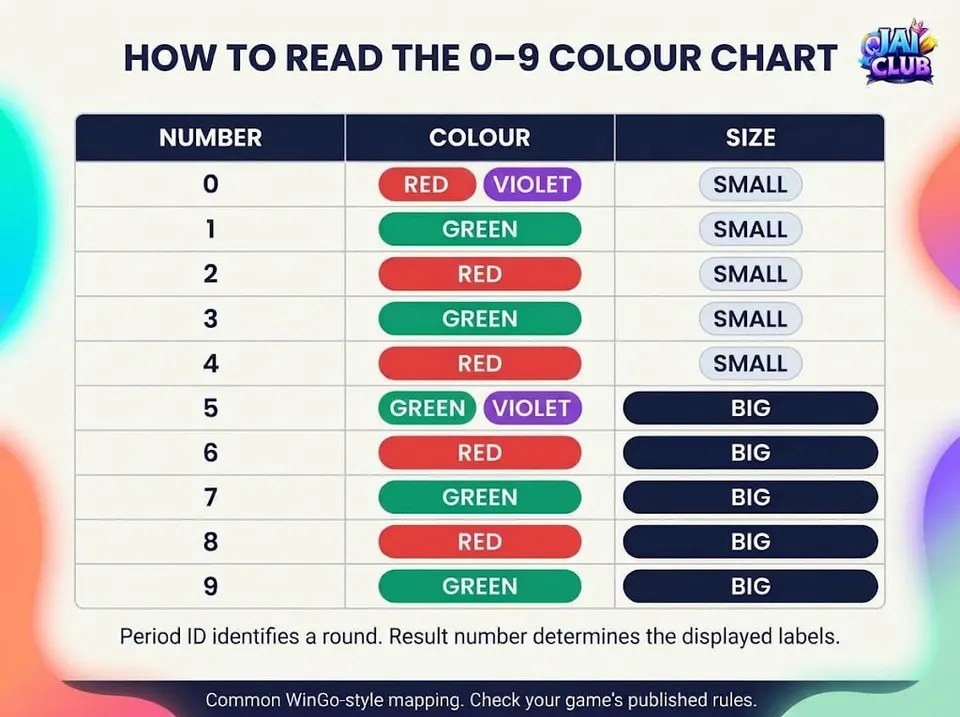
In a commonly documented WinGo-style result format, each completed round produces a digit from 0 to 9. That digit is associated with a colour label and a separate Big or Small classification.
The following reference shows a widespread mapping. It is an educational example, not verification that every Jai Club-branded game uses exactly the same rules.
| Number | Colour label | Size |
|---|---|---|
| 0 | Red + Violet | Small |
| 1 | Green | Small |
| 2 | Red | Small |
| 3 | Green | Small |
| 4 | Red | Small |
| 5 | Green + Violet | Big |
| 6 | Red | Big |
| 7 | Green | Big |
| 8 | Red | Big |
| 9 | Green | Big |
This table separates the primary digit from its displayed labels. For example, if the completed result is 8, the chart shows Red and Big under the common mapping. If the number is 3, the corresponding labels are Green and Small.
The special cases are 0 and 5 because they can appear with two colour labels. Understanding this distinction is especially useful when the result interface uses coloured dots instead of writing the colour names in full.
Red, Green and Violet Colour Meaning
In the common WinGo-style number chart, Red, Green and Violet are predefined result categories. They are not signs that a financial market is rising or falling, and the colours do not represent a trading strategy.
The regular Green digits are 1, 3, 7 and 9. The regular Red digits are 2, 4, 6 and 8. Violet is associated with the special digits 0 and 5, which can also carry another colour label.
What Does Red Mean?
Red is a result label associated with several even digits in the common mapping. Numbers 2, 4, 6 and 8 appear as Red, while 0 may be displayed as Red together with Violet.
If a round produces the number 6, the chart would therefore identify the result as Red and Big. The Red label does not reveal anything about the next round.
What Does Green Mean?
Green is associated with the regular digits 1, 3, 7 and 9. Number 5 may carry both Green and Violet labels, making it an exception to the simpler mapping.
For example, a result of 7 is Green and Big. A result of 1 is Green and Small, showing that the same colour can appear in either size category.
What Does Violet Mean?
Violet is linked with the special digits 0 and 5 in the common chart. It is not a separate number outside the 0–9 range, and the appearance of a Violet indicator does not mean two different rounds have been completed.
Readers should check the displayed digit first, then use the relevant game legend to interpret its associated colours.
Why Do Numbers 0 and 5 Have Two Colours?
Numbers 0 and 5 are frequently the most confusing entries in a colour trading number chart. In the commonly used mapping, 0 is associated with Red and Violet, while 5 is associated with Green and Violet.
This is a relationship between one numerical outcome and multiple display labels. It should not be interpreted as two independent results, and it does not establish how every platform settles a colour selection.
For instance, if a completed round shows 0, that round still has one numerical result: zero. Its chart labels may include Red and Violet, while the Big/Small classification is Small. The same principle applies to 5, except that its labels may include Green and Violet and its size classification is Big.
These examples help explain the chart's structure without claiming that a particular platform uses an identical award calculation.
Jai Colour Trading Big and Small Explained
Big and Small describe two numerical groups within the common 0–9 format. Small includes the digits 0, 1, 2, 3 and 4, while Big includes 5, 6, 7, 8 and 9.
These labels should be read separately from colour. A Green result can be Small, as with number 3, or Big, as with number 7. Similarly, a Red result can fall within either numerical group.
| Classification | Numbers |
|---|---|
| Small | 0, 1, 2, 3, 4 |
| Big | 5, 6, 7, 8, 9 |
The classification describes the completed number, not the size of a stake, the importance of a round or the likelihood of the next result. A sequence showing several Big results does not establish that Small must appear next.
How to Read Jai Colour Trading Results Step by Step
A result chart becomes easier to understand when its columns are read in a consistent order. Instead of immediately examining the coloured indicators, start by identifying the period and verifying that the displayed round has actually been completed.
Step 1: Identify the Period Number
The period number is an identifier assigned to a particular round. It distinguishes one result from another, especially when a game operates multiple rounds within a short period.
A period identifier may contain several digits or a date-like sequence, depending on the implementation. Its length and structure are not universal, so readers should avoid assuming that every game uses the same numbering format.
Step 2: Read the Result Digit
Once the round has been identified, locate its actual result. In the common chart explained here, the completed numerical outcome is a digit between 0 and 9.
This digit is the starting point for interpreting the remaining labels. If the number is missing or the round is still marked as pending, avoid treating a provisional display as a final outcome.
Step 3: Match the Colour
Use the game's colour legend or published rules to interpret the number. For example, under the common reference table, number 4 is Red, while number 9 is Green.
If the interface shows two colour indicators for number 0 or 5, check whether it uses the dual-colour mapping described earlier.
Step 4: Check Big or Small
Next, determine whether the number belongs to the Small group or the Big group. Number 4 is Small, while number 9 is Big under the common format.
This step should be treated as a classification of the same result rather than a separate random draw.
Step 5: Confirm the Round Status
Finally, confirm that the round has ended and that the result appears in the completed history. A countdown timer reaching zero is not necessarily the same thing as a completed result being published.
When an interface displays an outdated row, incomplete animation or pending label, the most recent visible number may still belong to an earlier round.
Example of a Colour Trading Result History
Consider the following fictional result history. These values are examples created to demonstrate how a chart can be read; they are not current or historical results from any particular Jai Club operator.
| Period | Number | Colour | Size | Status |
|---|---|---|---|---|
| 10421 | 2 | Red | Small | Completed |
| 10422 | 7 | Green | Big | Completed |
| 10423 | 0 | Red + Violet | Small | Completed |
| 10424 | 5 | Green + Violet | Big | Completed |
| 10425 | 8 | Red | Big | Completed |
The example shows how several different types of information appear together. The period identifies each round, the number represents the recorded outcome, and the colour and size fields describe that number according to the selected mapping.
A reader can use the table to check that number 2 appears with Red and Small or that number 8 appears with Red and Big. However, the sequence does not reveal which number will appear in period 10426.
Jai Colour Trading Result History vs Live Results
A result-history table records rounds that have already been completed. A live interface may also display the current countdown, selected round or provisional loading state. These are different pieces of information and should not be interpreted as though they represent the same completed result.
Someone searching for Jai Colour Trading results today may expect the newest completed row to match the current round shown on the screen. In reality, the timer can already be counting down the next round while the history displays the outcome of the previous one.
The difference becomes particularly important when the page has not refreshed correctly. Browser caching, connection delays or service-side processing can cause a result screen to temporarily display outdated information.
The period ID provides a more reliable way to match records than the colour alone. Two adjacent rounds can display the same colour, so checking only the colour indicator may lead to confusion.
What Do Chart Dots, Streaks and Trend Lines Mean?
Some result interfaces provide additional visualisations such as coloured dots, connected lines, frequency counters or streak summaries. These tools are designed to make historical records easier to inspect, but their precise meaning depends on the platform's interface.
A coloured dot may represent the colour label of a completed result, while a line may connect several historical positions. A frequency counter may show how many times a digit appeared within a selected set of previous rounds.
These visualisations should not be confused with evidence that a future result is predictable. A streak of several Red results describes earlier rounds, but it does not prove that the next outcome will be Green.
Can a Colour Trading Chart Predict the Next Number?
A result chart can show historical patterns, but the chart alone cannot establish a reliable prediction method. Previous rounds are observations. They do not reveal the internal process used to generate future outcomes.
If a game produces independent random results, the previous sequence does not determine the next one. A number that has appeared repeatedly is not automatically more likely to continue, and a number that has been absent is not necessarily due to appear.
Even where a platform displays detailed statistics, those statistics do not independently prove that the underlying game is fair or that the results can be forecast. Such claims would require evidence about the outcome-generation process rather than merely observing a chart.
Colour Trading Chart vs Hack and Prediction Tools
Readers may also encounter websites or applications claiming that a colour trading chart can reveal future results through a hack, secret algorithm or prediction bot. These claims should be distinguished from the ordinary purpose of a result-history chart.
A legitimate historical chart can organise numbers and display past outcomes. A prediction tool may analyse those observations, but its output is still a forecast rather than evidence of access to the actual future result.
Our existing article Jai Club Colour Trading Hack Download: Are APKs and Scripts Real? explains common claims involving modified APKs, scripts and supposedly guaranteed results. The important distinction is that reading a chart does not provide authorised access to a game's internal result-generation system.
Common Mistakes When Reading a Jai Colour Trading Chart
One frequent mistake is using the wrong number-to-colour mapping. A chart designed for a different game may associate completely different colours with its digits, so a reader should never apply an unfamiliar legend without verification.
Another mistake is overlooking the special cases of 0 and 5. Under the common WinGo-style mapping, both digits can carry two colour labels while still representing one completed numerical outcome.
A third problem is confusing a current countdown with a recorded result. The newest row in a history table may belong to the previous round, while the interface is already displaying the next period.
Finally, readers sometimes treat a streak or repeated number as proof of a future result. A chart is a record, not a guarantee. Understanding how it is constructed is more useful than searching for supposedly certain predictions.
Frequently Asked Questions
What is a Jai Colour Trading chart?
It is a reference or history display showing information about colour-based game rounds, including numerical results, colour labels and period identifiers.
Which numbers are Red in the common colour chart?
Numbers 2, 4, 6 and 8 are regular Red digits. Number 0 can appear with both Red and Violet labels.
Which numbers are Green?
Numbers 1, 3, 7 and 9 are regular Green digits, while 5 may appear with Green and Violet together.
What does Violet mean?
Violet is associated with special digits 0 and 5 in a commonly used WinGo-style mapping. The applicable game's rules should be checked.
What is the Jai Colour Trading number range?
In the format explained here, completed outcomes use digits from 0 to 9. Other game versions may use different structures.
What do Big and Small mean?
Small represents 0–4, while Big represents 5–9 in the common mapping.
How do I read a Jai Colour Trading result history?
Identify the completed period, read its result digit, check the associated colour and size, and confirm that the round is marked as completed.
What is the difference between a period number and a result number?
The period number identifies the round, while the result number is the recorded numerical outcome.
Are Jai Colour Trading results today available on this page?
No. This is an educational explanation, not a live-results feed. Any current result must be verified through the relevant service.
Can historical colour patterns predict future rounds?
Historical records do not provide a guaranteed method for predicting future outcomes.
Is a colour trading chart the same as a hack tool?
No. A result chart displays recorded information, while hack tools may claim capabilities that are not independently verified.
Are all Jai Club colour trading charts identical?
Not necessarily. Different game versions and operators may use different number mappings, round identifiers or result formats.
Final Thoughts
A Jai Colour Trading result chart becomes much easier to understand when the period number, result digit, colour label and Big or Small classification are read separately. The commonly used 0–9 format provides a useful educational example, particularly for understanding Red, Green, Violet and the special cases involving 0 and 5.
The most important distinction is between a completed result and a future round. Historical charts explain what has happened, but they do not establish guaranteed predictions. Readers should consult the applicable game's published rules when interpreting a specific platform.
For additional explanations of colours, numbered results and round terminology, explore our Jai Club Colour Trading guide and Jai Club Game homepage.
This independent article provides educational information and does not operate a live prediction or betting service.