
Chicken Road Game Explained: Steps, Difficulty & Multipliers
Explore the original Chicken Road game by InOut Games, including its step-based multiplier system, four difficulty levels, cash-out mechanics, 98% theoretical RTP, risk and differences from Aviator.

In this article
- What Is Chicken Road by InOut Games?
- Chicken Road at a Glance
- How Does Chicken Road Work?
- Stage 1: Select a Difficulty
- Stage 2: Begin a Round
- Stage 3: Progress Through Steps
- Stage 4: Continue or Cash Out
- Stage 5: The Round Ends
- What Is a Step Multiplier?
- Does Every Step Increase the Multiplier?
- Is the Next Step Guaranteed to Succeed?
- Is the Multiplier Already a Completed Return?
- Chicken Road Difficulty Levels Explained
- Easy Mode
- Medium Mode
- Hard Mode
- Hardcore Mode
- Chicken Road Difficulty Comparison
- How Many Steps Are There?
- Does More Steps Mean Easier?
- What Happens When the Chicken Reaches a Losing Step?
- Does the Chicken Always Reach the Golden Egg?
- Can a Losing Step Be Undone?
- Does a Losing Result Mean the Interface Is Broken?
- How Does Cash-Out Work in Chicken Road?
- Example of Cash-Out Arithmetic
- Gross Return vs Net Gain
- Is Cash-Out the Same as Withdrawal?
- Why Do Multipliers Increase With Each Step?
- Does a High Multiplier Mean a High Chance of Success?
- Does a Previous Successful Step Improve the Next Step's Chances?
- What Does 98% RTP Mean in Chicken Road?
- Does 98% RTP Mean a 98% Chance of Winning?
- Does RTP Guarantee Your Money Back?
- Is RTP the Same as Volatility?
- Can an Individual Session Lose Everything?
- Is Chicken Road a Crash Game?
- Conventional Crash Game
- Chicken Road
- Why the Distinction Matters
- Chicken Road vs Aviator: What's Different?
- Chicken Road vs Chicken Road 2
- Original Chicken Road
- Chicken Road 2
- Why This Matters
- Can Chicken Road Results Be Predicted?
- Can Previous Runs Reveal the Next Losing Step?
- Can a Prediction Bot Guarantee Progress?
- Are Previous Multipliers Useful for Understanding the Interface?
- Chicken Road on Android
- Common Problems
- How to Investigate
- Is an APK Required?
- Is Chicken Road Available on Jai Club?
- Common Chicken Road Misunderstandings
- Mistake 1: Treating Chicken Road as a Traditional Slot
- Mistake 2: Assuming Easy Mode Guarantees Success
- Mistake 3: Believing Every Step Is Safe After a Successful Start
- Mistake 4: Confusing a Multiplier With a Completed Return
- Mistake 5: Assuming Higher Multipliers Are More Likely
- Mistake 6: Treating 98% RTP as a Winning Probability
- Mistake 7: Mixing Original and Sequel Rules
- Mistake 8: Trusting Guaranteed Prediction Apps
- Frequently Asked Questions
- 1. What is Chicken Road?
- 2. Who developed Chicken Road?
- 3. When was Chicken Road released?
- 4. How many difficulty levels are available?
- 5. What happens after a successful step?
- 6. What happens after a losing step?
- 7. What does cash-out mean?
- 8. What is Chicken Road RTP?
- 9. Does 98% RTP mean a 98% chance of winning?
- 10. Is Chicken Road the same as Aviator?
- 11. Is Chicken Road the same as Chicken Road 2?
- 12. Can a Chicken Road signal predict the next step?
- 13. Can Chicken Road be accessed on Android?
- 14. Does a high multiplier guarantee a return?
- 15. Is Chicken Road currently available on Jai Club?
- Final Thoughts
Chicken Road is a step-based multiplier game developed by InOut Games. Instead of watching an aircraft fly across the screen, the game follows a chicken moving towards a golden egg through a series of potentially dangerous steps.
Each successful step increases the available multiplier. A losing step ends the run, while a successful cash-out settles the round at the applicable multiplier.
One of Chicken Road's distinguishing features is its selection of four difficulty levels: Easy, Medium, Hard and Hardcore.
But what actually changes between these levels? How do step multipliers work? What is the difference between Chicken Road and Aviator? And does the published 98% RTP guarantee anything about an individual round?
This guide explains the original Chicken Road game, its mathematical terminology, difficulty modes and key interface features.
The information is based on the original InOut Games title, rather than Chicken Road 2 or other similarly named games.
For a broader overview, explore our Jai Club Crash Games guide.
What Is Chicken Road by InOut Games?
Chicken Road is a single-player instant multiplier game created by InOut Games.
The developer lists its original release date as 4 April 2024.
The game follows a chicken travelling through a path containing potentially losing steps.
The objective of the interface is to progress along the path, with each successful stage increasing the applicable multiplier.
A run may end after a losing step or when a successful cash-out is accepted.
Chicken Road at a Glance
| Feature | Detail |
|---|---|
| Game | Chicken Road |
| Developer | InOut Games |
| Original release | 4 April 2024 |
| Genre | Step-based instant multiplier game |
| Main character | Chicken |
| Goal theme | Golden egg |
| Difficulty levels | Easy, Medium, Hard, Hardcore |
| Published theoretical RTP | 98% |
| Main mechanic | Progress through consecutive steps |
| Main risk | A losing step ends the run |
| Settlement | Cash-out according to game rules |
The 98% RTP is a published long-run theoretical specification. It is not a promise of recovering 98% of an individual stake or session.
How Does Chicken Road Work?
Chicken Road follows a progression-based structure.
Unlike a traditional slot game with reels and paylines, the main focus is the chicken's progress through successive stages.
Stage 1: Select a Difficulty
The original game provides four difficulty levels.
The selected level changes the game conditions, including the arrangement of risk and potential multipliers.
Stage 2: Begin a Round
The interface starts a new run along the road.
The chicken begins at the initial position.
Stage 3: Progress Through Steps
Each successful step allows the chicken to advance.
The multiplier increases as the run progresses.
Stage 4: Continue or Cash Out
Following successful progress, the interface allows the applicable choice between ending the run and continuing.
Continuing exposes the active stake to another possible losing outcome.
Stage 5: The Round Ends
A successfully accepted cash-out settles the game at its applicable multiplier.
A losing step ends the run without a successful cash-out.
The exact interface labels and operator limits may vary.
What Is a Step Multiplier?
A step multiplier is a value associated with successful progress through the game's route.
The multiplier usually increases as more stages are completed.
For example, a fictional demonstration could show:
| Successful Step | Example Multiplier |
|---|---|
| Step 1 | 1.10x |
| Step 2 | 1.25x |
| Step 3 | 1.50x |
| Step 4 | 1.85x |
| Step 5 | 2.30x |
These values are invented for illustration. They are not the official multiplier schedule for any particular difficulty.
Does Every Step Increase the Multiplier?
The game's published description states that successful progression increases the multiplier.
However, the amount of each increase depends on the applicable game configuration.
Is the Next Step Guaranteed to Succeed?
No.
A higher potential multiplier is associated with the possibility of a losing outcome.
Successfully completing earlier steps does not guarantee that the following step will succeed.
Is the Multiplier Already a Completed Return?
No.
The displayed multiplier should be distinguished from a completed settlement.
A successful cash-out must be recorded according to the rules.
Chicken Road Difficulty Levels Explained
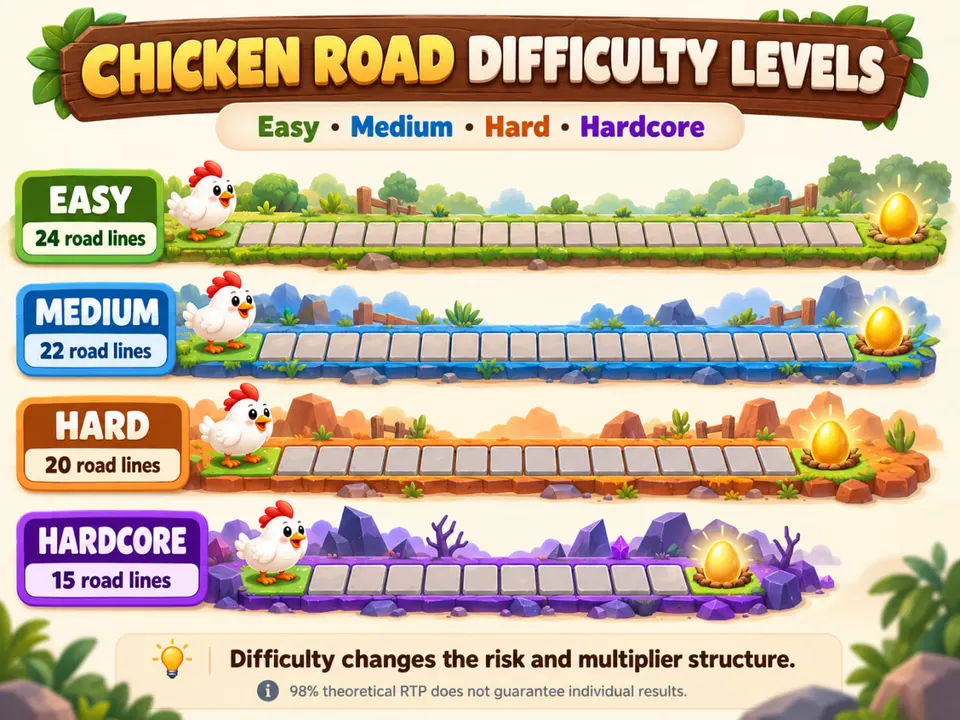
The original Chicken Road title offers four difficulty levels.
These are:
- Easy
- Medium
- Hard
- Hardcore
Each mode changes the risk structure and potential multiplier progression.
Easy Mode
Easy is the lowest difficulty classification in the original game.
It uses a different step and multiplier structure from the more demanding modes.
The name does not mean that success or a positive return is guaranteed.
Medium Mode
Medium represents another set of progression conditions.
Its multipliers and losing-step probabilities differ from Easy.
A Medium setting should not be assumed to follow the same route length or multiplier schedule as other levels.
Hard Mode
Hard introduces a more demanding risk structure.
Potential multiplier values may rise more sharply, but the possibility of losing a run remains important.
Hardcore Mode
Hardcore is the highest difficulty classification in the original game.
It is associated with the most extreme risk and potential multiplier structure among the four levels.
A high displayed maximum multiplier does not indicate that reaching it is probable.
Chicken Road Difficulty Comparison
| Difficulty | General Structure | What Changes |
|---|---|---|
| Easy | Lower difficulty | Route and multiplier progression |
| Medium | Intermediate difficulty | Different step-risk structure |
| Hard | Higher difficulty | Greater risk variation |
| Hardcore | Highest difficulty | More extreme risk and multiplier structure |
The names are defined by InOut Games.
The exact values must be checked using the applicable original game's rules.
How Many Steps Are There?
A documented original Chicken Road demo configuration uses the following route lengths:
| Difficulty | Road Lines |
|---|---|
| Easy | 24 |
| Medium | 22 |
| Hard | 20 |
| Hardcore | 15 |
These numbers describe a reviewed version of the original game.
They should not automatically be applied to Chicken Road 2 or another independently configured release.
Does More Steps Mean Easier?
Not necessarily.
The number of steps alone does not describe the likelihood of completing the route.
The probability associated with each stage and the multiplier schedule also matter.
What Happens When the Chicken Reaches a Losing Step?
A losing step ends the current run under the game's rules.
If the stake has not been successfully settled, the player loses that stake.
Does the Chicken Always Reach the Golden Egg?
No.
The game's theme involves progressing towards a golden egg, but successful completion is not guaranteed.
Can a Losing Step Be Undone?
Do not assume that a failed outcome can be reversed.
A completed round should be interpreted according to the official game record.
Does a Losing Result Mean the Interface Is Broken?
No.
A losing step can be a normal part of the game mechanics.
This is different from a genuine technical problem such as the page freezing or unexpectedly closing.
How Does Cash-Out Work in Chicken Road?
Cash-out is the process of settling an active run according to its current eligible multiplier.
This typically occurs after successful progression.
Example of Cash-Out Arithmetic
Suppose a hypothetical stake is 100 units.
A completed settlement at 1.50x would produce:
100 × 1.50 = 150 units gross return.
The original stake is included in the gross return.
The net gain would be:
150 − 100 = 50 units.
Gross Return vs Net Gain
| Original Stake | Multiplier | Gross Return | Net Gain |
|---|---|---|---|
| 100 | 1.20x | 120 | 20 |
| 100 | 1.50x | 150 | 50 |
| 100 | 2.00x | 200 | 100 |
| 100 | 3.00x | 300 | 200 |
These are mathematical examples only.
They do not indicate how likely any multiplier is to be reached.
Is Cash-Out the Same as Withdrawal?
No.
Cash-out concerns the settlement of a game run.
Withdrawal concerns a separate transaction from an account to a payment destination.
These processes must not be confused.
Why Do Multipliers Increase With Each Step?
The multiplier structure reflects the game's progressively changing conditions.
A later stage requires the run to have successfully passed the earlier stages.
Potential rewards and the probability of reaching them are related but distinct concepts.
Does a High Multiplier Mean a High Chance of Success?
No.
A larger multiplier does not establish a higher probability of reaching the associated stage.
Does a Previous Successful Step Improve the Next Step's Chances?
Not automatically.
The game's mathematical rules determine the relevant probabilities.
A previous successful outcome should not be treated as proof of a favourable future step.
What Does 98% RTP Mean in Chicken Road?
InOut Games publishes a theoretical Return to Player of 98% for the original Chicken Road game.
RTP is a long-run mathematical measure.
It describes the expected proportion of stakes returned under a defined model over a sufficiently large number of game rounds.
Does 98% RTP Mean a 98% Chance of Winning?
No.
RTP and the probability of a successful individual run are different quantities.
A game can have a published RTP of 98% while producing many losing outcomes and some larger returns.
Does RTP Guarantee Your Money Back?
No.
A theoretical RTP does not guarantee any particular person's results.
Is RTP the Same as Volatility?
No.
RTP concerns expected long-run return.
Volatility concerns the variation of possible outcomes.
Different difficulty levels can have different patterns of results even when a published theoretical RTP is shared.
Can an Individual Session Lose Everything?
Yes.
A published RTP does not prevent significant financial losses.
Is Chicken Road a Crash Game?
Chicken Road is often discussed alongside crash games because it involves multipliers and the possibility of losing an unresolved stake.
However, its mechanics differ from a conventional rising-multiplier game.
Conventional Crash Game
A multiplier rises during a shared round until a crash point ends the game.
Chicken Road
The multiplier progresses through individual steps.
The round can end after an unsuccessful stage.
Why the Distinction Matters
The interface, risk conditions and settlement decisions differ.
The term crash may be convenient as a category label, but it should not imply that every game follows Aviator's exact rules.
Chicken Road vs Aviator: What's Different?
Aviator was developed by SPRIBE.
Chicken Road was developed by InOut Games.
Their central mechanics are not identical.
| Feature | Chicken Road | Aviator |
|---|---|---|
| Developer | InOut Games | SPRIBE |
| Main theme | Chicken crossing road | Aircraft in flight |
| Progression | Consecutive steps | Rising flight multiplier |
| Difficulty selection | Four levels | Different interface structure |
| Ending event | Losing step or completed settlement | Aircraft flies away |
| Main interaction | Continue or cash out | Cash out during flight |
| Visual result | Road progression | Crash multiplier |
For detailed information about the flight-based game, read our Aviator Crash Game guide.
Chicken Road vs Chicken Road 2
The original Chicken Road and Chicken Road 2 are separate titles.
They should not be treated as identical versions with only cosmetic differences.
Original Chicken Road
InOut Games lists the original release in April 2024 with a published theoretical RTP of 98%.
Chicken Road 2
A separate sequel exists with its own published characteristics.
Why This Matters
Rules, multiplier schedules and other mathematical specifications may differ.
A guide describing the original should not automatically be used as a technical reference for the sequel.
This article focuses on the original title.
Can Chicken Road Results Be Predicted?
Some websites advertise Chicken Road predictions, signals or guaranteed step sequences.
Such claims should be approached critically.
A historical pattern or screenshot does not establish the future outcome of a game.
Can Previous Runs Reveal the Next Losing Step?
Not reliably without evidence about the result-generation mechanism.
Can a Prediction Bot Guarantee Progress?
No verified prediction method follows merely from a bot displaying future steps.
Are Previous Multipliers Useful for Understanding the Interface?
Yes.
They can illustrate past outcomes or explain the game's terminology.
That is different from predicting the next result.
Chicken Road on Android
Chicken Road is discussed as a mobile-compatible instant game.
However, compatibility depends on the version, website and device.
Common Problems
- Game remains on a loading screen
- Buttons do not respond
- The interface reloads unexpectedly
- A previous state is displayed
- A connection error appears
- Animations become slow
How to Investigate
Check the internet connection.
Use an updated supported browser.
Close unused tabs if the phone has limited available memory.
If a recorded action is unclear, verify its status rather than repeatedly submitting it.
Is an APK Required?
Do not assume that a separate APK is required.
Unknown websites may distribute modified applications using familiar game names.
Only obtain software from verified sources.
For broader troubleshooting, explore our App Help guides.
Is Chicken Road Available on Jai Club?
Some search phrases combine the terms Jai Club and Chicken Road.
However, this does not independently establish that the original InOut Games title is available on every Jai Club-related website.
The current catalogue should be checked directly.
If a listing is present, its title and developer should be verified before applying the original game's specifications.
This article is an independent guide to Chicken Road rather than a confirmed catalogue listing for a particular operator.
Common Chicken Road Misunderstandings
Mistake 1: Treating Chicken Road as a Traditional Slot
The game uses step progression rather than conventional reel combinations.
Mistake 2: Assuming Easy Mode Guarantees Success
Easy is a difficulty classification, not a guarantee.
Mistake 3: Believing Every Step Is Safe After a Successful Start
Previous success does not guarantee the next stage.
Mistake 4: Confusing a Multiplier With a Completed Return
A displayed multiplier is not necessarily a settled result.
Mistake 5: Assuming Higher Multipliers Are More Likely
A larger potential return does not imply a higher chance of reaching it.
Mistake 6: Treating 98% RTP as a Winning Probability
RTP and the probability of an individual successful outcome are different.
Mistake 7: Mixing Original and Sequel Rules
Chicken Road and Chicken Road 2 must be researched separately.
Mistake 8: Trusting Guaranteed Prediction Apps
Unverified tools cannot establish knowledge of future results.
Frequently Asked Questions
1. What is Chicken Road?
Chicken Road is a step-based instant multiplier game developed by InOut Games.
2. Who developed Chicken Road?
The original game was developed by InOut Games.
3. When was Chicken Road released?
InOut Games lists the original release date as 4 April 2024.
4. How many difficulty levels are available?
The original title has four: Easy, Medium, Hard and Hardcore.
5. What happens after a successful step?
The chicken progresses along the route and the available multiplier increases according to the game's rules.
6. What happens after a losing step?
The run ends, and an unsettled stake is lost under the game rules.
7. What does cash-out mean?
Cash-out is the settlement of an active run at an accepted multiplier.
8. What is Chicken Road RTP?
InOut Games publishes a theoretical RTP of 98% for the original title.
9. Does 98% RTP mean a 98% chance of winning?
No. RTP refers to theoretical long-run return, not an individual winning probability.
10. Is Chicken Road the same as Aviator?
No. Chicken Road uses stage-based progression, while Aviator uses a continuously rising aircraft multiplier.
11. Is Chicken Road the same as Chicken Road 2?
No. The original and sequel are separate games with potentially different rules and mathematical specifications.
12. Can a Chicken Road signal predict the next step?
There is no established basis for treating an unverified signal as a reliable prediction of a future result.
13. Can Chicken Road be accessed on Android?
Mobile compatibility depends on the game implementation and supported browser or application.
14. Does a high multiplier guarantee a return?
No. The multiplier must be reached and the settlement must be successfully recorded.
15. Is Chicken Road currently available on Jai Club?
Availability on a particular Jai Club-related platform has not been independently confirmed in this guide.
Final Thoughts
Chicken Road differs from conventional slots and flight-based crash games through its step-by-step progression system.
The original InOut Games title offers four difficulty levels, each with its own risk and multiplier structure.
Successful steps increase the displayed multiplier, while an unsuccessful step can end the run.
The published theoretical RTP of 98% describes a long-run mathematical characteristic, not a guarantee of positive results.
Readers should distinguish displayed multipliers from completed settlements, avoid relying on prediction claims and verify the exact game version before applying specific rules.
For more information about different multiplier-game formats, explore our Jai Club Crash Games guide.
This article provides educational information about the original Chicken Road game and does not guarantee winning outcomes or financial returns.