What Are Jai Club Crash Games? Aviator, Chicken Road & Vortex Explained
Explore crash and instant multiplier games including Aviator, Chicken Road and Vortex. Understand rising multipliers, cash-out, step progression, spinning-wheel mechanics, result history and the differences between these game formats.
In this article
- What Are Crash Games?
- Simple Crash Game Example
- Are All Instant Multiplier Games Crash Games?
- What Are Jai Club Crash Games?
- Aviator Crash Game Explained
- How Aviator Works
- Aviator Example
- What Is the Crash Point?
- What Is Auto Cash-Out?
- Chicken Road Game Explained
- How Chicken Road Differs From Aviator
- Understanding Step Multipliers
- Chicken Road Difficulty Levels
- Does Chicken Road Require Fast Reactions?
- What Is Vortex?
- Vortex Multiplier Wheel
- Is Vortex a Traditional Crash Game?
- Are All Vortex Games the Same?
- Aviator vs Chicken Road vs Vortex
- What Does Multiplier Mean in Crash Games?
- Multiplier Calculation
- Does a Higher Multiplier Guarantee a Higher Return?
- Do All Three Games Use Multipliers Identically?
- What Is Cash-Out in a Crash Game?
- Cash-Out Is Not the Same as Withdrawal
- What If a Cash-Out Button Does Not Respond?
- What Happens When a Crash Round Ends?
- Are These Outcomes the Same?
- Crash Games vs Slot Games
- Traditional Slot Games
- Crash Games
- Instant Multiplier Games
- What Does Crash Game Result History Show?
- Fictional History Example
- Can Result History Predict the Next Crash?
- What Is Result Verification?
- Are Crash Games Random?
- Does Player Timing Control the Crash Point?
- Does Choosing a Chicken Road Difficulty Guarantee a Result?
- Can Vortex Spin Animations Reveal the Landing Outcome?
- RTP and Volatility in Crash Games
- Does a Higher RTP Guarantee Winning?
- Is RTP the Same for Aviator, Chicken Road and Vortex?
- Crash Games on Android
- Common Android Problems
- How to Investigate
- Are Aviator, Chicken Road and Vortex Available on Jai Club?
- Common Crash Game Misunderstandings
- Mistake 1: Treating Every Instant Game as Aviator
- Mistake 2: Thinking Chicken Road Is Just a Plane Game
- Mistake 3: Assuming Every Vortex Game Uses the Same Rules
- Mistake 4: Confusing Gross Return With Net Profit
- Mistake 5: Treating Auto Cash-Out as a Guarantee
- Mistake 6: Using History as a Prediction Formula
- Mistake 7: Assuming a Visual Button Press Is a Confirmed Settlement
- Mistake 8: Assuming Crash Games Are Risk-Free Because They Are Short
- Frequently Asked Questions
- 1. What are Jai Club Crash Games?
- 2. What is Aviator?
- 3. What is Chicken Road?
- 4. What is Vortex?
- 5. Are Aviator and Chicken Road the same?
- 6. Is Vortex the same as Aviator?
- 7. What does cash-out mean?
- 8. What happens if the multiplier crashes before cash-out?
- 9. What is Auto Cash-Out?
- 10. Is cash-out the same as withdrawing money?
- 11. Can a crash game's history predict the next multiplier?
- 12. Are all crash games based on the same RTP?
- 13. Can crash games work on Android?
- 14. Is Vortex always a crash game?
- 15. Does a high multiplier guarantee profit?
- 16. Are all three games available on Jai Club?
- Final Thoughts
Crash games have become a familiar topic across online gaming websites serving readers in India. Unlike traditional slots that rely on spinning reels and symbol combinations, many crash-style games use rising multipliers, timed decisions or progressive stages.
Aviator, Chicken Road and Vortex are three names commonly discussed alongside crash and instant multiplier games.
However, they do not all work in exactly the same way.
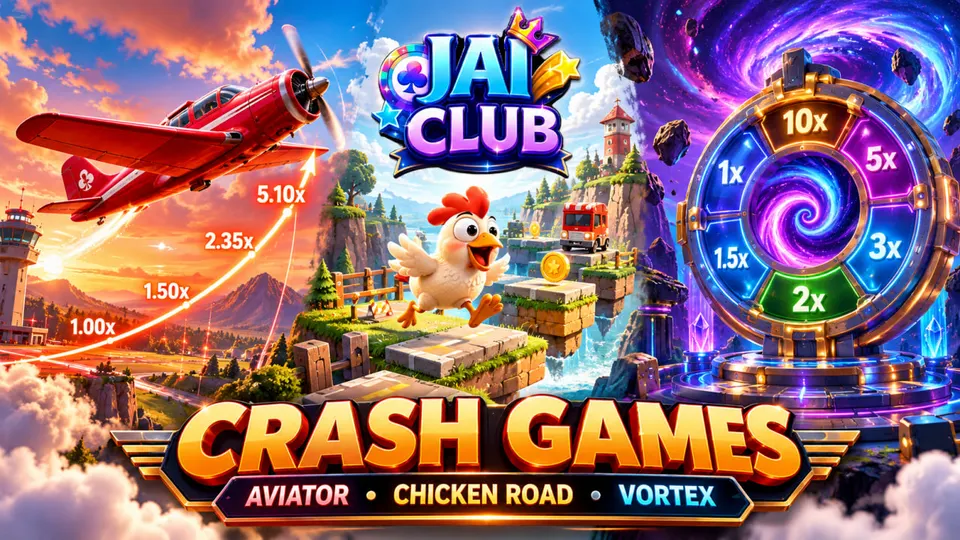
Aviator uses an aircraft-themed rising multiplier. Chicken Road uses a step-based progression system. Vortex is associated with spinning-wheel multiplier mechanics, depending on the specific game and provider.
Understanding these differences is important because the word "crash" is sometimes applied broadly to games with very different interfaces.
This Jai Club Crash Games guide explains the basic mechanics, differences between game formats, cash-out terminology, historical results and common misunderstandings.
The article is an independent educational guide. It does not independently confirm that all three specific titles are available in every platform using the Jai Club name.
What Are Crash Games?
A crash game is a type of online game where a multiplier or another measure of potential return progresses until a predefined ending condition occurs.
In a conventional rising-multiplier crash game, the displayed multiplier begins at a low value and increases during the round.
An active stake must be successfully cashed out before the round ends to receive the applicable gross return.
If the round ends first, the unresolved stake is generally lost under the relevant game's rules.
Simple Crash Game Example
Consider a fictional game round:
Starting multiplier: 1.00x
Multiplier increases: 1.20x
Multiplier increases: 1.75x
Multiplier increases: 2.40x
Round ends: 2.60x
An accepted cash-out at 1.75x would be evaluated using that multiplier.
A cash-out target of 3.00x would not be reached because the round ended at 2.60x.
These numbers are illustrative and do not represent an actual recorded result.
Are All Instant Multiplier Games Crash Games?
Not strictly.
Some games use a rising multiplier that abruptly ends.
Others use steps, wheels or independent instant outcomes.
These related formats may be grouped together on gaming websites because they are short, multiplier-based games.
However, their mathematical systems and controls should not be treated as identical.
What Are Jai Club Crash Games?
Jai Club Crash Games is the editorial category used on this website to explain crash-style and closely related instant multiplier games.
The category covers topics such as:
- Aviator-style rising multipliers
- Chicken Road step progression
- Vortex spinning-wheel mechanics
- Cash-out terminology
- Round endings
- Result history
- Technical problems
- Game comparisons
The purpose is to help readers understand how these formats work without confusing them with slot games or colour-based number games.
For other game formats, explore our Jai Club Slots guides.
Aviator Crash Game Explained
Aviator is a crash game developed by SPRIBE.
Its most recognisable feature is an aircraft animation accompanied by a multiplier that increases during the round.
The plane eventually flies away, ending the round.
How Aviator Works
According to the published SPRIBE rules, the basic process involves three stages.
First, a stake is submitted during the available betting period.
Second, the plane begins flying and the multiplier increases from 1.00x.
Third, an active stake must be successfully cashed out before the plane disappears.
If the flight ends before cash-out is accepted, that stake is lost.
Aviator Example
Suppose the fictional stake is 100 units.
An accepted cash-out at 1.50x gives:
100 × 1.50 = 150 units
The gross return is 150 units, including the original 100-unit stake.
The difference between gross return and original stake is 50 units.
If the plane disappears before the relevant cash-out is accepted, the stake is lost.
This calculation illustrates the multiplier concept. It is not an actual transaction or a recommended betting amount.
What Is the Crash Point?
The crash point is the multiplier at which a round ends.
SPRIBE's published rules describe a provably fair system in which the round coefficient is generated before the flight begins.
The visible flight animation does not allow players to know the ending multiplier in advance.
What Is Auto Cash-Out?
Aviator also describes an automatic cash-out option.
When enabled, it attempts to settle an active stake at a previously selected multiplier, provided the round reaches that point.
It does not guarantee that the multiplier will be reached.
Automatic cash-out should also not be confused with automatic betting, which concerns repeated stake submissions.
Chicken Road Game Explained
Chicken Road is a step-multiplier game developed by InOut Games.
Instead of displaying a continuously rising aircraft multiplier, the game uses a road-crossing theme.
A chicken progresses through stages, and successful progress increases the displayed multiplier.
How Chicken Road Differs From Aviator
In Aviator, the multiplier rises during the flight.
In Chicken Road, progression is linked to completed steps.
The game can end when the chicken encounters a losing outcome.
Understanding Step Multipliers
Imagine a fictional step sequence:
Step 1: 1.10x
Step 2: 1.30x
Step 3: 1.65x
Step 4: 2.20x
These values are illustrative only.
The idea is that the multiplier changes as additional stages are completed.
This does not mean every step is guaranteed to succeed.
Chicken Road Difficulty Levels
Chicken Road is commonly described with selectable difficulty levels.
The original InOut Games title is associated with modes such as Easy, Medium, Hard and Hardcore.
These modes alter the game's risk and multiplier structure.
The exact mathematical conditions should be checked within the relevant version rather than copied from an unrelated website.
Does Chicken Road Require Fast Reactions?
The original game is fundamentally a step-progression and cash-out format.
It should not be confused with a conventional reflex arcade game where avoiding animated traffic through physical reaction speed guarantees success.
The game outcome and available choices depend on the published rules.
What Is Vortex?
Vortex is a game name associated with multiple online gaming products.
One identified game family is Vortex by Turbo Games.
Its published description centres on a hold-to-spin wheel with multiplier rings.
This makes it different from both SPRIBE Aviator and InOut Chicken Road.
Vortex Multiplier Wheel
In the Turbo Games version, the interface features concentric multiplier rings.
The game involves holding to charge a spin and releasing it.
The resulting landing section determines the relevant multiplier or feature.
Is Vortex a Traditional Crash Game?
Not in the exact same sense as Aviator.
Aviator's main mechanic is a rising multiplier that ends at a crash point.
The identified Turbo Games Vortex product uses a spinning-wheel structure.
It can reasonably be discussed alongside instant multiplier games, but should not be described as having an identical flight-and-cash-out mechanic.
Are All Vortex Games the Same?
No.
The name Vortex may refer to different games and versions.
Vortex 2 and themed Vortex releases can have different features from the original.
Before explaining a particular Vortex interface, the developer and exact version should be identified.
This article does not claim that the Turbo Games version is the one offered by every Jai Club-related service.
Aviator vs Chicken Road vs Vortex

The three names are associated with different types of multiplier gameplay.
| Feature | Aviator | Chicken Road | Vortex |
|---|---|---|---|
| Identified developer | SPRIBE | InOut Games | Turbo Games version |
| Main theme | Aircraft flight | Chicken crossing | Spinning wheel |
| Core mechanic | Rising multiplier | Step progression | Wheel outcome |
| Main visual | Flying plane | Road and chicken | Multiplier rings |
| Round-ending concept | Plane flies away | Losing step or exit | Spin result |
| Cash-out structure | During flight | During progression | Version-specific |
| Traditional slot reels | No | No | Not central to identified version |
The comparison refers to the named examples and should not be generalised to every similarly named game.
What Does Multiplier Mean in Crash Games?
A multiplier is a numerical factor applied to an eligible stake or base amount.
For example:
1.50x means one and a half times the base amount.
2.00x means twice the base amount.
3.00x means three times the base amount.
Multiplier Calculation
The basic arithmetic is:
Gross Return = Stake × Accepted Multiplier
For a hypothetical 50-unit stake at 2.00x:
50 × 2.00 = 100 units
The total return is 100 units, which includes the original stake.
The net gain before any applicable adjustments would be 50 units.
Does a Higher Multiplier Guarantee a Higher Return?
A higher accepted multiplier produces a larger gross return for the same stake.
However, a higher displayed or desired multiplier is not a guaranteed outcome.
The round may end before the target is reached.
Do All Three Games Use Multipliers Identically?
No.
A multiplier can be associated with a continuously rising value, completed steps or a wheel result.
The actual rules determine how it is applied.
What Is Cash-Out in a Crash Game?
Cash-out refers to settling an active game position according to the applicable multiplier and rules.
In Aviator, the cash-out must be accepted before the flight ends.
In Chicken Road, cash-out is associated with ending a successful progression rather than advancing to another step.
In other instant games, settlement may happen automatically based on the resulting wheel or feature.
Cash-Out Is Not the Same as Withdrawal
These terms are sometimes confused.
Game cash-out means settling a game result.
Account withdrawal refers to transferring funds out of a gaming account through an operator's payment process.
The two are different operations.
What If a Cash-Out Button Does Not Respond?
An unresponsive button may indicate a connection issue, a closed round, an outdated page or another technical problem.
Do not assume the displayed multiplier was successfully recorded.
Check the completed record where available.
If a real-money action remains unresolved, avoid repeating it before confirming its status.
What Happens When a Crash Round Ends?
A crash round has a defined ending condition.
In Aviator, the plane flies away when the round reaches its predetermined endpoint.
In Chicken Road, a losing outcome can end progression.
In a wheel-based game such as the identified Vortex version, the spin produces its result according to the relevant rules.
Are These Outcomes the Same?
No.
The visual theme, timing, settlement and mathematics are different.
A game ending after a failed step is not necessarily equivalent to a plane reaching its crash point.
Similarly, a wheel landing on a segment is not the same as a continuously increasing multiplier stopping.
Crash Games vs Slot Games
Crash and instant multiplier games are often discussed alongside online slots, but their interfaces differ.
Traditional Slot Games
Slot games usually centre on reels, symbols, payline or ways-to-win rules, and bonus features.
Crash Games
Crash games may centre on an increasing multiplier and a choice about when to settle before the round ends.
Instant Multiplier Games
Related instant games may use steps, tiles, wheels or other mechanics.
| Feature | Traditional Slots | Crash / Instant Multiplier |
|---|---|---|
| Core visual | Reels and symbols | Plane, steps or wheel |
| Main outcome | Symbol or feature result | Multiplier or stage result |
| Paylines | Common in many slots | Not a defining feature |
| Cash-out timing | Usually not central | Central in some formats |
| Round history | May be available | May be available |
For more slot-specific terminology, read our Jai Club Slots Explained guide.
What Does Crash Game Result History Show?
A result-history interface may show previous rounds and recorded multipliers.
For a rising-multiplier game, the displayed history might include the multiplier at which each round ended.
Fictional History Example
| Period | Ending Multiplier |
|---|---|
| DEMO-101 | 1.24x |
| DEMO-102 | 3.16x |
| DEMO-103 | 1.08x |
| DEMO-104 | 7.42x |
These are invented educational examples, not actual results.
Can Result History Predict the Next Crash?
No reliable prediction follows from the previous multipliers alone.
A sequence of low outcomes does not establish that the next round must produce a high multiplier.
What Is Result Verification?
Some games provide a mechanism for checking recorded outcomes against cryptographic information.
For example, the SPRIBE Aviator rules describe a provably fair verification system.
That is a method for checking results under its published protocol, not a tool for discovering future outcomes.
Are Crash Games Random?
The answer depends on the particular product and its published mathematical system.
Some use random number generators and provably fair mechanisms.
Others use specific game-engine models.
A visual animation does not reveal the complete outcome-generation method.
Does Player Timing Control the Crash Point?
For SPRIBE Aviator, published rules describe the crash coefficient as generated before the flight starts.
Pressing a button does not change that underlying coefficient.
Does Choosing a Chicken Road Difficulty Guarantee a Result?
No.
Difficulty changes the applicable game conditions, not the certainty of a successful run.
Can Vortex Spin Animations Reveal the Landing Outcome?
A visual wheel animation should not be treated as evidence of a reliable prediction method.
The exact result-generation process must be assessed against the relevant game's rules.
RTP and Volatility in Crash Games
RTP stands for Return to Player.
It describes a theoretical long-run return under a specified mathematical model.
It does not mean that an individual session will return that percentage.
Volatility describes how results may vary in size and frequency.
Does a Higher RTP Guarantee Winning?
No.
Even a relatively high published theoretical RTP does not prevent short-term or long-term losses for an individual participant.
Is RTP the Same for Aviator, Chicken Road and Vortex?
No universal RTP should be assumed.
Different providers, versions and mathematical configurations can have different values.
Check the documentation for the exact title rather than applying one percentage to an entire category.
Crash Games on Android
Crash and instant multiplier games are often displayed through mobile browsers or applications.
Actual compatibility depends on the website, game provider and device.
Common Android Problems
- Game remains on a loading screen
- Multiplier animation freezes
- Page reloads after switching apps
- A button appears unresponsive
- Connection is interrupted
- Historical results fail to update
How to Investigate
Check whether the browser is up to date.
Confirm that ordinary websites load normally.
Close unused applications if device memory is limited.
Avoid installing unfamiliar APK files claiming to improve game results or unlock hidden features.
For related troubleshooting information, visit our App Help category.
Are Aviator, Chicken Road and Vortex Available on Jai Club?
Searches for Jai Club Crash Games may include names such as Aviator, Chicken Road and Vortex.
However, similar search phrases do not independently verify that all three titles are currently available in a specific Jai Club game lobby.
A platform may offer certain games and not others.
Game providers, versions and availability may also change.
Before identifying a particular game as part of a current catalogue, compare its title, developer and interface with the actual listing.
This guide explains known game formats without claiming independently verified availability in a specific operator's lobby.
Common Crash Game Misunderstandings
Mistake 1: Treating Every Instant Game as Aviator
Different games may use different multiplier systems.
Mistake 2: Thinking Chicken Road Is Just a Plane Game
Chicken Road uses stage-based progression rather than Aviator's continuous flight.
Mistake 3: Assuming Every Vortex Game Uses the Same Rules
The title can refer to different versions and products.
Mistake 4: Confusing Gross Return With Net Profit
Gross return can include the original stake.
Mistake 5: Treating Auto Cash-Out as a Guarantee
An automatic target cannot produce a successful settlement if the required multiplier is never reached.
Mistake 6: Using History as a Prediction Formula
Past multipliers do not guarantee future results.
Mistake 7: Assuming a Visual Button Press Is a Confirmed Settlement
The recorded result should be checked when a transaction is unclear.
Mistake 8: Assuming Crash Games Are Risk-Free Because They Are Short
Short rounds can still involve substantial financial risk.
Frequently Asked Questions
1. What are Jai Club Crash Games?
It is the category used on this website for guides about crash-style and related instant multiplier games, including Aviator, Chicken Road and Vortex.
2. What is Aviator?
Aviator is a SPRIBE crash game involving a rising multiplier and an aircraft that eventually flies away.
3. What is Chicken Road?
Chicken Road is an InOut Games step-multiplier game in which successful progression increases the displayed multiplier.
4. What is Vortex?
One identified Vortex game family is developed by Turbo Games and uses spinning multiplier rings. Other similarly named games may differ.
5. Are Aviator and Chicken Road the same?
No. Aviator uses a continuously rising multiplier, while Chicken Road uses step-based progression.
6. Is Vortex the same as Aviator?
No. The identified Turbo Games Vortex title uses a wheel-based structure rather than Aviator's plane-flight mechanic.
7. What does cash-out mean?
It means settling an eligible game position under the applicable multiplier and rules.
8. What happens if the multiplier crashes before cash-out?
In a conventional crash game such as SPRIBE Aviator, an unresolved stake is lost when the round ends.
9. What is Auto Cash-Out?
It is a control available in some games that attempts to settle an active stake when a selected multiplier is reached.
10. Is cash-out the same as withdrawing money?
No. Game cash-out is a round-settlement action, while withdrawal is a separate account process.
11. Can a crash game's history predict the next multiplier?
Historical multipliers do not provide a guaranteed method for predicting the next result.
12. Are all crash games based on the same RTP?
No. RTP depends on the specific game, provider and mathematical configuration.
13. Can crash games work on Android?
Many games support mobile environments, but compatibility depends on the title, software and device.
14. Is Vortex always a crash game?
Not necessarily. Some Vortex products are better described as instant multiplier wheel games.
15. Does a high multiplier guarantee profit?
No. A potential multiplier is not a completed return, and a round can end before settlement.
16. Are all three games available on Jai Club?
Their availability in every Jai Club-related platform has not been independently verified in this guide.
Final Thoughts
Crash and instant multiplier games can share similar terminology without using identical mechanics.
SPRIBE Aviator uses an aircraft-themed rising multiplier.
InOut Games Chicken Road uses step-based progression.
The identified Turbo Games Vortex title uses a spinning-wheel multiplier system.
Understanding these differences helps readers avoid confusing game rules, result histories and cash-out conditions.
A multiplier is not a guaranteed outcome, and previous rounds do not reveal future results.
For more educational game guides, explore our Jai Club Slots category, Lottery Games guides and WinGo articles.
This article is intended for general educational information and does not promise winning outcomes or financial returns.