
Jai Club 5D Lottery Explained: A–E Positions, SUM & Results
Explore Jai Club 5D Lottery and understand the five digit positions A, B, C, D and E, SUM calculations, Big Small, Odd Even, result history and common differences from K3 and WinGo.
In this article
- What Is Jai Club 5D Lottery?
- Why Is It Called 5D?
- Is 5D the Same as a Traditional Lottery?
- What Do A, B, C, D and E Mean in 5D?
- Why Does Position Matter?
- Can Two Positions Show the Same Digit?
- How Does a 5D Lottery Result Work?
- Step 1: Identify the Five Digits
- Step 2: Read Each Position
- Step 3: Calculate the SUM
- Step 4: Interpret the Total
- Step 5: Match the Result With Its Period
- What Is SUM in 5D Lottery?
- Is SUM the Fifth Digit?
- Is SUM the Same as the Five-Digit Number?
- Why Is This Distinction Important?
- What Is the Minimum and Maximum 5D SUM?
- Minimum Example
- Maximum Example
- Middle Example
- 5D Big and Small Explained
- Individual Position: Big and Small
- SUM: Big and Small
- Why the Two Systems Are Different
- 5D Odd and Even Explained
- Individual Position: Odd
- Individual Position: Even
- SUM Odd and Even
- Example With Five Positions
- 5D Position vs SUM: What's the Difference?
- Why Can Two 5D Results Have the Same SUM?
- Does the Order Affect SUM?
- Does the Order Affect Individual Positions?
- How Many Possible 5D Results Are There?
- Does Every SUM Have the Same Number of Combinations?
- Are These Verified Probabilities for Jai Club?
- Why Do Middle SUM Values Have More Combinations?
- Does a Common SUM Guarantee the Next Result?
- Can Previous SUM Values Predict Future SUM Values?
- What Is a 5D Lottery Period Number?
- How to Read 5D Result History
- Step 1: Identify the Completed Period
- Step 2: Read Positions A–E
- Step 3: Calculate the SUM
- Step 4: Compare the Displayed SUM
- Step 5: Check the Result Status
- Step 6: Confirm the Correct Game Mode
- Why Does 5D Result History Sometimes Look Incorrect?
- Example: Wrong Position
- Example: Wrong SUM
- Example: Wrong Period
- How to Investigate
- Jai Club 5D vs K3 Lottery
- K3
- 5D
- Quick Comparison
- 5D Lottery vs WinGo
- WinGo
- 5D
- Why This Difference Matters
- Can 5D Results Be Predicted?
- Does a Digit Become Due?
- Can a SUM Chart Show Patterns?
- Are Five-Digit Prediction Formulas Reliable?
- 5D Lottery on Android
- Common Mobile Issues
- What to Check
- Is 5D Available on Every Jai Club Website?
- Common 5D Lottery Mistakes
- Mistake 1: Treating A–E as Different Games
- Mistake 2: Confusing SUM With Position E
- Mistake 3: Treating 40718 as SUM 40718
- Mistake 4: Mixing Individual Big/Small With SUM Big/Small
- Mistake 5: Assuming Every SUM Has Equal Probability
- Mistake 6: Comparing Different Period IDs
- Mistake 7: Treating Historical Patterns as Predictions
- Mistake 8: Assuming Every Operator Uses Identical Rules
- Quick 5D Reference Checklist
- Frequently Asked Questions
- 1. What is Jai Club 5D Lottery?
- 2. What do A, B, C, D and E mean in 5D?
- 3. What numbers can appear in each position?
- 4. What is SUM in 5D?
- 5. What is the minimum 5D SUM?
- 6. What is the maximum 5D SUM?
- 7. What does Big mean in 5D?
- 8. What does Small mean in 5D?
- 9. Is zero Odd or Even?
- 10. Can two 5D results have the same SUM?
- 11. How many five-digit sequences are possible?
- 12. Is 5D the same as K3?
- 13. Is 5D the same as WinGo?
- 14. Can 5D result history predict the next number?
- 15. How can I check a 5D result mismatch?
- 16. Is 5D available on every Jai Club platform?
- Final Thoughts
Jai Club 5D Lottery is a search term associated with five-digit number games commonly discussed on Indian online gaming websites.
Unlike K3, which uses three dice, or WinGo, which commonly presents a single numerical result, 5D uses five positions labelled A, B, C, D and E.
Each position contains a digit from 0 to 9.
The five digits can also be added together to calculate a combined result known as SUM.
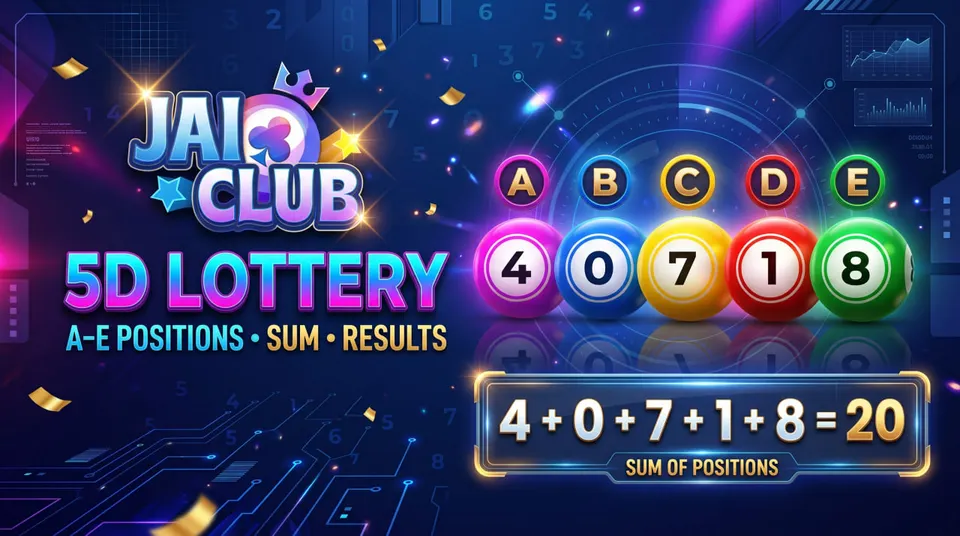
For example, a 5D result might display:
A = 4 B = 0 C = 7 D = 1 E = 8
The combined SUM is 20.
But why are there five positions? What does SUM mean? How are Big, Small, Odd and Even classifications calculated? And how can readers understand the difference between a single position and a combined total?
This Jai Club 5D Lottery guide explains the basic structure, number calculations, common result classifications and historical records.
The examples are educational illustrations rather than actual live game results.
For other number-based games, explore the Jai Club Game guides.
What Is Jai Club 5D Lottery?
5D Lottery is a five-position number game in which a completed round produces five digits.
The positions are labelled:
A, B, C, D and E.
Each position represents a separate part of the result.
In the commonly described format, the available digits range from 0 to 9.
The final five-digit sequence can therefore range from 00000 to 99999.
Why Is It Called 5D?
The name refers to the five digit positions that make up the displayed result.
For example:
58314
This sequence contains five digits.
Its positions are:
A = 5 B = 8 C = 3 D = 1 E = 4
The letters identify positions, not different types of numbers.
Is 5D the Same as a Traditional Lottery?
Not necessarily.
The term 5D is used by online gaming platforms for a particular five-digit result format.
It should not automatically be confused with a government-operated lottery or another independently regulated draw.
The operator, rules and game availability must be checked separately.
What Do A, B, C, D and E Mean in 5D?
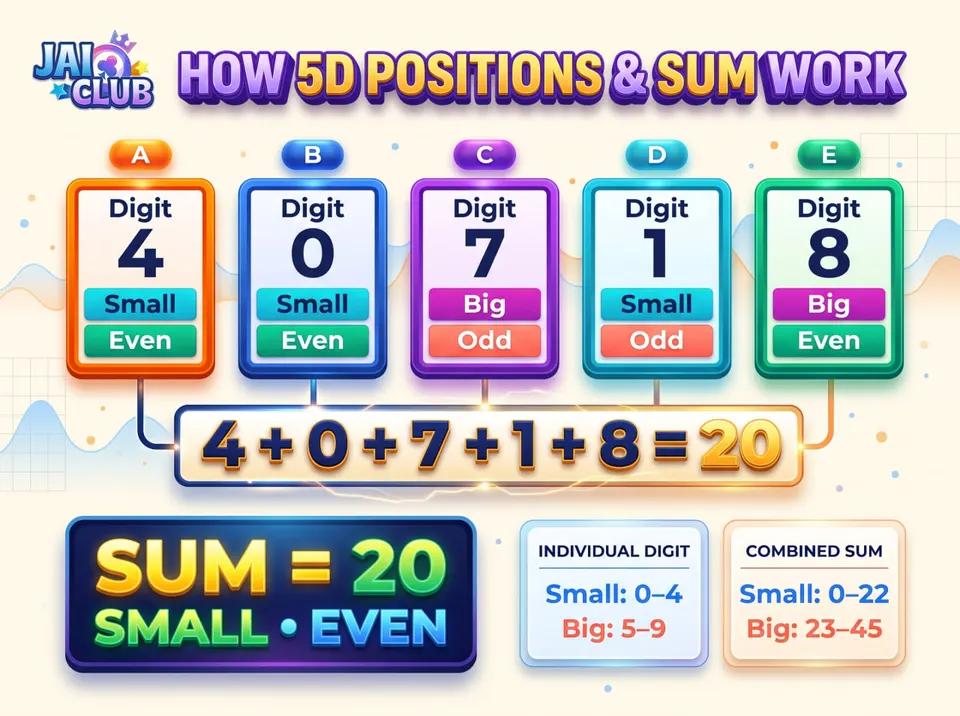
The five letters identify the order of the digits.
They are position labels.
| Position | Meaning | Example |
|---|---|---|
| A | First digit | 4 |
| B | Second digit | 0 |
| C | Third digit | 7 |
| D | Fourth digit | 1 |
| E | Fifth digit | 8 |
Using this example, the complete result is:
40718
The letters do not have separate numerical values.
They indicate where each result digit belongs.
Why Does Position Matter?
Consider these two results:
40718
47018
Both contain the same collection of digits, but the digits appear in different positions.
In the first sequence, position B contains 0.
In the second sequence, position B contains 7.
Therefore, the position changes how the result is interpreted.
Can Two Positions Show the Same Digit?
Yes.
There is no mathematical rule preventing repeated digits in a five-digit sequence.
For example:
A = 5 B = 5 C = 2 D = 5 E = 1
This is a valid five-digit arrangement within the general format.
Repeated digits do not automatically establish a pattern that must continue.
How Does a 5D Lottery Result Work?
A completed result contains five position-specific digits.
The interface may also show their combined total and other classifications.
Step 1: Identify the Five Digits
Consider this fictional result:
A = 3 B = 8 C = 0 D = 6 E = 1
Step 2: Read Each Position
The individual values are:
3, 8, 0, 6 and 1.
Step 3: Calculate the SUM
Add all five digits:
3 + 8 + 0 + 6 + 1 = 18
Step 4: Interpret the Total
SUM is 18.
Under a commonly described 5D classification, totals 0–22 are Small and 23–45 are Big.
Therefore, SUM 18 is Small.
It is also Even because 18 is divisible by 2.
Step 5: Match the Result With Its Period
If a result-history table is available, compare the complete period ID and its five recorded digits.
Do not confuse the period number with the result sequence.
What Is SUM in 5D Lottery?
SUM refers to the total obtained by adding the digits in positions A through E.
The general formula is:
SUM = A + B + C + D + E
For example:
A = 9 B = 2 C = 9 D = 2 E = 1
SUM = 9 + 2 + 9 + 2 + 1
SUM = 23
The sum is calculated from all five positions.
Is SUM the Fifth Digit?
No.
Position E is the fifth digit.
SUM is the total of all five digits.
Is SUM the Same as the Five-Digit Number?
No.
Consider:
Result: 40718
The five-digit number is 40,718.
But its digit SUM is:
4 + 0 + 7 + 1 + 8 = 20
The five-digit sequence and the arithmetic sum represent different information.
Why Is This Distinction Important?
A common mistake is to confuse the entire displayed sequence with the value shown under SUM.
A result of 40718 does not mean SUM is 40,718.
Its SUM is 20.
What Is the Minimum and Maximum 5D SUM?
Each of the five positions can contain a digit between 0 and 9.
The minimum possible SUM occurs when all five digits are 0.
0 + 0 + 0 + 0 + 0 = 0
The maximum possible SUM occurs when all five digits are 9.
9 + 9 + 9 + 9 + 9 = 45
Therefore, the theoretical SUM range is:
0 to 45.
Minimum Example
00000
SUM = 0
Maximum Example
99999
SUM = 45
Middle Example
45936
SUM = 4 + 5 + 9 + 3 + 6 = 27
This demonstrates how a five-digit result can produce a much smaller arithmetic total.
5D Big and Small Explained
Big and Small can describe either an individual digit or the combined SUM, depending on which section of a 5D interface is being interpreted.
These classifications are not identical.
Individual Position: Big and Small
In a commonly described 5D format:
Small = 0, 1, 2, 3, 4
Big = 5, 6, 7, 8, 9
For example:
A = 2 means Small.
B = 8 means Big.
SUM: Big and Small
For the combined total, a commonly described classification is:
Small SUM = 0–22
Big SUM = 23–45
For example:
SUM = 18 means Small.
SUM = 27 means Big.
Why the Two Systems Are Different
An individual position has only ten possible digits.
The SUM has 46 possible numerical values, from 0 through 45.
Therefore, the boundaries used for Big and Small are different.
Always confirm which position or total the interface is describing.
5D Odd and Even Explained
Odd and Even classifications are based on whether a number is divisible by 2.
The concept can apply to an individual digit or the combined SUM.
Individual Position: Odd
Odd digits are:
1, 3, 5, 7, 9
Individual Position: Even
Even digits are:
0, 2, 4, 6, 8
Zero is an even number.
SUM Odd and Even
The combined SUM can also be classified.
For example:
SUM = 23 is Odd.
SUM = 24 is Even.
Example With Five Positions
Consider the result:
A = 1 B = 6 C = 4 D = 3 E = 9
Its position classifications are:
A: Small, Odd B: Big, Even C: Small, Even D: Small, Odd E: Big, Odd
The SUM is:
1 + 6 + 4 + 3 + 9 = 23
Therefore, SUM is Big and Odd under the commonly described classification.
5D Position vs SUM: What's the Difference?
Position and SUM refer to two different types of information.
A position identifies an individual digit.
SUM combines all five digits.
| Feature | Individual Position | SUM |
|---|---|---|
| What it represents | One digit | Total of five digits |
| Possible values | 0–9 | 0–45 |
| Labels | A, B, C, D or E | SUM |
| Small classification | 0–4 | 0–22 |
| Big classification | 5–9 | 23–45 |
| Odd/Even | Based on one digit | Based on combined total |
These classifications are common in 5D-style games, but the relevant game's own rules should be checked before applying them to a particular service.
Why Can Two 5D Results Have the Same SUM?
Different five-digit sequences can produce the same combined total.
Consider:
Result A: 12345
SUM = 1 + 2 + 3 + 4 + 5 = 15
Result B: 54321
SUM = 5 + 4 + 3 + 2 + 1 = 15
The digits are arranged differently, but the total is the same.
Does the Order Affect SUM?
No.
Adding the same five digits in a different order produces the same total.
Does the Order Affect Individual Positions?
Yes.
In the first result, position A is 1.
In the second result, position A is 5.
Therefore, the position-specific information differs even though the SUM is identical.
How Many Possible 5D Results Are There?
Each of the five positions has ten possible digits under the standard 0–9 model.
The number of possible ordered five-digit sequences is:
10 × 10 × 10 × 10 × 10 = 100,000
This includes sequences with leading zeros.
For example:
00007
00421
12345
99999
All are possible five-position sequences.
Does Every SUM Have the Same Number of Combinations?
No.
The extreme SUM values have very few possible sequences.
For example, SUM 0 can occur only when all five digits are zero.
SUM 45 can occur only when all five digits are nine.
Middle SUM values can be formed through many more combinations.
Are These Verified Probabilities for Jai Club?
No.
The count of 100,000 is a mathematical property of five decimal-digit positions.
A probability model that treats all sequences as equally likely requires an additional assumption about how results are generated.
Without verified technical information, the calculation should not be presented as proof of a specific platform's outcome probabilities.
Why Do Middle SUM Values Have More Combinations?
There are many ways for five digits to produce a total near the middle of the possible range.
For example:
4 + 5 + 4 + 6 + 3 = 22
8 + 3 + 5 + 2 + 4 = 22
7 + 1 + 8 + 3 + 3 = 22
By contrast, SUM 0 requires every digit to be zero.
This difference comes from elementary combinatorics.
Does a Common SUM Guarantee the Next Result?
No.
A value having more theoretical combinations does not mean it must appear in the next round.
Can Previous SUM Values Predict Future SUM Values?
Historical observations alone do not establish a dependable forecasting method.
The actual outcome-generation process matters.
What Is a 5D Lottery Period Number?
A period number identifies a particular round.
It is separate from the five digits produced by the round.
For example:
Period ID: DEMO-501
Result: 40718
SUM: 20
The period ID is the record identifier.
The result is the five-digit sequence.
SUM is the total of those five digits.
These three values have different purposes.
For a broader explanation of round identifiers in related game formats, read our WinGo Period Number guide.
How to Read 5D Result History
A 5D history table may list completed rounds and their corresponding digits.
A typical educational example is shown below.
| Period | A | B | C | D | E | SUM |
|---|---|---|---|---|---|---|
| DEMO-101 | 4 | 0 | 7 | 1 | 8 | 20 |
| DEMO-102 | 9 | 2 | 9 | 2 | 1 | 23 |
| DEMO-103 | 1 | 2 | 3 | 4 | 5 | 15 |
| DEMO-104 | 3 | 8 | 0 | 6 | 1 | 18 |
These are fictional examples, not live Jai Club results.
Step 1: Identify the Completed Period
Find the period ID associated with the record.
Step 2: Read Positions A–E
Check each digit independently.
Step 3: Calculate the SUM
Add the five digits.
Step 4: Compare the Displayed SUM
Confirm whether the calculation matches the value shown.
Step 5: Check the Result Status
Ensure the record is completed rather than pending.
Step 6: Confirm the Correct Game Mode
Different round-duration modes may use different histories.
Why Does 5D Result History Sometimes Look Incorrect?
A result-history mismatch may occur when two different periods are compared.
Other possible causes include outdated page data, a different selected mode, or confusion between a single position and the SUM.
Example: Wrong Position
A record shows:
A = 4 B = 0 C = 7 D = 1 E = 8
If someone reads C as the result for position B, the comparison will be incorrect.
Example: Wrong SUM
The same result has:
SUM = 20
If the history displays 21 for those five digits, the calculation appears inconsistent and deserves checking.
Example: Wrong Period
A current round and the previous completed round should not be compared as if they were the same record.
How to Investigate
Record the full period ID.
Confirm the game mode.
Read all five positions.
Recalculate the SUM.
Then compare the same completed historical record.
Jai Club 5D vs K3 Lottery
5D and K3 use different numerical structures.
K3 commonly uses three six-sided dice.
5D uses five digit positions.
K3
Three dice each have possible values from 1 to 6.
The combined total ranges from 3 to 18.
Matching patterns such as 2 Same and 3 Same are commonly discussed.
5D
Five positions each display a digit from 0 to 9.
The combined total ranges from 0 to 45.
The A–E positions and SUM are central parts of the interface.
Quick Comparison
| Feature | K3 | 5D |
|---|---|---|
| Main result | Three dice | Five digits |
| Individual value range | 1–6 | 0–9 |
| Combined total range | 3–18 | 0–45 |
| Position labels A–E | No | Yes |
| Matching dice patterns | Common | Not the defining feature |
| SUM | Total of three dice | Total of five digits |
For a detailed explanation of K3, explore our Jai Club K3 Lottery guide.
5D Lottery vs WinGo
WinGo-style games commonly display one numerical result with a related colour or number classification.
5D produces five separate position-specific digits.
WinGo
A result may be associated with one number and a particular colour classification.
5D
A result contains five digits, each identified by a letter.
The game may also calculate their combined SUM.
Why This Difference Matters
A single result number should not be confused with five separate positions.
Similarly, a WinGo period ID is not interchangeable with a 5D period ID merely because both are round identifiers.
Read our WinGo Explained guide for more on number and round terminology.
Can 5D Results Be Predicted?
Some websites discuss 5D prediction charts, previous digit frequencies and SUM patterns.
These methods may describe earlier outcomes.
However, past results do not automatically establish future results.
Does a Digit Become Due?
A digit does not necessarily become more likely merely because it has not appeared recently.
Can a SUM Chart Show Patterns?
A chart can display historical totals and frequencies.
It does not guarantee the next SUM.
Are Five-Digit Prediction Formulas Reliable?
A formula can generate an output without having verified predictive accuracy.
Any such claim requires independent testing and reliable knowledge of the underlying game process.
5D Lottery on Android
A 5D-style interface may be displayed through a mobile website or application, depending on the service.
Some mobile layouts arrange the A–E position tabs horizontally.
Others may display history and position details in separate panels.
Common Mobile Issues
- Selected position is difficult to identify
- Result history loads slowly
- SUM is partially hidden
- The screen needs horizontal scrolling
- The page shows outdated data
- The countdown and results update at different times
What to Check
Use an updated browser.
Confirm the full website address.
Check the selected position.
Make sure the history belongs to the correct mode.
For broader mobile troubleshooting, browse Jai Club App Help.
Is 5D Available on Every Jai Club Website?
Not necessarily.
The 5D format is described by several online gaming websites serving Indian readers.
However, game catalogues and rules can vary between services.
A site mentioning Jai Club does not automatically confirm the current availability of a particular 5D implementation elsewhere.
This guide explains the commonly described five-digit format without claiming that every operator provides identical modes, probabilities or payout conditions.
Common 5D Lottery Mistakes
Mistake 1: Treating A–E as Different Games
The letters identify positions within a five-digit result.
Mistake 2: Confusing SUM With Position E
SUM is the total of all five digits.
Mistake 3: Treating 40718 as SUM 40718
The digit SUM is 20.
Mistake 4: Mixing Individual Big/Small With SUM Big/Small
The ranges differ.
Mistake 5: Assuming Every SUM Has Equal Probability
Different totals can be formed through different numbers of combinations.
Mistake 6: Comparing Different Period IDs
Results should be matched using the exact completed period.
Mistake 7: Treating Historical Patterns as Predictions
Previous results do not guarantee future outcomes.
Mistake 8: Assuming Every Operator Uses Identical Rules
Classification, timing and settlement conditions must be verified for each implementation.
Quick 5D Reference Checklist
When reading a 5D interface, check:
- The five positions A, B, C, D and E.
- The digit shown in each position.
- The complete five-digit result.
- The SUM of all five digits.
- Whether the selected view is a position or SUM.
- The applicable Big/Small classification.
- The applicable Odd/Even classification.
- The full period ID.
- The round status.
- The correct game mode.
- The completed history record.
- The relevant game's published rules.
Frequently Asked Questions
1. What is Jai Club 5D Lottery?
It refers to a five-digit number game associated with Jai Club-related searches. The commonly described format uses positions A, B, C, D and E.
2. What do A, B, C, D and E mean in 5D?
They identify the first, second, third, fourth and fifth digit positions.
3. What numbers can appear in each position?
In the standard five-digit format, each position contains a digit from 0 to 9.
4. What is SUM in 5D?
SUM is the total obtained by adding the digits in positions A through E.
5. What is the minimum 5D SUM?
The minimum is 0, produced by 00000.
6. What is the maximum 5D SUM?
The maximum is 45, produced by 99999.
7. What does Big mean in 5D?
For an individual position, Big commonly refers to digits 5–9. For SUM, Big commonly refers to totals 23–45.
8. What does Small mean in 5D?
For an individual position, Small commonly refers to digits 0–4. For SUM, Small commonly refers to totals 0–22.
9. Is zero Odd or Even?
Zero is Even.
10. Can two 5D results have the same SUM?
Yes. Different digit arrangements can produce the same total.
11. How many five-digit sequences are possible?
There are 100,000 ordered sequences from 00000 through 99999.
12. Is 5D the same as K3?
No. K3 uses three dice, while 5D uses five decimal-digit positions.
13. Is 5D the same as WinGo?
No. WinGo commonly uses a single number result and colour classifications, while 5D uses five positions and their combined SUM.
14. Can 5D result history predict the next number?
Historical records do not automatically establish a dependable prediction method.
15. How can I check a 5D result mismatch?
Match the exact period, read positions A–E, calculate their SUM and compare the same completed history record.
16. Is 5D available on every Jai Club platform?
Availability must be confirmed for the specific platform. Similar branding does not guarantee identical game catalogues.
Final Thoughts
Jai Club 5D Lottery is best understood through its five-position result structure.
Positions A, B, C, D and E each contain one digit from 0 to 9.
The SUM is calculated by adding those five digits, producing a possible total between 0 and 45.
Understanding the difference between an individual position and the combined SUM helps readers interpret number classifications and result history more accurately.
The 5D format also differs from K3 and WinGo, which use their own result structures.
For additional explanations about number-based games, explore our Jai Club Game guides and related lottery articles.
The purpose of this guide is to explain the terminology and calculations clearly, without presenting historical data as guaranteed future predictions.