Jai Club K3 Lottery Explained: Dice, Sums and Results
Explore Jai Club K3 Lottery and understand three-dice results, sums from 3 to 18, Big Small, Odd Even, 2 Same, 3 Same, round periods and result history. A beginner-friendly guide to K3 game rules and probability.
In this article
- What Is Jai Club K3 Lottery?
- How Does the K3 Dice Game Work?
- Step 1: Three Dice Are Represented
- Step 2: The Numbers Are Added
- Step 3: The Result Is Classified
- Step 4: The Result Is Recorded
- What Are the Possible K3 Dice Totals?
- K3 Dice Sum Chart: Numbers 3 to 18
- Why Are 10 and 11 More Common?
- Does This Predict the Next Result?
- What Does Big and Small Mean in K3?
- Small Example
- Big Example
- Important Triple Exception
- What Does Odd and Even Mean in K3?
- Odd Example
- Even Example
- Is Odd/Even Always a 50/50 Result?
- What Does 2 Same Mean in K3?
- Does Dice Order Matter?
- How Many Outcomes Contain Exactly One Pair?
- What Does 3 Same Mean in K3?
- How Many Triple Outcomes Exist?
- What Is a Specific Triple?
- Does a Triple Count as 2 Same?
- What Does Three Different Mean?
- How Many Three-Different Outcomes Exist?
- K3 Dice Patterns: Quick Comparison
- Why Do Some K3 Dice Totals Have Different Probabilities?
- Are Middle Totals Guaranteed?
- Can Recent Results Change the Dice Mathematics?
- How Does K3 Result History Work?
- Example of K3 Result History
- How to Read a Historical Entry
- What Is a K3 Period Number?
- Can a Period Number Predict K3 Dice?
- Why Might K3 Result History Show a Different Total?
- How to Check a Result
- Jai Club K3 vs WinGo: What's the Difference?
- K3
- WinGo
- Comparison Table
- Are K3 Results Random?
- What Does Independent Mean?
- Can History Predict the Next Roll?
- What About K3 Prediction Formulas?
- Why K3 Probability Is Not the Same as Payout
- Does a Rare Outcome Guarantee a Better Return?
- Can One Payout Table Apply Everywhere?
- K3 Lottery on Android
- What to Check on Android
- What If the Game Does Not Load?
- Avoid Unverified APK Files
- Is K3 Available on Every Jai Club Platform?
- Common K3 Lottery Misunderstandings
- Mistake 1: Thinking Every Total Is Equally Likely
- Mistake 2: Confusing the Total With the Period ID
- Mistake 3: Treating Two Same and Three Same as Identical
- Mistake 4: Assuming Big/Small Rules Are Universal
- Mistake 5: Assuming a Rare Result Is Due
- Mistake 6: Copying Payout Figures From Another Platform
- Mistake 7: Trusting Guaranteed Prediction Claims
- K3 Quick Reference Checklist
- Frequently Asked Questions
- 1. What is Jai Club K3 Lottery?
- 2. How many dice are used in K3?
- 3. What is the minimum K3 total?
- 4. What is the maximum K3 total?
- 5. How many possible K3 dice outcomes are there?
- 6. What does Big mean in K3?
- 7. What does Small mean in K3?
- 8. What is Odd and Even in K3?
- 9. What does 2 Same mean?
- 10. What does 3 Same mean?
- 11. What is the chance of any triple?
- 12. Which K3 totals are most common?
- 13. Can K3 result history predict the next round?
- 14. Are K3 payouts the same across all websites?
- 15. What is the difference between K3 and WinGo?
- Final Thoughts
K3 Lottery is a three-dice game commonly found in online number-based gaming categories. Instead of using colour results alone, K3 centres on three dice, their combined total and different patterns formed by the numbers.
Each die has six possible faces, numbered from 1 to 6. When three dice are combined, the smallest possible total is 3 and the largest is 18.
But what do Big and Small mean in K3? How are Odd and Even determined? What is the difference between 2 Same and 3 Same? And why do some dice totals appear more frequently than others?
This Jai Club K3 Lottery guide explains the basic mathematics, common terminology, round identifiers, result history and differences between K3 and WinGo.
The information is intended to explain K3-style dice mechanics. Exact options, settlement rules and game availability must be checked against the version being viewed.
For a broader introduction to the website's game coverage, read our Jai Club Game Features guide.
What Is Jai Club K3 Lottery?
Jai Club K3 Lottery refers to a dice-based number game associated with searches for Jai Club and K3.
The common K3 format uses three dice, each displaying a number between 1 and 6.
The values are added to produce a total.
For example:
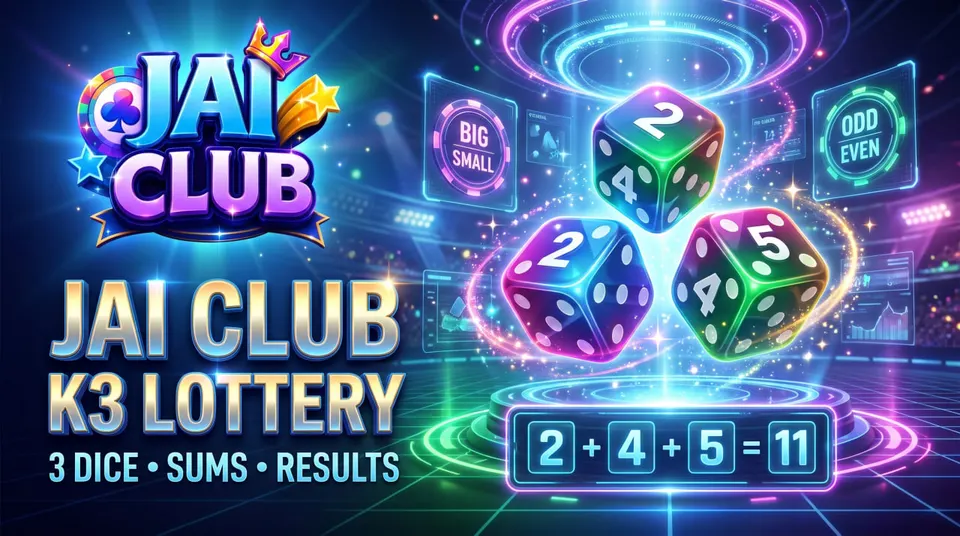
Die 1: 2
Die 2: 4
Die 3: 5
Total: 11
The total is calculated as:
2 + 4 + 5 = 11
Depending on the version, a K3 interface may also classify the result using categories such as Big, Small, Odd, Even, 2 Same and 3 Same.
These categories describe different mathematical properties of the same three-dice result.
The exact game rules can differ between services. A familiar game name does not prove that every operator uses identical options or payouts.
How Does the K3 Dice Game Work?
The basic mathematical structure is straightforward.
Three dice produce three face values.
Each value belongs to the set:
1, 2, 3, 4, 5, 6
The game can then evaluate their total, parity or matching pattern.
Step 1: Three Dice Are Represented
A standard K3-style result contains three numbers.
For example:
3, 3, 5
Step 2: The Numbers Are Added
3 + 3 + 5 = 11
The total is 11.
Step 3: The Result Is Classified
The total is odd because 11 is not divisible by 2.
Under a common simple classification where 11–18 is Big, the total also belongs to the Big group.
The result contains exactly two matching dice because two dice show 3.
Step 4: The Result Is Recorded
A round-based game may display the outcome beside a period ID.
The period ID identifies the round, while the three dice and their total describe the outcome.
What Are the Possible K3 Dice Totals?
The minimum total occurs when all three dice show 1.
1 + 1 + 1 = 3
The maximum total occurs when all three dice show 6.
6 + 6 + 6 = 18
Therefore, the possible totals are:
3, 4, 5, 6, 7, 8, 9, 10, 11, 12, 13, 14, 15, 16, 17 and 18.
There are 16 possible numerical totals.
However, this does not mean that all totals are equally likely.
Some totals can be formed through more dice arrangements than others.
K3 Dice Sum Chart: Numbers 3 to 18
For three independent, fair six-sided dice, there are:
6 × 6 × 6 = 216
possible ordered outcomes.
The following table shows how many of those outcomes produce each total.
| Dice Total | Combinations | Probability |
|---|---|---|
| 3 | 1 | 0.46% |
| 4 | 3 | 1.39% |
| 5 | 6 | 2.78% |
| 6 | 10 | 4.63% |
| 7 | 15 | 6.94% |
| 8 | 21 | 9.72% |
| 9 | 25 | 11.57% |
| 10 | 27 | 12.50% |
| 11 | 27 | 12.50% |
| 12 | 25 | 11.57% |
| 13 | 21 | 9.72% |
| 14 | 15 | 6.94% |
| 15 | 10 | 4.63% |
| 16 | 6 | 2.78% |
| 17 | 3 | 1.39% |
| 18 | 1 | 0.46% |
These are mathematical probabilities for fair, independent dice.
They are not independently verified probabilities for any particular online K3 implementation.
Why Are 10 and 11 More Common?
There are 27 ordered combinations producing a total of 10.
There are also 27 producing 11.
By contrast, only one ordered combination produces 3:
1, 1, 1
And only one produces 18:
6, 6, 6
The central totals have more possible arrangements.
Does This Predict the Next Result?
No.
A more common total has a higher theoretical probability under the fair-dice model, but it is not guaranteed to appear in the next round.
Previous outcomes do not automatically change the probability of the next independent roll.
What Does Big and Small Mean in K3?
Big and Small are common classifications used in K3-style games.
A simple mathematical grouping places totals into two ranges:
Small: 3 to 10
Big: 11 to 18
However, this is not the complete settlement rule for every K3 service.
Some implementations exclude triples from ordinary Big and Small awards.
Small Example
Dice:
1, 2, 4
Total:
1 + 2 + 4 = 7
The result belongs to the Small range in the simple classification.
Big Example
Dice:
3, 4, 6
Total:
3 + 4 + 6 = 13
The result belongs to the Big range.
Important Triple Exception
Consider:
4, 4, 4
The total is 12, which mathematically falls within the Big range.
However, some K3 implementations exclude triple outcomes from the ordinary Big/Small settlement rules.
Therefore, it would be inaccurate to assume that the Big classification always qualifies under every game's payment conditions.
Read the relevant game rules before interpreting settlement.
What Does Odd and Even Mean in K3?
Odd and Even refer to the parity of the total produced by the three dice.
An even number can be divided by 2 without a remainder.
An odd number cannot.
Odd Example
Dice:
2, 3, 6
Total:
2 + 3 + 6 = 11
The result is Odd.
Even Example
Dice:
1, 3, 4
Total:
1 + 3 + 4 = 8
The result is Even.
Is Odd/Even Always a 50/50 Result?
With three independent fair dice, exactly half of the 216 ordered outcomes have an odd sum and half have an even sum.
That means 108 outcomes in each group.
However, if a particular game's settlement rules exclude triple outcomes, the qualifying results for certain choices can differ from the simple parity classification.
The mathematical property of the number and the service's settlement conditions should be distinguished.
What Does 2 Same Mean in K3?
2 Same generally describes a pattern containing two matching dice.
A common example is:
2, 2, 5
Two dice show the number 2, while the third shows 5.
The result contains exactly one pair.
Other examples include:
1, 1, 6
3, 4, 3
5, 2, 5
Does Dice Order Matter?
For describing the same pair pattern, the order does not change the fact that exactly two dice match.
However, for counting ordered outcomes mathematically, each possible arrangement is counted separately.
How Many Outcomes Contain Exactly One Pair?
There are 90 ordered outcomes with exactly two matching faces and one different face.
The calculation is:
6 choices for the matching number
5 choices for the different number
3 positions for the different die
6 × 5 × 3 = 90
That represents:
90 / 216 = 41.67%
under the fair-dice model.
What Does 3 Same Mean in K3?
3 Same refers to three dice displaying the same face.
Examples include:
1, 1, 1
2, 2, 2
3, 3, 3
4, 4, 4
5, 5, 5
6, 6, 6
These are also called triples or three-of-a-kind outcomes.
How Many Triple Outcomes Exist?
There are six specific triple outcomes.
Out of 216 possible ordered outcomes:
6 / 216 = 2.78%
This is the theoretical probability of obtaining any triple under the fair-dice model.
What Is a Specific Triple?
A specific triple refers to one particular combination.
For example:
3, 3, 3
There is only one ordered outcome containing three 3s.
Its theoretical probability is:
1 / 216 = 0.46%
Does a Triple Count as 2 Same?
This depends on the terminology and rules.
Mathematically, three equal dice contain matching pairs.
But many K3 interfaces treat exactly two matching dice and three matching dice as different categories.
Always distinguish exactly one pair from a triple.
What Does Three Different Mean?
Three Different describes a result where all three dice show different numbers.
For example:
1, 3, 6
Another example:
2, 4, 5
No two dice have the same face.
How Many Three-Different Outcomes Exist?
Choose the first die in 6 ways.
Choose the second die in 5 ways, excluding the first value.
Choose the third die in 4 ways, excluding both previous values.
6 × 5 × 4 = 120
Therefore:
120 / 216 = 55.56%
of ordered outcomes have three different faces under the fair-dice model.
K3 Dice Patterns: Quick Comparison
| Pattern | Example | Ordered Outcomes | Probability |
|---|---|---|---|
| Exactly two same | 2, 2, 5 | 90 | 41.67% |
| Three same | 4, 4, 4 | 6 | 2.78% |
| Three different | 1, 3, 5 | 120 | 55.56% |
| Total | All possible outcomes | 216 | 100% |
These three pattern classes are mutually exclusive and cover every possible ordered outcome.
Their probabilities are mathematical properties of fair dice, not promises about future game results.
Why Do Some K3 Dice Totals Have Different Probabilities?
A total such as 10 can be formed by several arrangements.
For instance:
1 + 3 + 6 = 10
2 + 3 + 5 = 10
2 + 4 + 4 = 10
3 + 3 + 4 = 10
Each example can also have different ordered arrangements.
Meanwhile, the total 3 has only one possible combination:
1 + 1 + 1
This explains why the number of combinations differs across totals.
Are Middle Totals Guaranteed?
No.
Even though totals such as 10 and 11 have more possible combinations, neither is guaranteed on any particular independent round.
Can Recent Results Change the Dice Mathematics?
Not in an independent fair-dice model.
Past outcomes do not change the mathematical distribution of the next independent roll.
How Does K3 Result History Work?
A K3 result-history interface may contain the recorded outcome for each completed round.
Typical information can include:
- Period identifier
- Three dice values
- Combined total
- Big or Small classification
- Odd or Even classification
- Result status
- Timestamp, if available
The actual fields depend on the service.
Example of K3 Result History
| Period | Dice | Total | Parity |
|---|---|---|---|
| DEMO-201 | 2, 3, 4 | 9 | Odd |
| DEMO-202 | 1, 5, 6 | 12 | Even |
| DEMO-203 | 3, 3, 5 | 11 | Odd |
| DEMO-204 | 6, 6, 6 | 18 | Even |
These are fictional records created to explain how a history table may be organised.
They are not live results.
How to Read a Historical Entry
Start with the complete period ID.
Identify the three dice values.
Add them together.
Check the total and parity.
If the service displays a category or settlement label, compare it with the relevant game's rules.
What Is a K3 Period Number?
A period number identifies a particular round.
It serves a similar administrative purpose to period identifiers used by other round-based games.
A period ID is not the same as the dice total.
For example:
Period ID: DEMO-305
Dice: 2, 5, 6
Total: 13
The period ID identifies the record.
The total describes the outcome.
Can a Period Number Predict K3 Dice?
No reliable prediction follows from the period ID alone.
An identifier does not establish the future dice values.
For a more detailed explanation of round IDs in another game format, read our WinGo Period Number guide.
Why Might K3 Result History Show a Different Total?
A mismatch may occur when a user compares the current round with the previous completed round.
The interface might also display outdated information.
Other possible causes include:
- Different selected round modes
- Incomplete page updates
- An older history page
- A missing result
- Incorrect interpretation of the dice
- Technical errors
How to Check a Result
First confirm the selected game mode.
Find the complete period ID.
Read the three dice values.
Calculate their sum.
Then compare the result with the corresponding completed history record.
A mismatch should be checked using the same exact period rather than comparing unrelated rounds.
Jai Club K3 vs WinGo: What's the Difference?
K3 and WinGo are both discussed in connection with round-based gaming platforms, but their outcome formats differ.
K3 commonly uses three dice and their combined sum.
WinGo-style games generally use a result number and associated colour or number categories.
K3
The main mathematical elements include:
- Three dice
- Totals from 3 to 18
- Odd and Even
- Big and Small
- Matching dice patterns
WinGo
Common WinGo concepts include:
- Result numbers
- Colour categories
- Period identifiers
- Round countdowns
- Results history
Comparison Table
| Feature | K3 | WinGo |
|---|---|---|
| Main result format | Three dice | Number or colour result |
| Numerical total | 3–18 | Depends on game |
| Matching dice patterns | Yes | Not a defining feature |
| Colour mapping | Not essential to dice mathematics | Common feature |
| Period history | May be provided | May be provided |
| Main reference | Dice and game rules | Number/colour rules |
Read our Jai Club WinGo Explained guide for an explanation of the WinGo format.
Are K3 Results Random?
A standard mathematical model assumes three independent fair six-sided dice.
Under that model, each of the 216 ordered outcomes is equally likely.
However, an online implementation may generate results using software.
Without verified technical documentation or an independent assessment, it would be inappropriate to claim that a particular service uses a specific certified random-number system.
What Does Independent Mean?
Independent outcomes mean that the result of one round does not change the probabilities of a later round.
For example, three consecutive rounds showing high totals would not make a low total guaranteed next.
Can History Predict the Next Roll?
Historical data can reveal what has occurred.
It does not automatically reveal the next result.
What About K3 Prediction Formulas?
A formula may calculate a number from previous periods, but producing a number does not establish predictive accuracy.
Any forecasting claim requires evidence from genuinely unseen results.
Why K3 Probability Is Not the Same as Payout
Probability describes how frequently an outcome is expected under a mathematical model.
Payout describes the amount a game assigns to a qualifying result.
These are separate concepts.
For example, a specific triple is rare under the fair-dice model.
However, its actual payout is determined by the service's published rules and pricing.
Does a Rare Outcome Guarantee a Better Return?
No.
A larger advertised multiplier does not necessarily mean a better mathematical return.
The relationship between probability, stake and payout matters.
Can One Payout Table Apply Everywhere?
No.
Different K3 services may use different settlement and payment conditions.
This guide deliberately avoids assigning unverified Jai Club payout multipliers.
K3 Lottery on Android
K3-related interfaces may be displayed through mobile websites or applications, depending on the service.
The interface may show dice, round modes, result history and game information.
What to Check on Android
Identify the exact game title.
Confirm the round mode.
Review the rules screen.
Check whether the result history is visible.
Use a verified access destination.
What If the Game Does Not Load?
A loading problem may involve connectivity, browser compatibility, memory or a service issue.
For broader Android troubleshooting, explore our Jai Club App Help category.
Avoid Unverified APK Files
Do not assume that a file using the words K3 or Jai Club is an official application.
Check the publisher and source before installing software.
Is K3 Available on Every Jai Club Platform?
The Jai Club name appears across different gaming-related websites.
The fact that a K3 game is discussed on one site does not automatically confirm that it is available on every service using the name.
Game menus and rules can vary.
Readers should check the current catalogue and written rules of the exact platform they intend to research.
This article explains the common K3 dice format rather than claiming independently verified availability or payout terms for a particular operator.
Common K3 Lottery Misunderstandings
Mistake 1: Thinking Every Total Is Equally Likely
Some totals have more dice combinations than others.
Mistake 2: Confusing the Total With the Period ID
A period identifies the round. The dice sum describes the result.
Mistake 3: Treating Two Same and Three Same as Identical
Exactly one pair and three matching dice are different patterns.
Mistake 4: Assuming Big/Small Rules Are Universal
Some services apply special conditions involving triples.
Mistake 5: Assuming a Rare Result Is Due
A rare result is not guaranteed simply because it has not appeared recently.
Mistake 6: Copying Payout Figures From Another Platform
Actual payment and settlement rules may vary.
Mistake 7: Trusting Guaranteed Prediction Claims
Historical charts and simple formulas do not establish knowledge of future outcomes.
K3 Quick Reference Checklist
When examining a K3-style game, review:
- Whether the game uses three six-sided dice.
- How the combined total is calculated.
- The available result classifications.
- How Big and Small are defined.
- Whether triple results have special exceptions.
- How Odd and Even are handled.
- What 2 Same means.
- What 3 Same means.
- Whether Three Different is a separate category.
- How the period ID is displayed.
- Where completed results can be checked.
- Whether the payout information applies to the exact version.
Frequently Asked Questions
1. What is Jai Club K3 Lottery?
It is a term associated with K3-style dice games discussed in connection with Jai Club. The common format uses three dice and result classifications based on their values.
2. How many dice are used in K3?
The standard K3 format uses three six-sided dice.
3. What is the minimum K3 total?
The minimum is 3, produced by 1 + 1 + 1.
4. What is the maximum K3 total?
The maximum is 18, produced by 6 + 6 + 6.
5. How many possible K3 dice outcomes are there?
Three fair six-sided dice produce 216 possible ordered outcomes.
6. What does Big mean in K3?
A common simple grouping classifies totals 11–18 as Big, but some games apply exceptions to triple outcomes.
7. What does Small mean in K3?
A common simple grouping classifies totals 3–10 as Small, subject to the specific game's rules.
8. What is Odd and Even in K3?
Odd and Even describe whether the combined dice total is divisible by 2.
9. What does 2 Same mean?
It commonly describes a result with exactly two matching dice and one different die.
10. What does 3 Same mean?
It describes a triple, where all three dice show the same number.
11. What is the chance of any triple?
For three independent fair dice, six of the 216 ordered outcomes are triples, or approximately 2.78%.
12. Which K3 totals are most common?
Under the fair-dice model, totals 10 and 11 each occur in 27 of the 216 possible outcomes.
13. Can K3 result history predict the next round?
Historical results do not automatically provide a reliable method for predicting an independent future outcome.
14. Are K3 payouts the same across all websites?
No. Settlement rules and payout schedules can vary, so the relevant game's current information must be checked.
15. What is the difference between K3 and WinGo?
K3 is based on three-dice values and totals, while WinGo commonly uses number and colour-based round outcomes.
Final Thoughts
Jai Club K3 Lottery is best understood by starting with the basic mathematics of three dice.
Each result contains three face values from 1 to 6, producing a total between 3 and 18.
The game can also classify outcomes by parity, size and matching patterns such as 2 Same, 3 Same and Three Different.
Understanding the 216 possible ordered dice outcomes helps explain why some sums occur more frequently than others under the fair-dice model.
However, mathematical probability should not be confused with a guaranteed result, and game-specific settlement rules should always be verified.
For more explanations of round-based games, explore our Jai Club Game guides and related WinGo articles.
This guide is the foundation for further articles explaining K3 dice sums, matching patterns, period numbers and result history in greater detail.