Slot Hit Frequency vs RTP: Why They Are Different
Hit frequency and RTP are not the same. Learn how often slot games produce qualifying payouts, how theoretical returns are calculated, why volatility matters, and why a higher hit rate does not guarantee profit.
In this article
- What Is Hit Frequency in Slot Games?
- Hit Frequency Is Not Profit Frequency
- What Does RTP Mean?
- Theoretical RTP vs Observed RTP
- Observed RTP Formula
- Hit Frequency vs RTP: Quick Comparison
- How Is Slot Hit Frequency Calculated?
- Is Observed Hit Frequency the Same as Theoretical Hit Frequency?
- Why the Definition of a Hit Matters
- Can Two Games Have the Same RTP but Different Hit Frequencies?
- Hypothetical Game A
- Hypothetical Game B
- What Does the Comparison Show?
- Why a Higher Hit Frequency Does Not Guarantee Profit
- Frequent Small Payouts
- Less Frequent Larger Payouts
- The Key Point
- What Is Slot Volatility?
- Lower Volatility
- Higher Volatility
- Does Higher Volatility Always Mean Lower Hit Frequency?
- Hit Frequency vs RTP vs Volatility
- Can RTP Be High While Hit Frequency Is Low?
- Can Hit Frequency Be High While RTP Is Lower?
- Can Two Games Have the Same Hit Frequency but Different RTP?
- What Is the Difference Between Hit Frequency and Net-Positive Frequency?
- Example
- Does a Higher RTP Mean More Frequent Wins?
- Why Do Some Slot Games Show Many Small Wins?
- Example With Indian Rupees
- How Are Free Spins Included in RTP?
- Does a Retrigger Change the Advertised RTP?
- Can You Calculate a Game's RTP From 100 Spins?
- Example
- Why Short Samples Can Mislead
- Can Hit Frequency Predict the Next Spin?
- Common Misunderstanding
- Can Changing the Stake Change Hit Frequency?
- Where Can You Find Hit Frequency and RTP Information?
- RTP
- Hit Frequency
- Volatility
- How This Applies to Jai Club Slots
- Common Mistakes When Comparing Slot Statistics
- Mistake 1: Treating Hit Frequency as RTP
- Mistake 2: Assuming a Hit Always Means Profit
- Mistake 3: Assuming High RTP Means Frequent Payouts
- Mistake 4: Treating a Short Sample as Theoretical RTP
- Mistake 5: Assuming Volatility and Hit Frequency Are Identical
- Mistake 6: Predicting the Next Result From Previous Outcomes
- Quick Comparison Checklist
- Frequently Asked Questions
- 1. What is slot hit frequency?
- 2. Is hit frequency the same as RTP?
- 3. Does a higher hit frequency mean more profit?
- 4. Can two slots have the same RTP but different hit rates?
- 5. What is a good slot hit frequency?
- 6. Does a high RTP mean more frequent wins?
- 7. Is hit frequency the same as volatility?
- 8. Can I calculate hit frequency from past rounds?
- 9. Does a small payout count as a hit?
- 10. Do all Jai Club Slots have the same RTP?
- 11. Can hit frequency predict the next round?
- 12. Where can I check theoretical RTP?
- Final Thoughts
Two slot games can have the same theoretical RTP but produce very different patterns of payouts.
One game may display small qualifying wins relatively often. Another may produce fewer paid outcomes but include a different distribution of payout sizes.
How can both games have the same Return to Player percentage?
The answer lies in the difference between hit frequency, RTP and volatility.
These terms describe separate aspects of a slot game's mathematical design.
Hit frequency concerns how often a qualifying payout occurs.
RTP concerns the theoretical proportion of the total stake returned over a very large number of rounds.
Volatility concerns how outcomes vary in size and distribution.
This guide explains each concept in straightforward English, using percentage calculations, examples in Indian rupees and clear comparisons.
For a broader introduction to slot terminology, visit our Jai Club Slots explained guide.
What Is Hit Frequency in Slot Games?
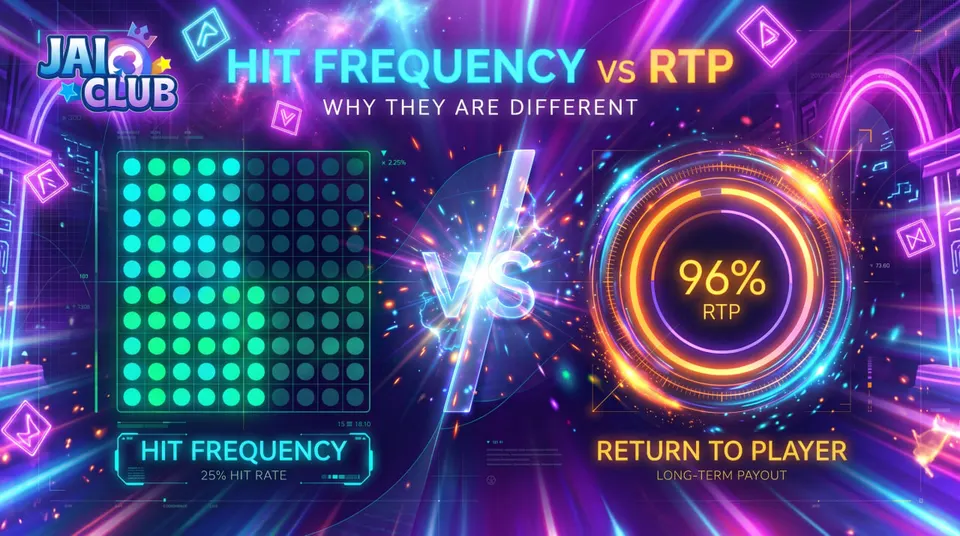
Hit frequency, sometimes called hit rate, describes the proportion of rounds that meet a defined condition for a qualifying payout.
The precise definition matters.
In many contexts, a hit refers to any round that returns a positive payout, even if the payout is smaller than the stake.
For example, if a hypothetical game produces qualifying payouts on 25 out of 100 observed rounds, its observed hit frequency is:
25 ÷ 100 × 100 = 25%
This means 25% of the observed rounds produced a payout under that definition.
It does not mean that 25% of the rounds generated a net profit.
Hit Frequency Is Not Profit Frequency
A round can return less than the amount staked.
Such a round may still qualify as a hit.
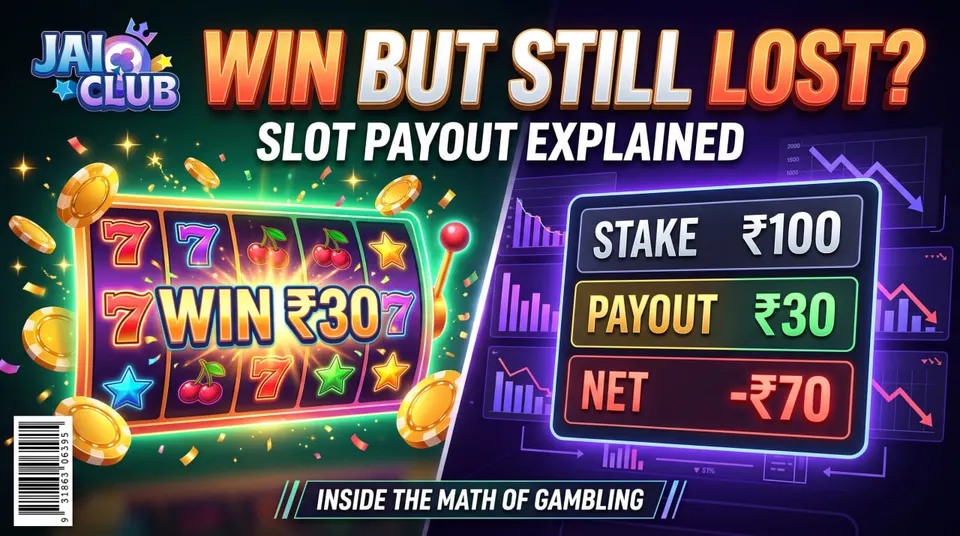
Suppose a ₹100 round returns ₹20.
The payout is positive, but the net result is -₹80.
If the game's hit definition includes all positive payouts, the round counts as a hit.
This is one reason hit frequency must be interpreted carefully.
What Does RTP Mean?
RTP stands for Return to Player.
It describes a game's theoretical long-run return as a proportion of total stakes under a specified mathematical configuration.
An RTP of 96% means that the model is designed around a theoretical aggregate return of ₹96 for every ₹100 staked over a sufficiently large number of rounds.
It does not mean that an individual ₹100 spin will return ₹96.
The actual outcome of one round may be zero, smaller than the stake or larger than the stake.
Theoretical RTP vs Observed RTP
Theoretical RTP is calculated from the game's mathematical design.
Observed RTP is calculated using actual recorded stakes and returns over a selected sample.
The observed figure can differ from the theoretical value, particularly over short samples.
Observed RTP Formula
Observed RTP = Total recorded payout ÷ Total recorded stake × 100
For example:
Total stake: ₹10,000
Total payout: ₹8,800
Observed RTP: 88%
This calculation describes that particular sample.
It does not establish the game's theoretical RTP.
Hit Frequency vs RTP: Quick Comparison
| Feature | Hit Frequency | RTP |
|---|---|---|
| Measures | Frequency of qualifying payouts | Theoretical aggregate return |
| Main question | How often is a hit recorded? | What proportion is returned in the long run? |
| Usually expressed as | Percentage | Percentage |
| Depends on payout size? | Not directly | Yes |
| Can include net-loss rounds? | Yes | All payouts contribute |
| Predicts next round? | No | No |
| Guarantees profit? | No | No |
Both metrics are useful for understanding a game, but they answer different questions.
How Is Slot Hit Frequency Calculated?
For an observed sample, the calculation is straightforward.
Observed hit frequency = Qualifying rounds ÷ Total rounds × 100
Suppose a hypothetical sample contains 200 rounds.
Forty rounds produce payouts that meet the stated definition of a hit.
The observed hit frequency is:
40 ÷ 200 × 100 = 20%
This result applies to the observed sample.
Is Observed Hit Frequency the Same as Theoretical Hit Frequency?
No.
A theoretical hit frequency is derived from the game's underlying outcome probabilities and its definition of a hit.
An observed hit frequency describes recorded outcomes.
A small sample may not reflect the theoretical rate closely.
Why the Definition of a Hit Matters
Some analyses count any positive payout.
Others may use a more restrictive definition.
Always identify what qualifies as a hit before comparing figures from different sources.
Can Two Games Have the Same RTP but Different Hit Frequencies?
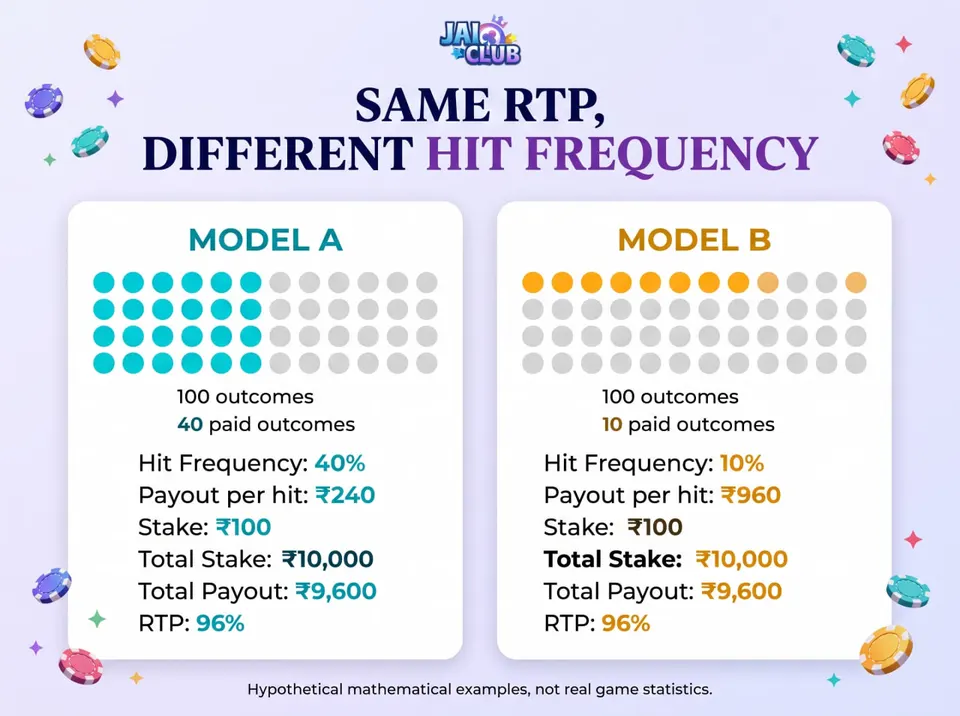
Yes.
RTP measures the amount returned in aggregate.
Hit frequency measures how often qualifying payouts occur.
The two metrics can vary independently because the sizes and probabilities of individual payouts can differ.
Hypothetical Game A
Imagine a simplified mathematical model with 100 equally likely outcomes and a ₹100 stake per outcome.
Forty outcomes return ₹240 each.
Sixty outcomes return ₹0.
Total stake across all 100 outcomes:
100 × ₹100 = ₹10,000
Total return:
40 × ₹240 = ₹9,600
Theoretical return for this simplified model:
₹9,600 ÷ ₹10,000 × 100 = 96%
Hit frequency:
40 ÷ 100 × 100 = 40%
Hypothetical Game B
Now imagine another simplified model.
Ten outcomes return ₹960 each.
Ninety outcomes return ₹0.
Total stake across all 100 outcomes:
₹10,000
Total return:
10 × ₹960 = ₹9,600
Theoretical return:
96%
Hit frequency:
10%
What Does the Comparison Show?
Both simplified models return ₹9,600 for every ₹10,000 staked in their equally weighted mathematical outcome sets.
Yet one has a 40% hit frequency and the other has a 10% hit frequency.
This demonstrates that identical theoretical RTP does not require identical payout frequency.
These are constructed mathematical examples, not statistics from real Jai Club games.
Why a Higher Hit Frequency Does Not Guarantee Profit
A higher hit frequency means that qualifying payouts occur more often under the relevant mathematical model.
It does not necessarily mean those payouts are larger.
Consider a hypothetical game that regularly produces awards smaller than the stake.
The interface may display many qualifying combinations, but the cumulative returned value can remain below the cumulative amount staked.
Frequent Small Payouts
A game may record many modest payouts.
The player may see more WIN messages, but those messages do not individually establish a net profit.
Less Frequent Larger Payouts
Another game may record fewer qualifying outcomes with a different distribution of award sizes.
Neither pattern alone identifies the game's theoretical return.
The Key Point
Frequency and value must be considered separately.
A high hit rate does not automatically establish a high RTP.
What Is Slot Volatility?
Volatility describes the variation in outcome sizes and their distribution.
It is often discussed alongside RTP and hit frequency.
However, it is a separate concept.
Lower Volatility
A lower-volatility design generally exhibits less extreme variation in its outcomes relative to a higher-volatility design.
Higher Volatility
A higher-volatility design generally features greater variation, potentially including less frequent large outcomes.
Does Higher Volatility Always Mean Lower Hit Frequency?
Not necessarily.
The relationship depends on the game's complete payout distribution.
Hit frequency alone does not define volatility.
Two games could share a hit frequency while having different payout sizes and different levels of variation.
Hit Frequency vs RTP vs Volatility
| Metric | Main Meaning |
|---|---|
| Hit frequency | How frequently qualifying payouts occur |
| RTP | Theoretical aggregate return relative to stake |
| Volatility | Variation and distribution of outcome sizes |
| Net-positive frequency | Proportion of rounds returning more than the stake |
These measurements are related through the game's overall mathematical model, but they are not interchangeable.
Can RTP Be High While Hit Frequency Is Low?
Yes.
A model can concentrate more of its aggregate return in relatively infrequent outcomes.
Can Hit Frequency Be High While RTP Is Lower?
Yes.
Frequent small payouts may produce many hits without producing a high aggregate return.
Can Two Games Have the Same Hit Frequency but Different RTP?
Yes.
If their payout sizes differ, the aggregate return can differ even when qualifying payouts occur equally often.
What Is the Difference Between Hit Frequency and Net-Positive Frequency?
This distinction is especially important when interpreting the term win.
A hit may include any payout greater than zero.
A net-positive round requires the payout to exceed the stake.
Example
Imagine 100 observed rounds.
Thirty rounds return something.
Of those thirty rounds, ten return more than the amount staked.
Under the stated definitions:
Observed hit frequency = 30%
Observed net-positive frequency = 10%
The remaining twenty paid rounds may have returned an amount equal to or below the stake.
The figures describe different aspects of the same sample.
Does a Higher RTP Mean More Frequent Wins?
No.
A higher RTP describes a different theoretical return percentage.
It does not necessarily mean that qualifying payouts occur more often.
For example, a game with a lower theoretical RTP might produce smaller payouts more frequently than a game with a higher RTP.
To compare frequency, the actual hit-frequency information would be required.
The RTP percentage alone is insufficient.
Why Do Some Slot Games Show Many Small Wins?
A game may be designed with a payout distribution that includes numerous small qualifying awards.
Such outcomes can produce frequent WIN messages.
However, a payout smaller than the stake is not a net profit.
Example With Indian Rupees
Stake: ₹100
Payout: ₹25
Net result:
₹25 - ₹100 = -₹75
The game has recorded a qualifying payout, but the balance is lower after the round.
Our Jai Club Slots category covers related terminology involving payouts, reels and special symbols.
How Are Free Spins Included in RTP?
Free-spin features and bonus rounds can contribute to the mathematical return of a slot game.
The precise treatment depends on the game's design and RTP calculation.
Some models allocate part of the theoretical return to base-game outcomes and part to bonus features.
However, the presence of a free-spin feature does not reveal its contribution without verified game-specific information.
Does a Retrigger Change the Advertised RTP?
A retrigger is a feature event within the game.
Its probability and possible outcomes may already be included in the game's theoretical mathematical model.
A retrigger does not automatically mean that a new RTP applies.
Any separate configuration would need to be identified through the game's documentation.
Can You Calculate a Game's RTP From 100 Spins?
You can calculate an observed return percentage from 100 recorded spins.
However, that does not establish the game's theoretical RTP.
One hundred outcomes are generally insufficient for drawing reliable conclusions about the full mathematical model of a slot game.
Example
Suppose a person records:
Total stake: ₹5,000
Total return: ₹4,200
Observed RTP:
₹4,200 ÷ ₹5,000 × 100 = 84%
This is the observed result for that sample.
It does not prove that the game's theoretical RTP is 84%.
Why Short Samples Can Mislead
Slot outcomes can vary considerably.
A small number of rounds can be strongly influenced by individual large or small results.
Reliable theoretical figures should come from authoritative game information rather than short observational samples.
Can Hit Frequency Predict the Next Spin?
No.
A theoretical hit frequency describes the overall probability structure of qualifying outcomes.
It does not identify the next result.
An observed sequence of several rounds without a payout does not, by itself, make a hit due.
The actual outcome probabilities depend on the game's design.
Common Misunderstanding
If a game has a theoretical hit frequency of 25%, that does not mean exactly one in every four consecutive rounds must produce a payout.
The figure represents a long-run probability or expectation under a defined model, not a fixed repeating schedule.
Can Changing the Stake Change Hit Frequency?
The answer depends on the game's mathematical configuration.
In a game where stake size simply scales the payout values, the underlying probabilities may remain unchanged.
However, different configurations or features can have different rules.
Do not assume that increasing or decreasing the stake changes the chance of a hit unless the game documentation confirms such behaviour.
Where Can You Find Hit Frequency and RTP Information?
A game's verified information screen or technical documentation is the appropriate place to look.
RTP
Some titles disclose theoretical RTP in their help or information section.
The figure may depend on the configured game version.
Hit Frequency
Hit frequency is not always publicly displayed.
If the number is unavailable, it should not be invented or estimated from a short session.
Volatility
Some game providers publish a volatility classification or related information.
However, classification methods can differ, so comparisons should be made carefully.
How This Applies to Jai Club Slots
Readers searching for Jai Club Slots may encounter different titles and provider names across gaming-related websites.
It would be misleading to assign one RTP or hit-frequency figure to every slot associated with the Jai Club name.
The mathematical characteristics belong to individual games and their specific configurations.
This guide explains the concepts rather than claiming verified RTP or hit-frequency data for any particular Jai Club title.
For further background, see our Jai Club Slots guide.
Common Mistakes When Comparing Slot Statistics
Mistake 1: Treating Hit Frequency as RTP
One measures qualifying payout frequency, while the other measures aggregate theoretical return.
Mistake 2: Assuming a Hit Always Means Profit
A positive payout can be smaller than the stake.
Mistake 3: Assuming High RTP Means Frequent Payouts
RTP does not reveal the frequency distribution by itself.
Mistake 4: Treating a Short Sample as Theoretical RTP
Observed results and theoretical calculations are different.
Mistake 5: Assuming Volatility and Hit Frequency Are Identical
Volatility concerns the distribution and variation of outcome sizes.
Mistake 6: Predicting the Next Result From Previous Outcomes
A sequence of previous results does not establish the next outcome.
Quick Comparison Checklist
When examining game statistics, ask:
- Is the RTP theoretical or observed?
- What counts as a hit?
- Does a hit include payouts below the stake?
- Is the hit-frequency value published by a reliable source?
- Is volatility described separately?
- Does the game have multiple configurations?
- Is the information relevant to the exact game version?
- Are the figures being incorrectly used to predict short-term outcomes?
Frequently Asked Questions
1. What is slot hit frequency?
Hit frequency is the proportion of rounds that meet a stated definition of a qualifying payout.
2. Is hit frequency the same as RTP?
No. Hit frequency concerns payout frequency, while RTP concerns theoretical aggregate return.
3. Does a higher hit frequency mean more profit?
No. Small payouts can count as hits even when they are below the stake.
4. Can two slots have the same RTP but different hit rates?
Yes. Their payout distributions can differ while producing the same theoretical aggregate return.
5. What is a good slot hit frequency?
There is no universal value that establishes a favourable outcome. Hit frequency must be interpreted alongside payout sizes, RTP and the game's full mathematical design.
6. Does a high RTP mean more frequent wins?
Not necessarily. RTP alone does not identify how often qualifying payouts occur.
7. Is hit frequency the same as volatility?
No. Volatility concerns the variation and distribution of results, not simply the proportion of paid rounds.
8. Can I calculate hit frequency from past rounds?
You can calculate the observed hit frequency of a recorded sample, but it does not establish the exact theoretical hit frequency.
9. Does a small payout count as a hit?
It may, depending on the definition used. A payout below the stake can still qualify as a hit.
10. Do all Jai Club Slots have the same RTP?
That cannot be assumed. RTP depends on the individual game and applicable configuration.
11. Can hit frequency predict the next round?
No. It is a statistical characteristic, not a schedule of future outcomes.
12. Where can I check theoretical RTP?
Look for verified information provided for the exact game title and version.
Final Thoughts
Slot hit frequency and RTP describe different parts of a game's mathematics.
Hit frequency measures how often a qualifying payout occurs.
RTP measures the theoretical proportion of total stakes returned over the long run.
Volatility describes the variation in the outcomes that produce those returns.
A game can have frequent small payouts without generating a high aggregate return, and two games can have similar RTP figures with different hit frequencies.
Understanding the distinction helps readers interpret slot statistics without treating them as promises or predictions.
Explore additional explanations in the Jai Club Slots category, including reels, paylines, symbols and bonus features.