Why Does a Slot Show a Win Smaller Than Your Stake?
Why does a slot game display WIN even when the return is smaller than the stake? Learn the difference between a winning combination, total return, net profit and losses disguised as wins, with simple rupee examples.
In this article
- Why Does a Slot Show a Win Smaller Than the Stake?
- A Simple Example Using Indian Rupees
- What Does WIN Actually Mean in Slot Games?
- Win Amount Is Not Always Profit
- What About a Zero Payout?
- What About a Payout Equal to the Stake?
- Three Examples: Loss, Break-Even and Profit
- Why Does My Balance Decrease After a Winning Spin?
- Balance Example
- Does Every Game Update the Balance in the Same Order?
- What Are Losses Disguised as Wins?
- An Illustrative Example
- Does Every Small Payout Use Celebratory Effects?
- Why Do Slot Games Celebrate Small Payouts?
- Visual Effects and Financial Results Are Different
- Total Stake vs Total Payout vs Net Result
- Total Stake
- Total Payout
- Net Result
- Does a Payline Win Guarantee a Profit?
- Can Several Winning Lines Still Produce a Net Loss?
- What Is the Difference Between Hit Frequency and Profit?
- Example
- Does a Small Win Affect RTP?
- Example of a Theoretical RTP
- Why Hit Frequency Can Be Misleading
- What If the Slot Displays WIN but Does Not Credit the Balance?
- Check the Display Carefully
- Allow the Round to Finish
- Compare the Account History
- Avoid Repeating the Round to Test the Error
- How to Read Slot Results More Accurately
- Frequently Asked Questions
- 1. Why does a slot show WIN when I have lost money?
- 2. Is a payout smaller than the stake a real win?
- 3. Why does my slot balance decrease after a WIN message?
- 4. What is a loss disguised as a win?
- 5. Does a payline win always return the full stake?
- 6. Can several winning paylines still result in a loss?
- 7. Does hit frequency mean profitable spins?
- 8. Does a higher RTP guarantee a profitable round?
- 9. How do I calculate my actual result?
- 10. Are these rules the same for all Jai Club Slots?
- Final Thoughts
A slot game displays a bright WIN message, the reels flash, and a small amount appears on the screen. However, when you check the balance, it has actually decreased.
How can a game show a win when you have lost money on that round?
The explanation is simple: a winning symbol combination is not necessarily the same as making a net profit.
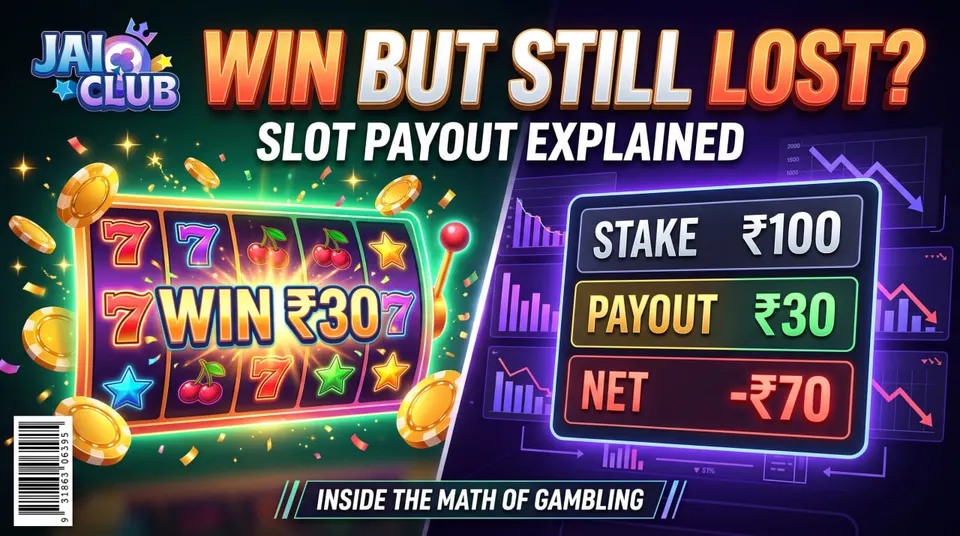
If a spin costs ₹100 and returns ₹30, the game may recognise a qualifying symbol combination and display a ₹30 win. Yet the net result of that spin is a loss of ₹70.
This distinction matters when understanding slot paytables, results and account balances.
In this guide, we explain why a slot can display WIN even when the return is smaller than the stake, how to calculate the actual result, and why visual celebrations do not always represent a financial gain.
For an introduction to slot terminology, read our Jai Club Slots guide.
Why Does a Slot Show a Win Smaller Than the Stake?
Slot games commonly distinguish between a qualifying payout and the net financial result of a round.
A qualifying payout occurs when the displayed symbols satisfy an award condition defined by the game's paytable.
The payout might be smaller than, equal to or greater than the stake used for that round.
A game can therefore show a WIN label whenever it recognises a payable combination, even if the total return is below the original stake.
A Simple Example Using Indian Rupees
Imagine a hypothetical slot round with these figures:
- Total stake: ₹100
- Displayed payout: ₹30
- Net result: -₹70
The game has awarded ₹30, but the amount returned is ₹70 less than the amount staked.
The calculation is:
Net result = Total payout - Total stake
₹30 - ₹100 = -₹70
The WIN message describes the payout event, not necessarily a net-positive result.
What Does WIN Actually Mean in Slot Games?
The meaning of WIN depends on the game's interface and terminology.
In many slot titles, WIN refers to the amount awarded through qualifying symbols or features.
It does not necessarily represent the profit after subtracting the stake.
A paytable determines which combinations qualify for an award.
For example, a hypothetical game might recognise three matching symbols along an eligible payline.
If that combination awards ₹25 on a ₹100 stake, the screen may display WIN ₹25.
The combination qualifies for an award, but the round still produces a net loss.
Win Amount Is Not Always Profit
A payout is the amount returned according to the game rules.
Profit or loss takes the original stake into account.
These concepts should not be confused.
What About a Zero Payout?
If no qualifying award occurs, the round may return ₹0.
With a ₹100 stake, the net result would be -₹100.
What About a Payout Equal to the Stake?
If the stake is ₹100 and the payout is ₹100, the net result is ₹0.
This is a break-even outcome rather than a profit.
Three Examples: Loss, Break-Even and Profit
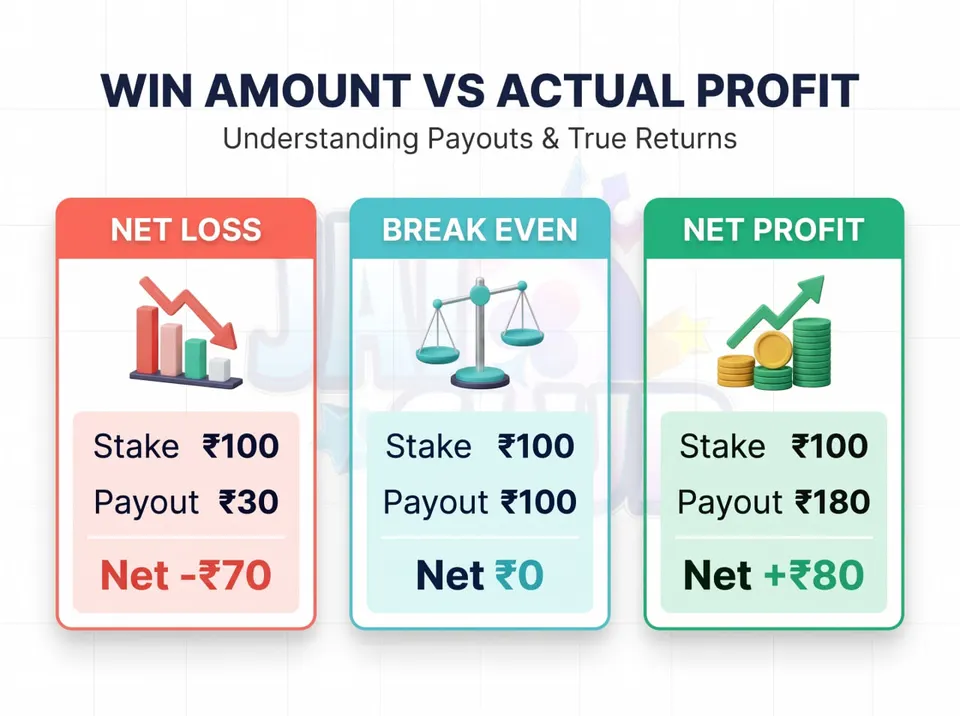
Consider three hypothetical rounds with an identical ₹100 stake.
| Round | Stake | Payout | Net Result |
|---|---|---|---|
| A | ₹100 | ₹30 | -₹70 |
| B | ₹100 | ₹100 | ₹0 |
| C | ₹100 | ₹180 | +₹80 |
Round A has a qualifying payout but produces a net loss.
Round B returns the full stake.
Round C returns more than the stake and produces a positive net result.
These examples are mathematical illustrations, not predictions or reported results from any specific Jai Club game.
Why Does My Balance Decrease After a Winning Spin?
An account balance reflects debits and credits rather than just the presence of a WIN label.
Suppose a hypothetical account begins with ₹1,000.
A spin uses ₹100, leaving ₹900 before its payout is credited.
The game then awards ₹30.
The resulting balance becomes ₹930.
Compared with the original ₹1,000, the balance is ₹70 lower.
Balance Example
Starting balance: ₹1,000
Stake deducted: ₹100
Payout credited: ₹30
Ending balance: ₹930
Net balance change: -₹70
This explains how the game can display a payout while the overall balance falls.
Does Every Game Update the Balance in the Same Order?
Not necessarily.
Some interfaces show the stake deduction immediately.
Others combine several display updates.
The timing of the animation can vary, but the underlying financial comparison remains the same.
What Are Losses Disguised as Wins?
The phrase "losses disguised as wins" is used in research and discussions about certain gambling-machine designs.
It refers to outcomes where a game produces a payout smaller than the stake but presents the event with celebratory effects resembling a larger win.
These effects may include flashing symbols, animations and sound.
The important distinction is between the screen's presentation and the actual net result.
An Illustrative Example
A player stakes ₹50.
The displayed symbols qualify for a ₹10 payout.
The interface uses a colourful WIN animation.
However:
₹10 - ₹50 = -₹40
The round has produced a net loss of ₹40.
Does Every Small Payout Use Celebratory Effects?
No.
Different games use different interfaces.
Some distinguish small payouts from larger ones, while others provide similar visual feedback for several types of qualifying outcomes.
A specific game should be assessed by its actual display behaviour.
Why Do Slot Games Celebrate Small Payouts?
Slot interfaces often use animation to identify qualifying symbol combinations.
A win animation tells the user that the game has recognised a particular result.
However, the amount awarded may be small relative to the stake.
The presence of music, flashing colours or moving graphics does not establish that the player has made a profit.
Visual Effects and Financial Results Are Different
The animation communicates a game event.
The financial result requires a calculation.
A useful approach is to compare the total payout with the total stake rather than judging the result by its visual presentation.
Total Stake vs Total Payout vs Net Result
These three terms help explain the financial meaning of a slot result.
Total Stake
The amount used for the round.
Total Payout
The amount returned by the game for the qualifying outcome.
Net Result
The payout minus the stake.
The general calculation is:
Net result = Total payout - Total stake
If the payout is smaller than the stake, the net result is negative.
If both amounts are equal, the net result is zero.
If the payout is larger, the net result is positive.
Does a Payline Win Guarantee a Profit?
No.
A payline determines whether symbols form a qualifying combination under the game's rules.
It does not guarantee that the resulting amount exceeds the stake.
The paytable establishes the award associated with that combination.
A small award can still be a valid payline result.
For readers learning how different symbol arrangements are evaluated, our Jai Club Slots overview provides related explanations.
Can Several Winning Lines Still Produce a Net Loss?
Yes.
A hypothetical game may recognise multiple qualifying lines during the same round.
Their combined payouts might still be smaller than the total stake.
For example:
- Total stake: ₹100
- First qualifying line: ₹15
- Second qualifying line: ₹10
- Third qualifying line: ₹20
- Combined payout: ₹45
Net result:
₹45 - ₹100 = -₹55
Even though three lines produced awards, the round ended with a net loss.
The actual handling of multiple combinations depends on the game's rules.
What Is the Difference Between Hit Frequency and Profit?
Hit frequency concerns how often a game produces outcomes that meet a specified definition of a hit.
A hit may include a payout smaller than the stake.
A profitable outcome, by contrast, requires the total return to exceed the stake.
These are different measurements.
Example
Imagine a hypothetical sample of 100 rounds.
Thirty rounds produce payouts greater than zero.
However, only eight rounds return more than their respective stakes.
Under a definition that counts every positive payout as a hit:
Observed hit frequency = 30%
Observed net-positive round frequency = 8%
These are illustrative sample figures, not theoretical values for a real game.
Does a Small Win Affect RTP?
Yes, qualifying payouts contribute to the total return used in RTP calculations.
RTP stands for Return to Player.
The theoretical RTP describes the long-run proportion of total stakes that a game is mathematically designed to return under a specified configuration.
Both small and large payouts contribute to that return.
However, RTP is not the same as the probability of making a profit on any individual round.
Example of a Theoretical RTP
A hypothetical game with a theoretical RTP of 96% has a long-run model in which ₹96 is returned per ₹100 staked in aggregate expectation.
That does not mean a ₹100 round will return exactly ₹96.
Actual short-term outcomes can differ substantially.
Why Hit Frequency Can Be Misleading
A game that frequently produces small payouts may display WIN messages more often than another game.
But that does not establish a better net financial result.
The amount returned matters as much as the presence of a payout.
Two games can differ in how frequently they produce qualifying combinations and in the sizes of those awards.
Therefore, hit frequency should not be confused with RTP or profitability.
What If the Slot Displays WIN but Does Not Credit the Balance?
This is a separate technical question.
A normal small payout is not the same as a missing credit.
If the interface shows an award but the corresponding balance does not update as expected, review the actual account transaction information where available.
Check the Display Carefully
Determine whether the amount shown refers to a single line, the total round payout or a bonus feature.
Allow the Round to Finish
Some interfaces update totals after all animations or feature events have completed.
Compare the Account History
If a verified transaction or game history is available, compare the specific round and its recorded payout.
Avoid Repeating the Round to Test the Error
Another round will not establish what happened to the previous one.
Instead, record the displayed information and consult the verified service's support channel if necessary.
How to Read Slot Results More Accurately
A useful checklist includes:
- Identify the total stake.
- Check the total payout.
- Distinguish line awards from the final round total.
- Calculate payout minus stake.
- Read the paytable.
- Check whether bonus events are still being processed.
- Review account history if the displayed balance seems inconsistent.
- Avoid treating animation as proof of profit.
Frequently Asked Questions
1. Why does a slot show WIN when I have lost money?
The WIN label may describe a qualifying payout, even when the amount returned is smaller than the total stake.
2. Is a payout smaller than the stake a real win?
It may be a valid award under the game's paytable, but it produces a net financial loss when the payout is below the stake.
3. Why does my slot balance decrease after a WIN message?
Because the stake deducted may exceed the payout credited.
4. What is a loss disguised as a win?
It is an outcome where a payout smaller than the stake is presented using feedback associated with winning, such as celebratory animations.
5. Does a payline win always return the full stake?
No. The award depends on the game's paytable and the qualifying combination.
6. Can several winning paylines still result in a loss?
Yes. Their combined payout can remain below the total stake.
7. Does hit frequency mean profitable spins?
Not necessarily. Hit frequency may count any qualifying payout, including payouts smaller than the stake.
8. Does a higher RTP guarantee a profitable round?
No. RTP describes a theoretical long-run return, not the result of one round.
9. How do I calculate my actual result?
Subtract the total stake from the total payout.
10. Are these rules the same for all Jai Club Slots?
Exact symbols, payouts and interface behaviour vary by title. Check the verified paytable for the individual game.
Final Thoughts
A slot game can show a WIN message even when the payout is smaller than the stake.
The key is to distinguish a qualifying symbol combination from a net financial gain.
A ₹30 return from a ₹100 stake is a valid payout if the paytable awards that amount, but the net result is still -₹70.
Understanding total stakes, payouts, hit frequency and RTP helps readers interpret slot results without relying on animations or labels alone.
For more explanations of slot symbols and mathematical concepts, browse the Jai Club Slots category.