WinGo Live Prediction: Real-Time Signals and Accuracy
Explore WinGo live prediction, real-time result updates, prediction signals, timestamps and accuracy claims. Learn the difference between a live forecast and a completed result, why updates may be delayed and how to check prediction records.

In this article
- What Is WinGo Live Prediction?
- WinGo Live Prediction vs Live Result
- Live Prediction
- Live Result
- Historical Result
- How Does a Live WinGo Prediction Page Work?
- Countdown Timer
- Period Number
- Prediction Panel
- Latest Result
- History Table
- Why Prediction Timestamps Matter
- What Information Should Be Recorded?
- Can a Screenshot Prove the Forecast Was Early?
- WinGo Live Prediction Today
- Date and Time Differences
- Why the Exact Period Matters
- WinGo Live Colour Prediction
- Does a Colour Streak Help?
- Can a Live Colour Chart Be Useful?
- WinGo Live Big Small Prediction
- Why Predictions Appear Convincing
- WinGo 30 Second Live Prediction
- Timing Problems
- How to Check
- WinGo 1 Minute Live Prediction
- Why Mixing Modes Creates False Results
- Why Is My Live Prediction Delayed?
- What Should You Compare?
- Live Prediction vs Telegram Signals
- What Should Be Checked?
- What About Bots?
- What About WinGo AI Live Prediction?
- Real-Time Data Is Not Future Knowledge
- AI Requires Independent Evaluation
- Claims Need Evidence
- How to Check a WinGo Live Prediction Claim
- Step 1: Identify the Game Mode
- Step 2: Record the Full Period ID
- Step 3: Record the Prediction
- Step 4: Preserve the Timestamp
- Step 5: Find the Completed Result
- Step 6: Record Whether the Forecast Was Correct
- Step 7: Include Every Forecast
- Step 8: Compare Against an Appropriate Baseline
- Why the Latest Result May Look Different
- How to Investigate
- Does a Live Prediction Have to Be Updated Every Round?
- Common Mistakes With WinGo Live Prediction
- Mistake 1: Confusing Latest Results With Future Predictions
- Mistake 2: Ignoring Timestamps
- Mistake 3: Comparing Different Periods
- Mistake 4: Mixing Round Modes
- Mistake 5: Trusting Selected Successful Signals
- Mistake 6: Assuming AI Guarantees Accuracy
- Mistake 7: Treating a Fast Dashboard as Proof
- Frequently Asked Questions
- 1. What is WinGo live prediction?
- 2. Is WinGo live prediction the same as a live result?
- 3. What does WinGo live prediction today mean?
- 4. Can live prediction guarantee the next colour?
- 5. Can WinGo AI predict live results accurately?
- 6. Why are live prediction signals delayed?
- 7. Does a 30-second mode produce more accurate predictions?
- 8. Can Telegram bots generate live predictions?
- 9. Why does the latest result differ from history?
- 10. How is live prediction accuracy measured?
- 11. Can a period number reveal the next result?
- 12. Are live prediction screenshots reliable proof?
- Final Thoughts
WinGo live prediction is a search term used by people looking for forecasts, signals and colour or number updates associated with ongoing game rounds.
A page may claim to provide a live prediction for the next period. Another may display a countdown, recent results and a continuously updated chart.
Both pages can look similar, but they may be showing completely different information.
A live prediction is a forecast about an outcome that has not yet been confirmed.
A live result is information reported after a round has been completed.
This distinction matters because an updated page is not necessarily an accurate forecasting system.
This guide explains WinGo live prediction, real-time signal terminology, countdowns, result verification, update delays and how to interpret claims about prediction accuracy.
For a broader introduction to forecasting concepts, see our WinGo guides.
What Is WinGo Live Prediction?
WinGo live prediction generally refers to a forecast presented in connection with a current or upcoming WinGo round.
The prediction may attempt to identify:
- A future number
- A colour category
- A Big or Small result
- A specific upcoming period outcome
Some services display forecasts next to a countdown timer or period ID.
Others provide continuously updated charts or messages claiming to offer real-time signals.
However, the word live does not establish that the forecast is accurate, official or generated before the result.
WinGo Live Prediction vs Live Result
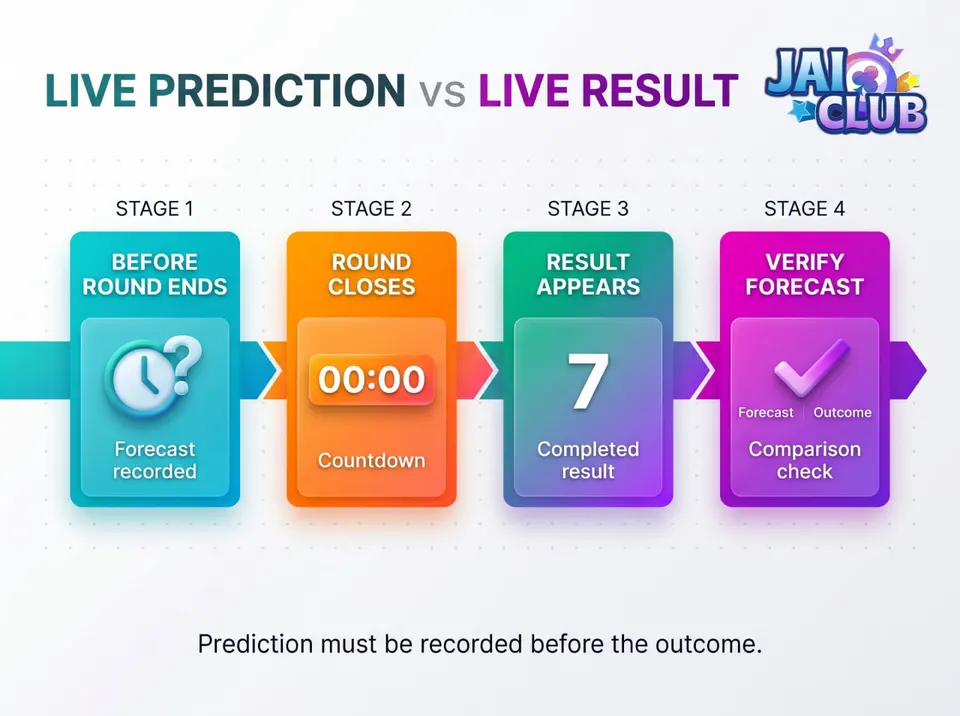
This is the most important difference to understand.
Live Prediction
A forecast recorded before the actual result is available.
Live Result
A displayed outcome associated with a completed round.
Historical Result
A previous outcome stored in result history.
| Feature | Live Prediction | Live Result | History |
|---|---|---|---|
| Main purpose | Forecast an outcome | Report an outcome | Record earlier outcomes |
| Future information? | Claimed forecast | No | No |
| Period ID | Should be stated | Should be stated | Usually recorded |
| Timestamp | Important for verification | Useful for reporting | Useful for records |
| Accuracy claim | Requires testing | Not a forecast | Not a forecast |
A page that updates immediately after a round ends may simply be reporting the completed result.
That does not establish successful prediction.
How Does a Live WinGo Prediction Page Work?
Different pages can use different systems.
A typical interface may include a timer, period number, history table and prediction panel.
However, these components perform separate functions.
Countdown Timer
Shows the time remaining in a displayed round stage.
Period Number
Identifies a particular round.
Prediction Panel
Displays a claimed forecast for a specified period.
Latest Result
Displays an outcome after the relevant round has been completed.
History Table
Shows previous completed outcomes.
The presence of all five components does not prove that the prediction panel has useful forecasting information.
Why Prediction Timestamps Matter
A timestamp helps establish when a forecast was recorded.
This is essential for evaluating real-time prediction claims.
Imagine a forecast for fictional period DEMO-301.
A prediction published before the round's outcome becomes available may be evaluated as an advance forecast.
A prediction first displayed after the result is known does not demonstrate advance forecasting ability.
What Information Should Be Recorded?
A proper log should contain:
- Exact period ID
- Game mode
- Forecast number or category
- Forecast timestamp
- Result timestamp
- Actual result
- Evaluation status
Can a Screenshot Prove the Forecast Was Early?
A screenshot may provide supporting context, but it does not always establish when the underlying record was created.
Edited images and retrospective posts can make a prediction appear older than it is.
Independent, timestamped records are more useful.
WinGo Live Prediction Today
People searching for "wingo live prediction today" generally want information about current rounds.
The word today creates a freshness expectation.
However, a page should not present old predictions as current results.
Date and Time Differences
For readers in India, local time is India Standard Time (UTC+05:30).
Nevertheless, the game server or prediction service may use a different reference time.
A page displaying a timestamp should explain which time zone it uses.
Why the Exact Period Matters
Two forecasts created on the same day may refer to completely different rounds.
A date alone is not enough to match a prediction with its outcome.
The full period ID should be used.
WinGo Live Colour Prediction
Live colour prediction attempts to forecast a colour classification for the next round.
A panel might display Red, Green or Violet, depending on the relevant game's terminology.
But a displayed colour is not evidence that the forecast is reliable.
Does a Colour Streak Help?
Previous colour streaks are historical observations.
They do not automatically create a predictable next outcome.
Can a Live Colour Chart Be Useful?
It can help organise past results and distinguish completed rounds.
It may also help audit whether a forecast was recorded before the outcome.
It cannot guarantee the next colour.
WinGo Live Big Small Prediction
Big Small live prediction attempts to forecast the next classification.
The actual mapping between numbers and the Big or Small labels depends on the game rules.
A live chart may display several previous classifications.
For example:
Big, Small, Small, Big, Big.
This sequence is not a mathematical guarantee about the next round.
Why Predictions Appear Convincing
A short sequence can contain visually interesting patterns.
A forecaster may highlight selected examples that appear successful.
But evaluating accuracy requires every forecast, not only successful ones.
WinGo 30 Second Live Prediction
Some searches specifically target 30-second WinGo forecasts.
The short duration can create a rapid stream of new periods and result updates.
However, a high update frequency is not evidence of superior forecasting accuracy.
Timing Problems
With short rounds, even a small delay may create confusion over which period a prediction belongs to.
For example, a signal may appear when the referenced round has already ended.
How to Check
Review the exact period ID and timestamp.
Do not assume the most recent message refers to the next active round.
WinGo 1 Minute Live Prediction
A 1-minute mode has a different timing interval from a 30-second mode.
Its period history and countdown should be treated separately.
A forecast generated for a 1-minute period should not be evaluated against a 30-second history entry.
Why Mixing Modes Creates False Results
If the prediction and actual result belong to different round sequences, the comparison is invalid.
Correct identification comes before accuracy analysis.
Our WinGo Period Number Explained article explains how to distinguish round identifiers.
Why Is My Live Prediction Delayed?
A live prediction page may display information later than expected.
Possible explanations include:
- Slow internet connection
- Browser tab being paused
- Delayed network requests
- Server-side update problems
- An outdated browser session
- Incorrect period selection
- Different time-zone conventions
These possibilities describe technical display problems.
They do not establish that a prediction is more or less accurate.
What Should You Compare?
Check whether the countdown, prediction timestamp and period ID refer to the same round.
If the page appears frozen, record the current information before refreshing.
For more on timer behaviour, read our WinGo Countdown Timer troubleshooting guide.
Live Prediction vs Telegram Signals
Some groups distribute WinGo predictions through Telegram or other messaging platforms.
These signals may include a period number, colour or Big/Small label.
However, the existence of a prediction group does not validate its claims.
What Should Be Checked?
Look for a complete record of predictions, including errors.
Check whether timestamps were recorded before outcomes.
Avoid treating edited or deleted messages as an independently verified history.
What About Bots?
A bot can automatically generate and distribute messages.
Automation does not prove that the underlying forecasts are accurate.
The bot may be using a simple formula, historical pattern or another unverified rule.
What About WinGo AI Live Prediction?
An AI system can process historical data and generate predictions automatically.
However, AI cannot guarantee that future outcomes are predictable.
Real-Time Data Is Not Future Knowledge
Receiving the latest completed result is different from knowing the next outcome.
AI Requires Independent Evaluation
An AI system should be evaluated against unseen future results.
Claims Need Evidence
Accuracy percentages should be supported by complete prediction records and appropriate statistical comparisons.
A sophisticated dashboard does not substitute for evidence.
How to Check a WinGo Live Prediction Claim
A useful evaluation involves several steps.
Step 1: Identify the Game Mode
Confirm whether the forecast refers to the 30-second, 1-minute or another mode.
Step 2: Record the Full Period ID
This identifies the exact round.
Step 3: Record the Prediction
Note the claimed outcome before the round completes.
Step 4: Preserve the Timestamp
The forecast should have been recorded before the actual result.
Step 5: Find the Completed Result
Use the matching historical record.
Our WinGo Results History guide explains how completed rounds are organised.
Step 6: Record Whether the Forecast Was Correct
Apply a consistent scoring method.
Step 7: Include Every Forecast
Do not exclude unsuccessful predictions.
Step 8: Compare Against an Appropriate Baseline
An accuracy percentage has limited meaning without considering the underlying outcome probabilities.
Why the Latest Result May Look Different
Some live pages update their result panel before their history table.
Others may retain an older result until a refresh.
This can create the appearance that the displayed prediction or result has changed.
How to Investigate
Compare the exact period identifiers.
Check completion status.
Verify the source.
If two records for the same completed period conflict, preserve the information and investigate the discrepancy.
A result mismatch should not be treated as proof of a forecasting method.
Does a Live Prediction Have to Be Updated Every Round?
Not necessarily.
An interface could update every round while containing no meaningful prediction method.
Conversely, infrequent updates do not automatically establish accuracy or inaccuracy.
The evaluation should focus on whether predictions are genuinely made in advance and perform better than an appropriate baseline.
Common Mistakes With WinGo Live Prediction
Mistake 1: Confusing Latest Results With Future Predictions
Reporting a completed outcome is not forecasting.
Mistake 2: Ignoring Timestamps
Without timing information, advance prediction cannot be verified reliably.
Mistake 3: Comparing Different Periods
A prediction must match the exact completed period.
Mistake 4: Mixing Round Modes
Different intervals can have separate histories.
Mistake 5: Trusting Selected Successful Signals
All predictions are needed for a meaningful accuracy calculation.
Mistake 6: Assuming AI Guarantees Accuracy
AI can produce predictions without having reliable forecasting information.
Mistake 7: Treating a Fast Dashboard as Proof
Update speed and predictive accuracy are different properties.
Frequently Asked Questions
1. What is WinGo live prediction?
It is a forecast claimed to relate to a current or upcoming WinGo round.
2. Is WinGo live prediction the same as a live result?
No. A prediction concerns an unknown future outcome; a live result reports a completed outcome.
3. What does WinGo live prediction today mean?
It usually refers to forecasts claimed to apply to rounds taking place on the current date.
4. Can live prediction guarantee the next colour?
A guarantee cannot be established merely from a live chart, algorithm or prediction signal.
5. Can WinGo AI predict live results accurately?
Its performance would require independent, timestamped testing against future outcomes.
6. Why are live prediction signals delayed?
Possible causes include network delays, browser behaviour, update schedules and timing differences.
7. Does a 30-second mode produce more accurate predictions?
A shorter interval does not automatically provide better forecasting information.
8. Can Telegram bots generate live predictions?
They can generate and distribute forecasts, but automation does not establish predictive accuracy.
9. Why does the latest result differ from history?
The screens may show different periods, data may be delayed, or the interface may not have refreshed.
10. How is live prediction accuracy measured?
By comparing complete advance forecasts against their matching completed outcomes under a consistent scoring rule.
11. Can a period number reveal the next result?
A period ID is an identifier, not evidence of a future result.
12. Are live prediction screenshots reliable proof?
Selected screenshots are weaker evidence than complete, independently timestamped forecast logs.
Final Thoughts
WinGo live prediction refers to forecasts associated with ongoing or upcoming rounds.
However, a live result, a history update and a genuine advance forecast are three different things.
Countdown timers, charts and automatically updated interfaces can help organise information, but they do not establish forecasting accuracy.
The most useful approach is to examine period IDs, timestamps, complete prediction records and independent accuracy measurements.
For related explanations about round timing and recorded outcomes, explore our WinGo guide collection.
A live interface should be evaluated by the quality of its evidence, not simply by how quickly its numbers change.