WinGo Prediction Explained: Charts, Patterns and Accuracy
Explore WinGo prediction, number and colour charts, Big Small patterns, period history and prediction accuracy. Learn how popular prediction methods are presented, what past results can reveal and why future outcomes cannot be guaranteed.
In this article
- What Is WinGo Prediction?
- How Do WinGo Prediction Methods Work?
- WinGo Colour Prediction Explained
- What Is a Colour Prediction Chart?
- Can Repeated Colours Reveal the Next Colour?
- WinGo Number Prediction
- Are Frequently Appearing Numbers More Likely Next?
- Are Missing Numbers Due to Appear?
- WinGo Big Small Prediction
- Why Do People Look for Big Small Patterns?
- Can Big Small Charts Be Useful?
- What Is a WinGo Prediction Chart?
- Historical Result Chart
- Frequency Chart
- Trend Chart
- Prediction Signal Chart
- WinGo Prediction Formula: Is There a Reliable Calculation?
- An Illustrative Formula
- Why Back-Testing Matters
- Why Transparent Results Matter
- WinGo Prediction Accuracy: How Should It Be Measured?
- Why the Baseline Matters
- Why Small Samples Can Mislead
- Why Selective Screenshots Are Weak Evidence
- WinGo Prediction Today: What Does the Search Mean?
- What Should a Prediction Record Contain?
- WinGo 30 Second Prediction vs 1 Minute Prediction
- More Frequent Rounds Do Not Prove Better Forecasting
- Never Mix Period Histories
- Can WinGo Period Numbers Predict Results?
- Does WinGo History Help With Prediction?
- What History Can Show
- What History Cannot Establish Alone
- WinGo AI Prediction: Does Artificial Intelligence Make It Accurate?
- AI Models Can Overfit
- Real Testing Requires Unseen Data
- AI Accuracy Claims Need Evidence
- Common WinGo Prediction Mistakes
- Mistake 1: Treating a Streak as a Rule
- Mistake 2: Assuming a Missing Colour Must Appear
- Mistake 3: Believing Every Prediction Formula
- Mistake 4: Mixing Game Modes
- Mistake 5: Trusting Selected Winning Screenshots
- Mistake 6: Confusing Period IDs With Results
- Mistake 7: Trusting Claims Without Timestamps
- How to Evaluate a WinGo Prediction Claim
- Frequently Asked Questions
- 1. What is WinGo prediction?
- 2. Can WinGo numbers be predicted accurately?
- 3. Does a WinGo prediction chart show future results?
- 4. Is WinGo colour prediction guaranteed?
- 5. Can Big Small patterns predict the next round?
- 6. Is there a WinGo prediction formula?
- 7. Can AI predict WinGo results?
- 8. What does WinGo prediction today mean?
- 9. Can period IDs reveal future numbers?
- 10. How can prediction accuracy be checked?
- 11. Is a 30-second mode more predictable than a 1-minute mode?
- 12. Why do some prediction charts appear accurate?
- Final Thoughts
WinGo prediction is a popular search topic among people looking for number patterns, colour charts, Big Small results and methods claiming to identify the next game outcome.
Some prediction guides focus on previous results. Others refer to number sequences, mathematical formulas, trend charts or AI-based systems.
But how do these methods actually work, and can they accurately identify a future WinGo result?
The most important distinction is between analysing previous rounds and making a reliable prediction about an upcoming round.
A results chart can show what has already happened. It cannot automatically establish what will happen next.
This guide explores common WinGo prediction methods, the meaning of prediction accuracy, the role of period numbers and the limitations of using historical results to forecast future colours or numbers.
For basic information about round identifiers, read our WinGo Period Number Explained guide.
What Is WinGo Prediction?
WinGo prediction refers to an attempt to estimate a future outcome in a WinGo-style game.
A prediction might relate to:
- A particular result number
- A colour category
- A Big or Small classification
- A future game period
- A pattern expected to appear in upcoming results
These predictions may be based on earlier results, numerical calculations or externally generated signals.
However, producing a prediction is not the same as demonstrating that it has predictive value.
A reliable forecasting method must be tested against results it did not already know.
How Do WinGo Prediction Methods Work?
There is no single recognised prediction method that applies to every WinGo implementation.
Different online guides use different approaches.
Some examine historical frequencies.
Others look for repeating sequences or try to associate period IDs with predicted outcomes.
A few describe automated software that analyses past results.
The central question is whether the method identifies information that genuinely influences future outcomes.
If results are generated independently under a random process, previous results alone do not provide a dependable forecasting advantage.
The actual mechanism of a particular service should not be assumed without reliable technical information.
WinGo Colour Prediction Explained
Colour prediction attempts to estimate which colour classification will appear in an upcoming round.
The available categories and their mapping to numbers depend on the specific game rules.
Some WinGo-style games use labels such as Red, Green and Violet.
However, the exact number-to-colour mapping must be verified for the relevant platform.
What Is a Colour Prediction Chart?
A colour prediction chart generally presents previous outcomes in a structured format.
For example, a fictional chart might show:
| Period | Colour |
|---|---|
| DEMO-101 | Red |
| DEMO-102 | Green |
| DEMO-103 | Green |
| DEMO-104 | Violet |
| DEMO-105 | Red |
The chart is a historical record.
It does not contain the next result.
Can Repeated Colours Reveal the Next Colour?
Not necessarily.
Seeing several Green results consecutively does not prove that Red must appear next.
Likewise, a recently observed colour does not automatically become more likely in the following round.
The probabilities depend on the actual outcome-generation mechanism.
WinGo Number Prediction
Number prediction attempts to identify a future numerical result.
A typical number-prediction discussion may include:
- Previous result numbers
- Frequently occurring numbers
- Missing numbers
- Repeating digits
- Odd and even classifications
- Number sequences
These are descriptions of historical observations.
They are not evidence of a working predictive formula.
Are Frequently Appearing Numbers More Likely Next?
Not automatically.
A number appearing frequently in a historical sample does not establish that it has a higher probability in the next round.
Are Missing Numbers Due to Appear?
The belief that an outcome becomes due simply because it has not occurred recently is a common statistical misunderstanding.
Without a verified dependency in the system, absence in recent history is not a prediction.
WinGo Big Small Prediction
Big Small prediction involves estimating the classification of an upcoming result.
The rules determine which numbers belong to each group.
A chart may show sequences such as:
Small, Big, Small, Small, Big.
This sequence describes previous results.
It does not, by itself, establish the next classification.
Why Do People Look for Big Small Patterns?
Patterns are easy for humans to recognise.
A sequence of repeated values can appear meaningful, particularly in a small sample.
However, a visually interesting sequence does not necessarily represent a dependable relationship.
Can Big Small Charts Be Useful?
They can help readers understand how historical classifications are organised.
They can also reveal whether the correct period and result are being compared.
But describing historical patterns is different from predicting future outcomes accurately.
What Is a WinGo Prediction Chart?
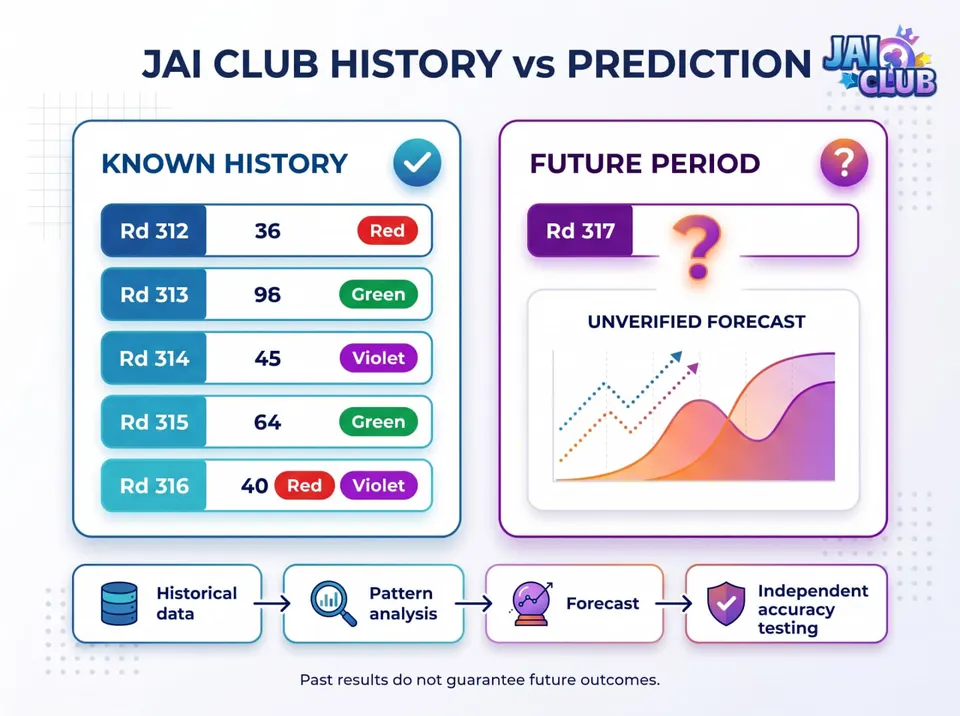
A WinGo prediction chart is generally a table or visualisation used to examine round data or display forecasts.
The term can refer to different things.
Historical Result Chart
Shows completed rounds and recorded outcomes.
Frequency Chart
Shows how often each category appears within a selected sample.
Trend Chart
Visualises changes across historical observations.
Prediction Signal Chart
Displays forecasts or recommendations generated by an external source.
These chart types should not be confused.
A history chart reports outcomes that have already occurred.
A prediction chart claims something about outcomes that have not yet occurred.
WinGo Prediction Formula: Is There a Reliable Calculation?
Some websites publish formulas that use period digits, previous results, or arithmetic operations to generate predictions.
Such formulas can always produce a number or colour label.
But producing an output does not prove that the calculation is predictive.
An Illustrative Formula
Suppose someone proposes taking the final digit of a period number and adding the previous result.
The calculation may look systematic.
However, unless the inputs have a demonstrated relationship with the future outcome, the formula has no established forecasting power.
Why Back-Testing Matters
A proposed formula should be tested against a separate set of future results.
Testing only on the historical data used to design the formula can be misleading.
Why Transparent Results Matter
A trustworthy accuracy claim should disclose:
- How predictions were generated
- Which periods were predicted
- When each prediction was recorded
- How many predictions were evaluated
- Which predictions were incorrect
- Whether the evaluation used unseen outcomes
Without these details, an accuracy percentage is difficult to interpret.
WinGo Prediction Accuracy: How Should It Be Measured?
Prediction accuracy generally means the proportion of evaluated forecasts that were correct under a clearly defined scoring rule.
A simple calculation is:
Accuracy = Correct predictions / Total predictions × 100
Imagine a hypothetical test containing 100 recorded forecasts.
If 48 forecasts are correct, the observed accuracy is 48%.
However, this percentage alone does not establish whether the method is effective.
Why the Baseline Matters
A forecast should be compared with an appropriate baseline.
If an outcome has two equally likely categories, a naive baseline may be around 50%.
But real classification probabilities may differ, especially if outcomes are not divided into equal groups.
The correct baseline depends on the verified rules and probabilities.
Why Small Samples Can Mislead
A prediction method may appear unusually successful over a short run by chance.
A much larger independent sample may produce different results.
Why Selective Screenshots Are Weak Evidence
A collection of correct predictions does not show how many incorrect predictions were omitted.
Full prediction logs are more meaningful than selected screenshots.
WinGo Prediction Today: What Does the Search Mean?
People searching for "wingo prediction today" are often looking for an up-to-date forecast or a recent prediction chart.
The word today makes the query time-sensitive.
However, a page containing today's date does not prove that its predictions are reliable.
A forecast should have a timestamp recorded before the outcome became available.
Otherwise, it may be impossible to distinguish a genuine earlier forecast from a result posted afterwards.
What Should a Prediction Record Contain?
A proper record should include:
- Game mode
- Exact period ID
- Prediction timestamp
- Predicted category or number
- Actual completed result
- Correct or incorrect status
Historical observations should be clearly separated from forecasts.
WinGo 30 Second Prediction vs 1 Minute Prediction
Different WinGo modes may operate on different round intervals.
For example, a 30-second mode and a 1-minute mode produce results on different schedules.
That does not automatically mean that one mode is easier to predict.
More Frequent Rounds Do Not Prove Better Forecasting
A shorter round interval creates more observations over a given amount of time.
It does not establish a predictable pattern.
Never Mix Period Histories
Prediction records should belong to the same verified game and mode.
A forecast associated with one mode should not be evaluated using another mode's results.
Can WinGo Period Numbers Predict Results?
A period number identifies a round.
It is primarily a reference used to associate information with that round.
The number may contain digits that resemble a date or sequence.
However, this does not prove that those digits encode the upcoming result.
For a more detailed explanation, see our WinGo period and result history guide.
Does WinGo History Help With Prediction?
Result history can help with record analysis.
It allows readers to examine past outcomes and check whether a claimed forecast corresponds to the correct period.
However, historical records do not automatically predict future events.
Our Jai Club WinGo Results History article explains how to understand round history without confusing it with future results.
What History Can Show
Historical records can show:
- Previous results
- Period identifiers
- Recorded colour classifications
- Ordering of completed rounds
- Historical frequencies
What History Cannot Establish Alone
Historical data alone cannot establish:
- A guaranteed next number
- A guaranteed next colour
- A secret winning formula
- Whether an unrelated prediction app has special access
- That a particular outcome is due
WinGo AI Prediction: Does Artificial Intelligence Make It Accurate?
AI systems can analyse numerical data, detect associations and generate forecasts.
However, the presence of AI does not automatically make an outcome predictable.
If the underlying process does not provide usable predictive information, a sophisticated model cannot create reliable signals from nothing.
AI Models Can Overfit
A model may learn patterns specific to one historical dataset.
Those patterns may not continue in future rounds.
Real Testing Requires Unseen Data
A meaningful test evaluates predictions on data that was not used to create or tune the model.
AI Accuracy Claims Need Evidence
Claims such as 95% or 99% accurate should be supported by transparent, independently testable records.
An AI label is not evidence by itself.
Common WinGo Prediction Mistakes
Mistake 1: Treating a Streak as a Rule
A repeated sequence does not prove the next outcome.
Mistake 2: Assuming a Missing Colour Must Appear
An outcome is not automatically due.
Mistake 3: Believing Every Prediction Formula
A formula can generate an answer without having forecasting value.
Mistake 4: Mixing Game Modes
Different round modes may have separate histories.
Mistake 5: Trusting Selected Winning Screenshots
A few correct forecasts do not establish long-term accuracy.
Mistake 6: Confusing Period IDs With Results
Identifiers label rounds rather than determine outcomes.
Mistake 7: Trusting Claims Without Timestamps
A prediction published after the actual result is not a genuine advance forecast.
How to Evaluate a WinGo Prediction Claim
A practical evaluation should follow a transparent sequence.
- Identify the exact game and mode.
- Record the claimed prediction method.
- Confirm that each forecast was recorded before its result.
- Match the full period IDs.
- Include incorrect predictions.
- Calculate observed accuracy.
- Compare the results with an appropriate baseline.
- Check whether the test used independent data.
- Avoid drawing conclusions from a small sample.
- Reject guaranteed-outcome claims lacking verifiable evidence.
This process evaluates a claim rather than offering a prediction method.
Frequently Asked Questions
1. What is WinGo prediction?
It is an attempt to forecast a future WinGo outcome using historical data, patterns, formulas or other claimed methods.
2. Can WinGo numbers be predicted accurately?
A reliable method cannot be established without evidence about the outcome process and independent testing.
3. Does a WinGo prediction chart show future results?
Not necessarily. Many charts display historical data rather than verified future forecasts.
4. Is WinGo colour prediction guaranteed?
No reliable guarantee follows from historical colours or simple pattern analysis.
5. Can Big Small patterns predict the next round?
A historical sequence alone does not establish a dependable next-round forecast.
6. Is there a WinGo prediction formula?
Various formulas are promoted online, but a calculation is not proof of predictive accuracy.
7. Can AI predict WinGo results?
AI can generate forecasts, but its accuracy depends on whether meaningful predictive information exists.
8. What does WinGo prediction today mean?
It normally refers to a forecast claimed to be relevant to the current day's rounds.
9. Can period IDs reveal future numbers?
Not without reliable evidence that the numbering system contains such information.
10. How can prediction accuracy be checked?
Use complete, timestamped forecasts and matching completed results, then evaluate them against a relevant baseline.
11. Is a 30-second mode more predictable than a 1-minute mode?
A shorter interval does not, by itself, imply better predictability.
12. Why do some prediction charts appear accurate?
Short samples, selective reporting, chance variation and retrospective explanations can make a method look more accurate than it is.
Final Thoughts
WinGo prediction is a broad term covering colour forecasts, number analysis, Big Small patterns, trend charts and formula-based methods.
Historical data can explain previous results and help verify prediction claims.
However, past outcomes do not automatically establish future outcomes, and a claimed forecasting system needs independent evidence before its accuracy can be trusted.
A useful WinGo prediction guide should distinguish historical analysis from genuine forecasting.
For additional information about period numbers, results and game timing, explore our WinGo guides.
Understanding the difference between recorded facts and unverified predictions is more useful than relying on promises of guaranteed results.