Big vs Small in WinGo, K3 and 5D: Number Ranges Compared
Compare Big and Small rules in WinGo, K3 and 5D Lottery. Understand number ranges, three-dice totals, five-digit positions, SUM calculations and important exceptions.
In this article
- What Does Big and Small Mean in Number Games?
- Big and Small Do Not Have Universal Number Ranges
- Big vs Small: WinGo, K3 and 5D Comparison Chart
- WinGo Big and Small Explained
- WinGo Small Numbers
- WinGo Big Numbers
- WinGo Big and Small Number Chart
- Example: WinGo Result 3
- Example: WinGo Result 7
- Is Zero Small in WinGo?
- Is Five Big in WinGo?
- K3 Big and Small Explained
- K3 Small Numbers
- K3 Big Numbers
- Why Are K3 Triple Results Different?
- Example: Triple 4-4-4
- Example: Non-Triple 3-4-5
- Why the Exception Matters
- K3 Probability: Are Big and Small Equally Likely?
- Does Big Have a Higher Chance Than Small?
- 5D Lottery Big and Small Explained
- 1. Individual Position Big and Small
- 2. SUM Big and Small
- 5D Example: Five Digits and Their SUM
- Does Having Two Big Digits Make SUM Big?
- Can Every Position Be Big While SUM Is Small?
- Can Some Positions Be Small While SUM Is Big?
- Why Are 22 and 23 Important in 5D?
- Example: SUM 22
- Example: SUM 23
- WinGo Big vs K3 Big vs 5D Big
- WinGo Big
- K3 Big
- 5D Position Big
- 5D SUM Big
- Worked Comparison
- Are Big and Small the Same as Odd and Even?
- Example: WinGo Number 8
- Example: WinGo Number 7
- Example: 5D SUM 22
- Example: 5D SUM 23
- How to Read Big and Small in Result History
- Step 1: Identify the Game
- Step 2: Identify the Evaluated Value
- Step 3: Apply the Relevant Classification
- Step 4: Check Special Exceptions
- Step 5: Match the Period ID
- Does Big and Small Have the Same Probability in Every Game?
- WinGo
- K3
- 5D Position
- 5D SUM
- Important Limitation
- Can Big and Small History Predict the Next Result?
- Does Five Big Results Mean Small Is Due?
- Can a Formula Predict Big and Small?
- Are Big and Small Results More Predictable Than Exact Numbers?
- Common Big and Small Mistakes
- Mistake 1: Using WinGo Ranges for K3
- Mistake 2: Ignoring K3 Triple Exceptions
- Mistake 3: Treating the 5D Five-Digit Number as SUM
- Mistake 4: Confusing 5D Position With SUM
- Mistake 5: Mixing Big and Small With Odd and Even
- Mistake 6: Assuming Common Ranges Are Universal Rules
- Mistake 7: Treating a 50% Theoretical Probability as a Guaranteed Return
- Frequently Asked Questions
- 1. What does Big and Small mean in number games?
- 2. What numbers are Small in WinGo?
- 3. What numbers are Big in WinGo?
- 4. Is 0 Small in WinGo?
- 5. What is Big in K3 Lottery?
- 6. What is Small in K3 Lottery?
- 7. What happens if all three K3 dice match?
- 8. What does Big mean in a 5D position?
- 9. What does Small mean in a 5D position?
- 10. What is Big SUM in 5D?
- 11. What is Small SUM in 5D?
- 12. Is 22 Big or Small in 5D?
- 13. Is 23 Big or Small in 5D?
- 14. Is Big and Small the same as Odd and Even?
- 15. Can Big and Small results be predicted from previous rounds?
- 16. Are Big and Small rules identical across every Jai Club game?
- Final Thoughts
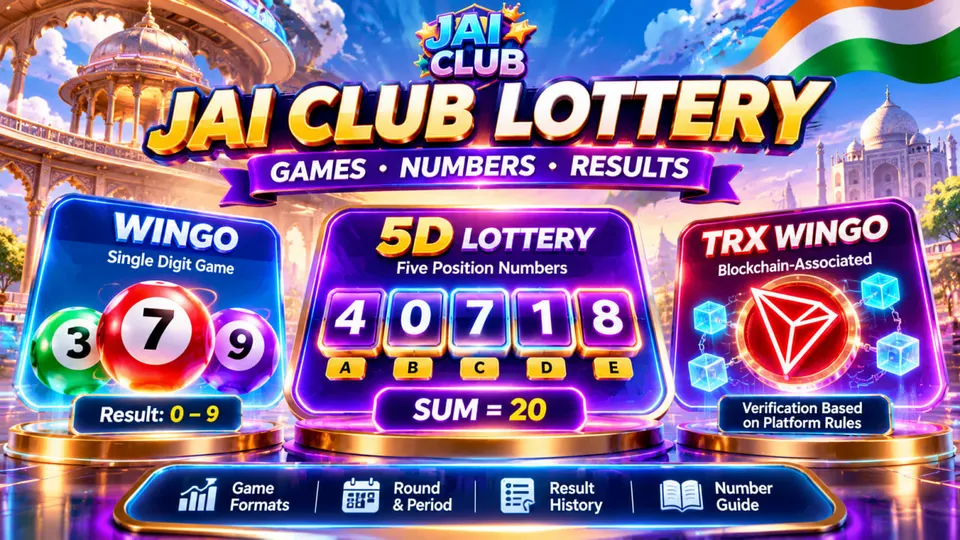
The terms Big and Small appear in several online number games, including WinGo, K3 Lottery and 5D Lottery.
At first glance, these categories seem simple. Big refers to larger numbers, while Small refers to smaller numbers.
However, the exact meaning changes depending on the game.
In WinGo, Big and Small are commonly determined by a single result digit from 0 to 9.
In K3, the classification is based on the combined total of three dice, with special exceptions in some implementations.
In 5D, the classification can refer to an individual digit in positions A, B, C, D or E, or the combined SUM of all five digits.
This guide explains the differences with practical examples, number charts and important rule exceptions.
It covers common game formats discussed by readers in India. The exact rules and settlement conditions of a particular gaming service should always be checked independently.
What Does Big and Small Mean in Number Games?
Big and Small are labels used to divide a set of possible numerical results into two groups.
The classification depends on which value the game evaluates.
For example, a game involving a single digit from 0 to 9 may classify 0–4 as Small and 5–9 as Big.
A three-dice game has a different possible range.
A five-digit game can have different classifications for individual positions and their sum.
Therefore, the correct question is not simply "What number is Big?"
It is:
"Which game's result is being classified?"
Big and Small Do Not Have Universal Number Ranges
A number that counts as Big in one format may count as Small in another.
For example:
WinGo result 8: Big
K3 dice total 8: Small under a common classification
5D SUM 8: Small under a common classification
The number is the same, but its meaning depends on the game's result structure.
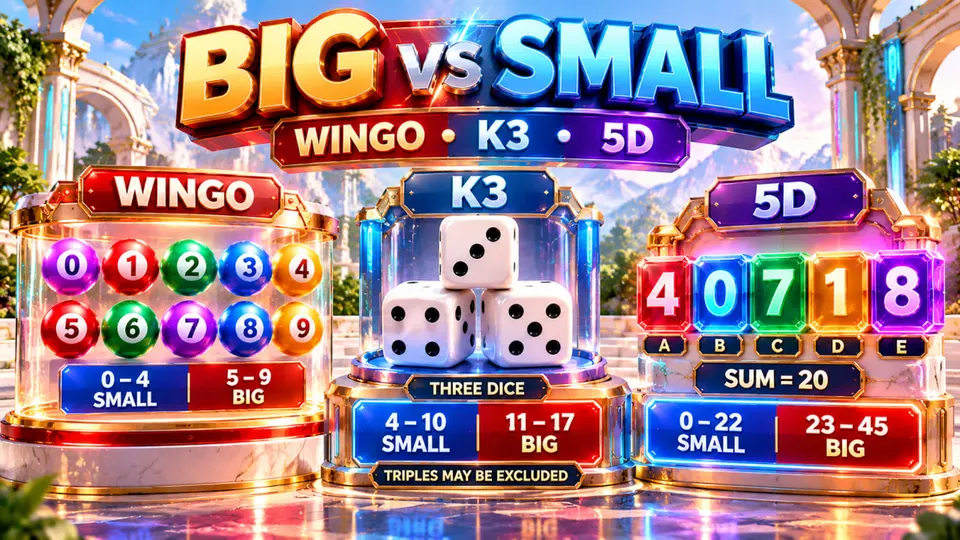
Big vs Small: WinGo, K3 and 5D Comparison Chart
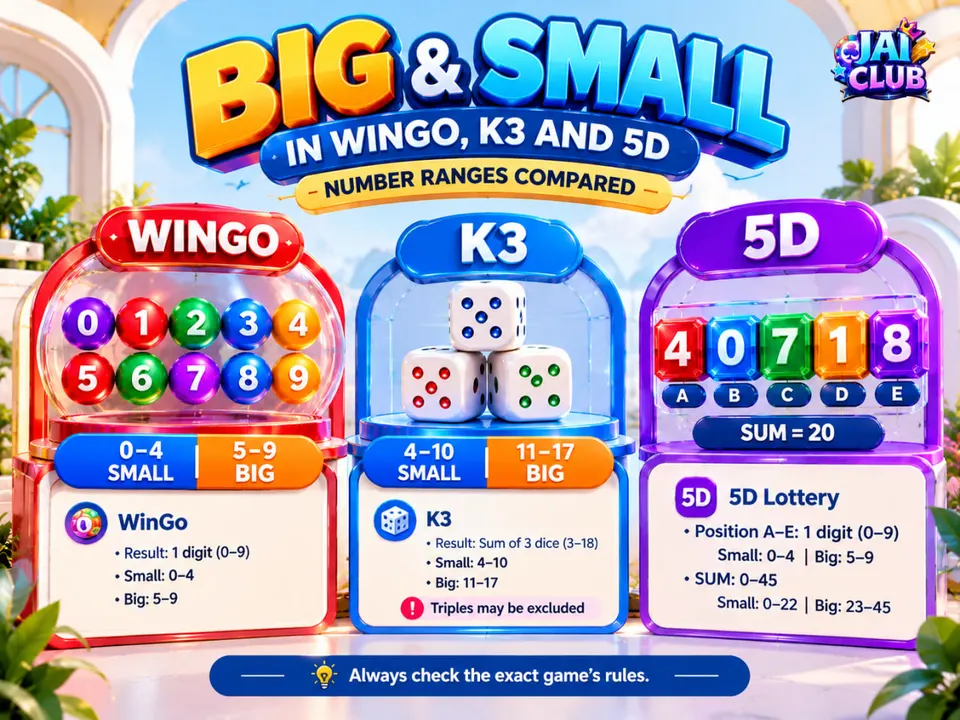
The following table summarises commonly described classifications.
| Game | Value Evaluated | Small | Big |
|---|---|---|---|
| WinGo | One result digit | 0–4 | 5–9 |
| K3 | Sum of three dice | 4–10 | 11–17 |
| 5D Position | One digit at A, B, C, D or E | 0–4 | 5–9 |
| 5D SUM | Sum of five digits | 0–22 | 23–45 |
Important notes:
For K3, the table shows a common settlement convention in which triple outcomes are excluded from ordinary Big and Small. The arithmetic total itself can range from 3 to 18.
Some guides use the broader arithmetic labels Small 3–10 and Big 11–18, but game-specific settlement rules may treat totals 3 and 18, or all triples, as exceptions.
The 5D categories are based on commonly described A–E and SUM rules.
Do not assume that every independently operated game follows exactly the same conditions.
WinGo Big and Small Explained
WinGo is a round-based number game commonly associated with a result digit between 0 and 9.
In a widely used WinGo classification, the possible results are divided into two groups.
WinGo Small Numbers
Small includes:
0, 1, 2, 3 and 4.
WinGo Big Numbers
Big includes:
5, 6, 7, 8 and 9.
WinGo Big and Small Number Chart
| Result | Classification |
|---|---|
| 0 | Small |
| 1 | Small |
| 2 | Small |
| 3 | Small |
| 4 | Small |
| 5 | Big |
| 6 | Big |
| 7 | Big |
| 8 | Big |
| 9 | Big |
Example: WinGo Result 3
A completed round displays the result number 3.
Since 3 belongs to the range 0–4, it is classified as Small.
Example: WinGo Result 7
A completed round displays the result number 7.
Since 7 belongs to the range 5–9, it is classified as Big.
Is Zero Small in WinGo?
Yes, under the common 0–4 classification.
Zero is a valid digit and belongs to Small.
Is Five Big in WinGo?
Yes, under the common 5–9 classification.
The dividing line is between 4 and 5.
For more background on number categories and completed periods, read our WinGo guide.
K3 Big and Small Explained
K3 is different from WinGo because the result is based on three dice.
Each standard die has six faces, numbered 1 through 6.
The three values are added together.
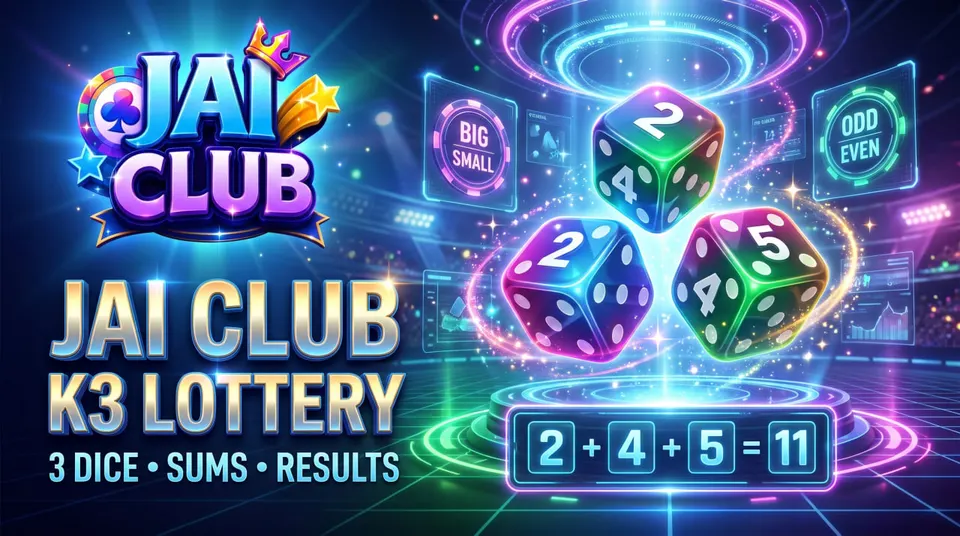
For example:
Die 1 = 2
Die 2 = 4
Die 3 = 5
Total = 2 + 4 + 5 = 11
The smallest possible sum is 3.
The largest possible sum is 18.
K3 Small Numbers
In a common K3 settlement format, the qualifying non-triple totals for Small are:
4, 5, 6, 7, 8, 9 and 10.
K3 Big Numbers
The qualifying non-triple totals for Big are:
11, 12, 13, 14, 15, 16 and 17.
However, there is an important exception involving matching dice.
Why Are K3 Triple Results Different?
Some K3 implementations exclude triple outcomes from ordinary Big and Small settlement.
A triple occurs when all three dice show the same number.
Examples include:
1 + 1 + 1 = 3
2 + 2 + 2 = 6
3 + 3 + 3 = 9
4 + 4 + 4 = 12
5 + 5 + 5 = 15
6 + 6 + 6 = 18
Although their sums can be classified mathematically, their settlement may follow special game rules.
Example: Triple 4-4-4
The dice show:
4, 4, 4
Their sum is:
12
A total of 12 is mathematically in the Big range of 11–18.
However, if the game's rules exclude triples from Big and Small awards, this result does not qualify for the ordinary Big category.
Example: Non-Triple 3-4-5
The dice show:
3, 4, 5
The sum is:
12
This is not a triple.
Under the common settlement convention, it qualifies as Big.
Why the Exception Matters
Two K3 rounds can have the same total but different dice patterns.
The exact dice values may therefore matter, not just the sum.
This is one major difference between K3 and WinGo.
For a detailed introduction, read our K3 Lottery guide.
K3 Probability: Are Big and Small Equally Likely?
Under the mathematical model of three independent fair six-sided dice, there are:
6 × 6 × 6 = 216
possible ordered outcomes.
Exactly half have sums from 3 to 10, and half have sums from 11 to 18.
That is:
108 outcomes in each arithmetic group.
However, the common triple-exclusion settlement rule removes three triple outcomes from each group.
This leaves:
105 qualifying outcomes for Small
105 qualifying outcomes for Big
6 excluded triple outcomes in total
The probability of a qualifying Big or Small result is therefore:
105 / 216 = approximately 48.61%
This applies only to the specified fair-dice model and triple-exclusion rule.
It is not a verified probability for every online K3 implementation.
Does Big Have a Higher Chance Than Small?
Under the symmetric model above, no.
Both categories have the same number of qualifying ordered outcomes.
However, equal qualifying probabilities do not imply equal payouts or a fair return.
Settlement terms must be checked separately.
5D Lottery Big and Small Explained
5D uses five positions:
A, B, C, D and E.
Each position contains a digit from 0 through 9.
The game may also show SUM, which is calculated by adding all five digits.
This creates two distinct ways to interpret Big and Small.
1. Individual Position Big and Small
For positions A, B, C, D and E, a common classification is:
Small = 0–4
Big = 5–9
This is the same numerical division commonly used for WinGo.
2. SUM Big and Small
The combined SUM has a larger range.
Its minimum is:
0 + 0 + 0 + 0 + 0 = 0
Its maximum is:
9 + 9 + 9 + 9 + 9 = 45
In a common 5D format:
Small SUM = 0–22
Big SUM = 23–45
The distinction between position and SUM is essential.
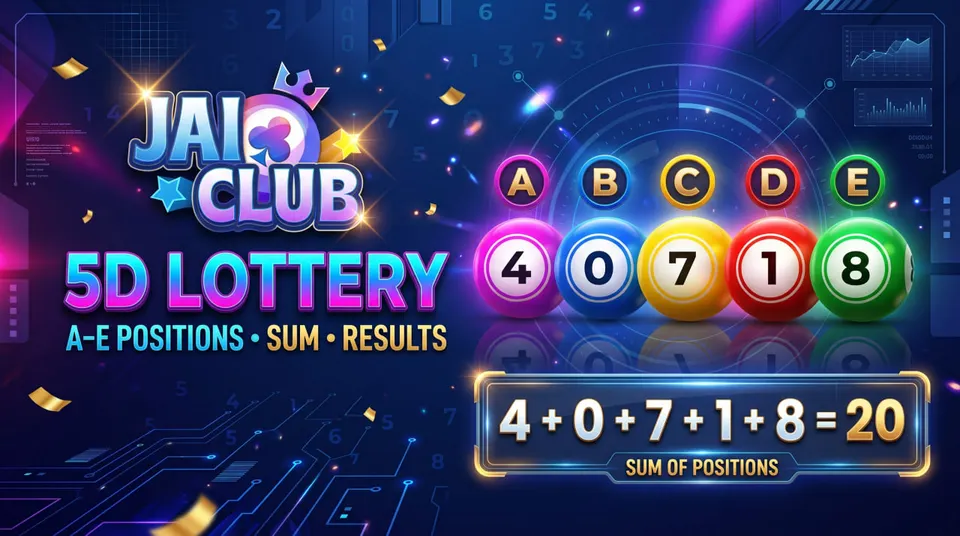
5D Example: Five Digits and Their SUM
Consider the following fictional result:
A = 4
B = 0
C = 7
D = 1
E = 8
The displayed five-digit sequence is:
40718
Its classifications are:
| Position | Digit | Big or Small |
|---|---|---|
| A | 4 | Small |
| B | 0 | Small |
| C | 7 | Big |
| D | 1 | Small |
| E | 8 | Big |
Now calculate SUM:
4 + 0 + 7 + 1 + 8 = 20
SUM is 20.
Under the common 5D SUM classification, 20 is Small.
Does Having Two Big Digits Make SUM Big?
No.
The number of individual Big positions does not directly determine the SUM category.
The actual total must be calculated.
Can Every Position Be Big While SUM Is Small?
No, under the standard ranges.
If all five positions are Big, each contains at least 5.
The minimum SUM would therefore be:
5 + 5 + 5 + 5 + 5 = 25
Since 25 exceeds 22, SUM would be Big.
Can Some Positions Be Small While SUM Is Big?
Yes.
For example:
2 + 7 + 4 + 8 + 6 = 27
Two positions are Small, but the SUM is Big.
The combined total and individual categories describe different information.
Why Are 22 and 23 Important in 5D?
The SUM range extends from 0 through 45.
The midpoint falls between 22 and 23.
Under the commonly described grouping:
22 is Small.
23 is Big.
Example: SUM 22
A = 4
B = 5
C = 3
D = 6
E = 4
SUM = 22
Classification: Small
Example: SUM 23
A = 4
B = 5
C = 3
D = 6
E = 5
SUM = 23
Classification: Big
A change of one digit has moved the result across the category boundary.
For more examples of A–E positions and SUM calculations, read our 5D Lottery guide.
WinGo Big vs K3 Big vs 5D Big
The term Big refers to different values in each format.
WinGo Big
The individual result digit belongs to 5–9.
K3 Big
The three-dice total belongs to the qualifying upper range, subject to the game's triple conditions.
5D Position Big
The selected position contains a digit from 5–9.
5D SUM Big
The total of all five digits belongs to 23–45.
Worked Comparison
Consider the number 8.
WinGo result 8:
Big.
K3 dice total 8:
Small, assuming a non-triple result under the common settlement rules.
5D position A = 8:
Big.
5D SUM = 8:
Small.
This explains why readers should not use a Big and Small chart from one game to interpret another.
Are Big and Small the Same as Odd and Even?
No.
Big and Small describe which numerical range contains the result.
Odd and Even describe whether the number is divisible by 2.
Both classifications may apply to the same result.
Example: WinGo Number 8
8 is Big.
8 is also Even.
Example: WinGo Number 7
7 is Big.
7 is also Odd.
Example: 5D SUM 22
22 is Small.
22 is also Even.
Example: 5D SUM 23
23 is Big.
23 is also Odd.
A result can therefore have two separate labels without any contradiction.
How to Read Big and Small in Result History
When checking a history table, first identify the game format.
The same result label can mean different things.
Step 1: Identify the Game
Is the record from WinGo, K3 or 5D?
Step 2: Identify the Evaluated Value
For WinGo, read the result digit.
For K3, read the three dice and their total.
For 5D, identify whether the record refers to an individual position or SUM.
Step 3: Apply the Relevant Classification
Use the range defined by that game's rules.
Step 4: Check Special Exceptions
For K3, check whether the dice form a triple.
Step 5: Match the Period ID
Confirm that the result belongs to the correct completed round.
Do not compare unrelated history records or different game modes.
Does Big and Small Have the Same Probability in Every Game?
No universal probability can be assigned to every implementation.
The mathematical structure differs between games.
WinGo
If each result digit from 0 to 9 is independently and equally likely, Big and Small each contain five of the ten possible outcomes.
Each has a theoretical probability of 50%.
K3
With three independent fair dice and a triple-exclusion settlement rule, each category has 105 qualifying ordered outcomes out of 216.
That is approximately 48.61% for each.
5D Position
If each digit is independently and uniformly selected from 0 to 9, an individual position has a 50% theoretical probability of belonging to either range.
5D SUM
If all 100,000 five-digit sequences are equally likely, the symmetric SUM boundaries 0–22 and 23–45 divide the outcomes equally.
Each category has a theoretical probability of 50%.
Important Limitation
These figures are derived from mathematical assumptions.
They do not independently verify how any particular online gaming service generates its results.
Probability is also separate from payout and expected financial return.
Can Big and Small History Predict the Next Result?
Historical results can show previously recorded classifications.
However, past Big and Small sequences do not reliably establish the next outcome in an independent random process.
Does Five Big Results Mean Small Is Due?
No.
A streak does not guarantee a reversal.
Can a Formula Predict Big and Small?
A formula can generate a suggested label, but that does not establish future accuracy.
Claims about guaranteed predictions require credible evidence from independent testing.
Are Big and Small Results More Predictable Than Exact Numbers?
Grouping outcomes into two categories reduces the number of possible labels, but it does not automatically create a dependable prediction method.
A 50% theoretical classification should not be confused with a guaranteed financial return.
Common Big and Small Mistakes
Mistake 1: Using WinGo Ranges for K3
WinGo evaluates one digit, while K3 evaluates the sum of three dice.
Mistake 2: Ignoring K3 Triple Exceptions
Some K3 rules exclude triple results from ordinary Big and Small settlement.
Mistake 3: Treating the 5D Five-Digit Number as SUM
SUM is calculated by adding the five individual digits.
Mistake 4: Confusing 5D Position With SUM
A position uses the 0–9 range. SUM uses the 0–45 range.
Mistake 5: Mixing Big and Small With Odd and Even
They describe different mathematical properties.
Mistake 6: Assuming Common Ranges Are Universal Rules
Different services may implement different classifications and exceptions.
Mistake 7: Treating a 50% Theoretical Probability as a Guaranteed Return
Theoretical frequency does not establish settlement value or profitability.
Frequently Asked Questions
1. What does Big and Small mean in number games?
Big and Small are labels used to classify results into lower and upper numerical ranges.
2. What numbers are Small in WinGo?
Under the common rule, 0, 1, 2, 3 and 4 are Small.
3. What numbers are Big in WinGo?
Under the common rule, 5, 6, 7, 8 and 9 are Big.
4. Is 0 Small in WinGo?
Yes, under the usual 0–4 classification.
5. What is Big in K3 Lottery?
In a common settlement format, qualifying non-triple sums from 11 through 17 count as Big.
6. What is Small in K3 Lottery?
In a common settlement format, qualifying non-triple sums from 4 through 10 count as Small.
7. What happens if all three K3 dice match?
Some implementations exclude triples from ordinary Big and Small settlement, even when their sums fall within the normal mathematical ranges.
8. What does Big mean in a 5D position?
For an individual A–E position, Big commonly means a digit from 5 through 9.
9. What does Small mean in a 5D position?
For an individual A–E position, Small commonly means a digit from 0 through 4.
10. What is Big SUM in 5D?
Under the common rule, Big SUM includes totals from 23 through 45.
11. What is Small SUM in 5D?
Under the common rule, Small SUM includes totals from 0 through 22.
12. Is 22 Big or Small in 5D?
A SUM of 22 is Small under the common classification.
13. Is 23 Big or Small in 5D?
A SUM of 23 is Big under the common classification.
14. Is Big and Small the same as Odd and Even?
No. Big and Small refer to numerical ranges, while Odd and Even refer to divisibility by 2.
15. Can Big and Small results be predicted from previous rounds?
Past results do not provide a guaranteed method for predicting future outcomes.
16. Are Big and Small rules identical across every Jai Club game?
No. WinGo, K3 and 5D use different result structures, and exact settlement conditions may vary across implementations.
Final Thoughts
Big and Small may sound like universal gaming terms, but their meaning depends on the game being examined.
WinGo commonly divides the digits 0–9 into Small 0–4 and Big 5–9.
K3 uses the combined total of three dice and may apply special triple-exclusion rules.
5D uses either an individual position from A to E or the SUM of five digits, with different numerical boundaries.
The most important step is to identify the correct game and the value being classified before interpreting a completed result.
For additional explanations, explore our WinGo guides and Jai Club Lottery Games category.
This article is intended for general educational information and does not guarantee future outcomes or financial returns.