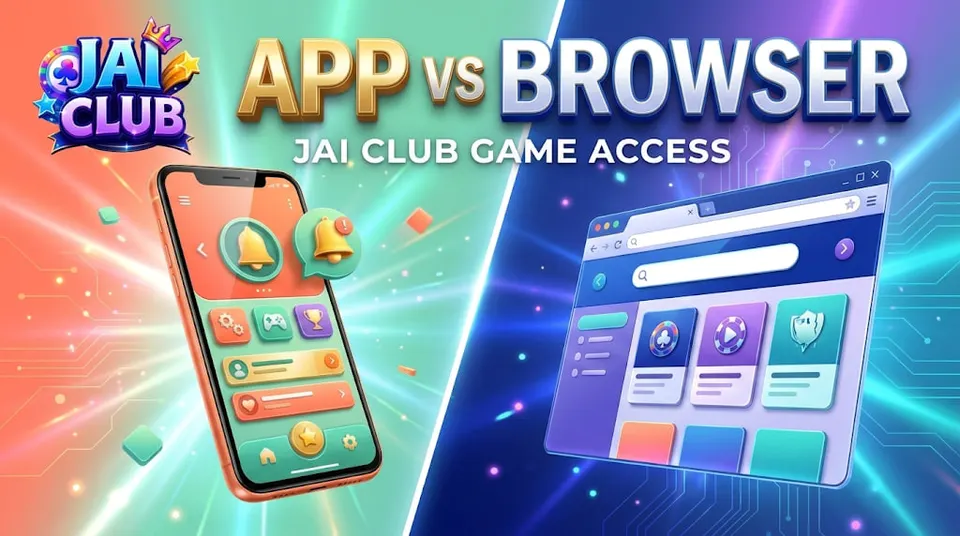
App vs Browser: Which Is Better for Jai Club Game Access?
Compare Jai Club app and browser access on Android and desktop, including installation, login sessions, updates, storage, notifications, security and common compatibility differences.
In this article
- What Is Jai Club App vs Browser Access?
- Jai Club App vs Mobile Website Comparison
- Jai Club Game on Chrome Without Installing an APK
- Android App Installation vs Browser Access
- Which Method Is Easier to Update?
- Browser Login Sessions vs App Login Sessions
- Saved Passwords and Autofill
- Jai Club App vs Browser on Android Phones
- App Access vs Browser Access on Windows PCs
- Which Is Better for Security?
- App Permissions vs Browser Permissions
- Does a Jai Club App Work Offline?
- What About Notifications?
- Why an App May Work While the Website Does Not
- Can a Web Shortcut Replace an APK?
- How to Choose Between App and Browser
- Frequently Asked Questions
- Is Jai Club app better than browser access?
- Can I access Jai Club through Chrome?
- Does Jai Club require an APK?
- Can I use Jai Club on a laptop?
- Are app login sessions shared with Chrome?
- Does a browser automatically have fewer security risks?
- Are APK updates different from website updates?
- Can a web shortcut replace a native app?
- Does jaiclub-game.com provide an official Jai Club app?
- Final Thoughts
Choosing between a Jai Club app and browser access depends on the device being used, the available software and the features supported by the particular service. Some users prefer opening a website directly through Chrome, while others are familiar with launching an installed Android application from their home screen.
The difference is not limited to convenience. A mobile website and an Android application can use different storage systems, update methods, login sessions and security permissions. They may also display different layouts even when they connect to a related online service.
This guide compares Jai Club app vs browser access across Android phones, Windows laptops and other supported devices. It explains installation requirements, password management, updates, notifications, compatibility and the limitations of assuming that every Jai Club-branded app belongs to the same operator.
What Is Jai Club App vs Browser Access?
The term Jai Club app vs browser describes two possible methods of accessing online information or account services. Browser access involves opening a website through software such as Google Chrome or Microsoft Edge, whereas app access involves an application installed on a device.
A browser can render an online service without requiring a separate APK. An Android application, on the other hand, may include its own interface, locally stored resources and integrations with device features.
The availability of either method depends on the particular service. The existence of a Jai Club website does not automatically establish that a corresponding official Android application exists for every operator using a similar name.
Jai Club App vs Mobile Website Comparison
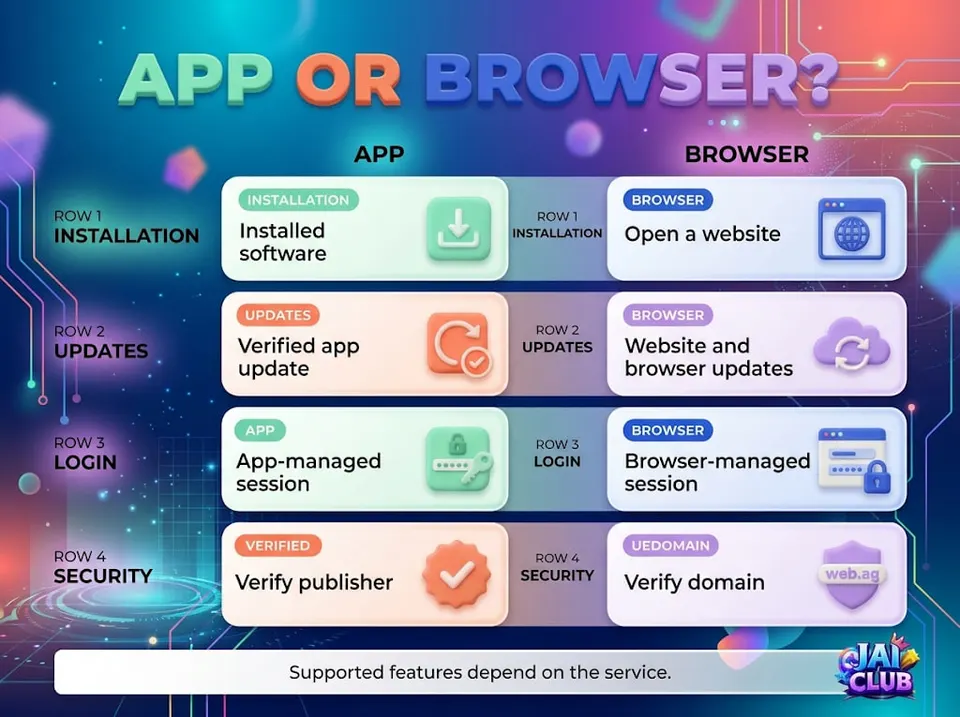
The easiest way to compare the two options is to examine how they handle access, updates and device-level functions. A website is normally accessed through a URL, while an application is launched from the installed software list.
| Feature | Android Application | Mobile Browser |
|---|---|---|
| Entry method | Installed app icon | Website address |
| Installation | Required | No separate service APK needed |
| Updates | Through verified app distribution | Browser and website updates |
| Password storage | Depends on the app | Browser or password manager |
| Login session | App-managed | Browser-managed |
| Permissions | May request device permissions | Browser/site permissions |
| Desktop use | Depends on available software | Often possible if website supports it |
| Notifications | May support app notifications | May support web notifications |
| Offline function | Depends on app design | Depends on web implementation |
This table describes technical differences rather than a verified feature list for one particular Jai Club application. Readers should confirm which functions are actually supported by their intended service.
Jai Club Game on Chrome Without Installing an APK
A user searching for Jai Club app without download may be looking for a browser-based alternative to installing an Android package. If the intended service provides a mobile website, Chrome can open that website directly.
Browser access can make it easier to review the full domain before entering account information. It also avoids installing a separate package simply to visit an online service. However, some websites may offer different features or layouts from their application versions.
For an explanation of Chrome-specific login settings, see our existing Jai Club Login on Chrome guide. That article focuses on browser cookies, saved passwords and sessions, while this comparison covers the broader differences between applications and websites.
Android App Installation vs Browser Access
Installing an Android application normally requires obtaining a compatible package from a trustworthy distribution source. The package has its own version information and signing identity, which can matter during updates.
Opening a website through a browser does not require installing the website's APK. The browser retrieves pages and resources from the relevant domain, subject to its own settings and the website's technical requirements.
These differences matter when an unfamiliar website promotes an APK as the only way to access ordinary information. Readers should verify that the software belongs to the intended publisher before installing it.
Our Jai Club APK Download guide explains Android installation concepts, package versions and source-verification considerations in greater detail.
Which Method Is Easier to Update?
Websites are generally updated on their servers, allowing new content or interface changes to appear when users visit the site. However, cached resources and browser compatibility can still affect what appears on a particular device.
Applications are updated through a software distribution process. The installed version may remain unchanged until a new build is installed or an update mechanism completes its work.
This does not mean that a browser is always more current or that an installed application is necessarily outdated. The service's technical design determines how quickly different interfaces receive changes.
Browser Login Sessions vs App Login Sessions
Both browsers and applications can maintain authenticated sessions, but they may store session-related information differently. A browser commonly uses cookies or other website storage, while an application may rely on its own local data and authentication mechanisms.
Because these environments are separate, being logged in through Chrome does not guarantee that an installed app is also logged in. The reverse is equally true.
A session may expire for reasons including inactivity, security changes or server-side authentication rules. A user should not assume that an expired session means the account has been deleted.
Saved Passwords and Autofill
Google Chrome can work with Google Password Manager to store credentials for supported websites. When a user returns to a matching domain, the browser may offer the saved information.
An Android application may use a different login interface or integrate with the device's credential-management system. Its behaviour depends on the app and operating system.
Saved credentials should always be associated with a verified service. An unfamiliar page that resembles a known login screen may still be operated by another party, and autofill convenience is not proof that a website is authentic.
Jai Club App vs Browser on Android Phones
Android phones support multiple browsers and may also run compatible installed applications. In both environments, the user experience can depend on available memory, operating-system version and network conditions.
A mobile website may use responsive design to adapt its layout to a narrow screen. An application may have interface elements tailored specifically to Android, but there is no guarantee that it will be faster or more stable in every situation.
A comparison should therefore focus on the behaviour of the actual service rather than assuming that an app always performs better than Chrome. Different devices can produce different results, especially when older software or unstable connections are involved.
App Access vs Browser Access on Windows PCs
A Windows laptop or desktop commonly supports browser access through Chrome, Edge or Firefox. If the relevant service offers a compatible website, a browser may be sufficient without needing an Android application.
Android APK files do not run as ordinary Windows programmes by default. Specialised compatibility environments may exist, but they are not automatically necessary or appropriate for a browser-supported service.
The most useful starting point is to determine whether the service has a verified desktop website. Installing unknown APK packages or unofficial desktop launchers should not be treated as a normal requirement.
Which Is Better for Security?
Neither method is universally safer in all circumstances. Browser security depends on factors such as the authenticity of the website, software updates and account protection. Application security depends on the software's publisher, package integrity, permissions and update source.
A trustworthy application can offer a secure experience, while a fraudulent application can create serious risks. Similarly, a browser can help users inspect the domain but cannot make a malicious website legitimate.
Our Jai Club APK Safety guide explains suspicious download sources, permission requests and app authenticity checks.
App Permissions vs Browser Permissions
Installed Android applications may request access to notifications, storage, camera functions or other device capabilities, depending on their legitimate purpose. Browsers can also request site-specific permissions, but these are managed through a different interface.
The correct question is whether each requested permission is necessary for the service's stated function. A game-information website generally does not need access to private SMS messages or unrelated account credentials.
Readers should review permissions rather than automatically approving them because an interface uses familiar branding. Requests for OTPs or passwords from unknown support contacts should also be treated cautiously.
Does a Jai Club App Work Offline?
An application can contain locally stored resources, but that does not mean an online account service or live game will work without internet access. Many applications require connectivity for authentication, account information and result updates.
A browser also normally requires a connection to retrieve current website data, although certain websites can cache limited content for offline access.
Offline compatibility depends on the actual implementation. Readers should not assume that a previously loaded game screen contains current information when the device is disconnected.
What About Notifications?
Applications may use Android's notification system to display alerts when permission has been granted. Websites can also support web notifications under certain browser and operating-system conditions.
However, notification availability is not universal. A particular Jai Club-related service may not provide the same notification options through both interfaces.
Users should not interpret a missing notification as proof that an account event never occurred. The relevant authenticated account record is more important than whether a device displayed an alert.
Why an App May Work While the Website Does Not
Different access methods can encounter different technical problems. A website might fail because of DNS, browser storage or network restrictions, while an application could continue functioning through a different configuration.
The opposite can also occur. An installed application may crash because of compatibility problems, damaged local files or outdated resources while the website remains accessible.
These differences do not establish that one method is universally more reliable. Our existing Jai Club App Not Opening guide covers Android crashes, cache problems and other application-specific symptoms.
Can a Web Shortcut Replace an APK?
A web shortcut is an icon that opens a particular website through a browser or supported web-app interface. It can make a familiar website easier to revisit without necessarily installing a native Android application.
A Progressive Web App, or PWA, may provide additional web-based features when the website supports them. However, adding a shortcut does not automatically create a genuine native app.
Readers should distinguish a browser shortcut from an APK, as the two have different installation, update and permission models.
How to Choose Between App and Browser
The appropriate method depends on the user's actual requirements. Someone interested in reading game guides may only need a normal browser, while an operator-specific function could require a supported application.
The most important factors are whether the intended service is authentic, whether the access method is officially supported and whether the device can use it safely.
Neither option should be selected solely because an advertisement promises faster results or special privileges. Such claims should be supported by verifiable technical information.
Frequently Asked Questions
Is Jai Club app better than browser access?
Neither method is universally better. The answer depends on the service's supported features, device compatibility and user requirements.
Can I access Jai Club through Chrome?
A compatible website can be accessed through Chrome. The particular service and domain must be verified.
Does Jai Club require an APK?
A separate APK is not necessary merely to open a normal website. Operator-specific application requirements may differ.
Can I use Jai Club on a laptop?
Browser access may be possible where the relevant website supports desktop devices.
Are app login sessions shared with Chrome?
Not necessarily. Applications and browsers may maintain separate sessions.
Does a browser automatically have fewer security risks?
No. A fraudulent website can still be dangerous, even when opened through an updated browser.
Are APK updates different from website updates?
Yes. Installed applications have their own update mechanisms, while websites commonly deliver content from the server.
Can a web shortcut replace a native app?
A shortcut can provide convenient browser access but does not necessarily include native application features.
Does jaiclub-game.com provide an official Jai Club app?
No. It is an independent educational website, not an official application distributor.
Final Thoughts
The difference between a Jai Club app and browser access involves installation, authentication, updates, local storage, device permissions and compatibility. Both methods can be useful in the right circumstances, but their features depend on the specific service rather than the brand name alone.
A verified mobile website may be sufficient for reading information or using supported online functions, while an installed application may provide a different interface or device integration. Users should consider authenticity and compatibility before choosing either method.
For further independent information about Android access, login and software safety, explore our App Help category.