Limbo by JILI: Rocket, Target Multiplier and Result Verification
Explore Limbo by JILI with its rocket theme, target multiplier system, bonus feature, 1000x advertised maximum and round verification. Understand how lower and higher multiplier targets differ.
In this article
- What Is Limbo by JILI?
- Limbo Game Specifications
- How a Target Multiplier Works
- Low Multiplier vs High Multiplier
- Why Higher Multipliers Are Less Likely
- Limbo Multiplier Calculation in Rupees
- Gross Return vs Net Profit
- The 1000x Maximum Win Explained
- What Is the Rocket Feature?
- Limbo Bonus Feature Explained
- Is Limbo the Same as Aviator?
- Limbo vs Other JILI Instant Games
- Does Choosing a Lower Target Guarantee Profit?
- Expected Value vs Winning Frequency
- Limbo RTP: What Can Be Verified?
- Fairness Verification in Limbo
- Fairness Verification vs Prediction
- How to Read Limbo Result History
- Are Previous Rocket Flights Useful for Forecasting?
- Is Limbo Available on Every Jai Club Platform?
- Common Mistakes When Reading Limbo
- Frequently Asked Questions
- What is Limbo by JILI?
- When was Limbo listed by JILI?
- What is the maximum advertised win?
- Does a lower multiplier have a higher chance?
- Does a higher multiplier guarantee a larger payout?
- What is the Limbo Bonus feature?
- Can Limbo results be verified?
- Is Limbo the same as Aviator?
- Can past Limbo results predict the next multiplier?
- Is Limbo confirmed on Jai Club?
- Conclusion
- Sources and Editorial Method
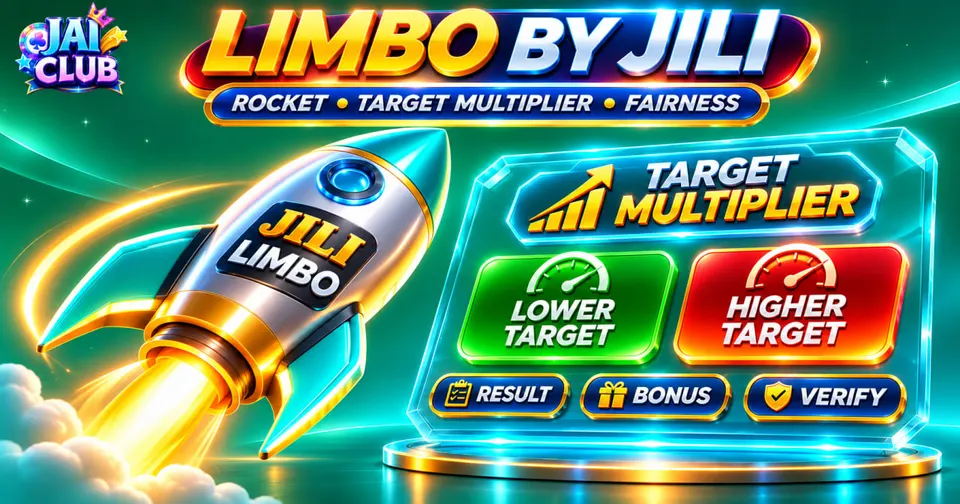
Limbo by JILI is a rocket-themed instant game built around target multipliers and the uncertainty of a completed round. JILI describes its central concept as a choice between lower multipliers, which are associated with a higher probability of reaching the target, and higher multipliers, which offer a larger possible return but are less likely to be reached.
The developer's catalogue lists a maximum advertised win of 1,000x, a Bonus feature and the ability to verify completed results. However, these features do not establish a guaranteed payout, a fixed winning sequence or a method for predicting the next round.
This guide explains Limbo's official specifications, the mathematical relationship between target multipliers and possible returns, the difference between Limbo and aircraft-style crash games, and why fairness verification is not the same as forecasting results. It also considers the terminology readers may encounter while researching Jai Club crash-style games.
What Is Limbo by JILI?
Limbo is a game developed by JILI Games and listed in its official catalogue with a May 2023 publication date.
The game's visual theme involves a rocket travelling through space. Its central interaction is based on choosing a target multiplier rather than matching conventional slot symbols along reels.
JILI's description emphasises that lower targets are associated with higher chances of a successful result, while higher targets are associated with larger potential awards.
The exact mathematical relationship depends on the game's underlying model.
A target multiplier is therefore best understood as a condition that a completed result must satisfy, not a guaranteed amount that will be returned.
Limbo Game Specifications
The following specifications are drawn from the official JILI product listing.
| Feature | JILI information |
|---|---|
| Game title | Limbo |
| Developer | JILI Games |
| Catalogue date | May 2023 |
| Visual concept | Space rocket |
| Main mechanic | Multiplier target |
| Advertised maximum win | 1,000x |
| Special feature | Bonus |
| Result verification | Advertised |
| Conventional paylines | Not listed |
| Verified universal RTP | Not established from product summary |
The official page currently displays a Casino category label. However, its rocket-and-multiplier design is commonly discussed alongside crash-style instant games.
That similarity does not mean every mechanic operates identically to other crash titles.
How a Target Multiplier Works
A target multiplier is a numerical level associated with an eligible game result.
In a typical Limbo-style model, the user selects a target and the game generates a round result. Whether the target is satisfied depends on the completed multiplier and the applicable rules.
For example, a hypothetical target of 2.00x would require the result to satisfy that threshold under the game's settlement conditions.
A target of 5.00x is more demanding because the completed result would need to reach a higher value.
The exact acceptance conditions, rounding rules and final award calculation must come from the relevant game.
Low Multiplier vs High Multiplier
JILI explicitly links lower targets with higher success probability and higher targets with larger possible returns.
The underlying trade-off is straightforward. A lower target is easier to satisfy in a conventional threshold-based model, while a higher target requires a less common result.
However, this does not mean a low target guarantees profit.
| Target level | General implication | What remains uncertain |
|---|---|---|
| Lower target | More likely to be reached | Individual round result |
| Moderate target | Intermediate risk profile | Exact probability |
| Higher target | Less likely to be reached | Whether target is met |
| Very high target | Larger possible gross return | Frequency and maximum conditions |
The table describes the general relationship, not exact JILI probabilities.
Without the complete mathematical model, a reliable winning percentage cannot be assigned to each multiplier.
Why Higher Multipliers Are Less Likely
In a threshold-based game, a higher target requires the result to satisfy a stricter condition.
For example, consider a hypothetical model in which a result has a certain chance of reaching 2.00x.
Any result that reaches 5.00x would also satisfy a lower 2.00x threshold under that same model, but not every result reaching 2.00x would reach 5.00x.
Therefore, the set of outcomes satisfying the higher target is contained within the set satisfying the lower one.
This explains the broad probability relationship without assuming one particular JILI algorithm.
It also explains why increasing the target multiplier cannot be treated as a free increase in financial return.
Limbo Multiplier Calculation in Rupees
Multiplier arithmetic can be illustrated with simple rupee examples.
Under a hypothetical stake-inclusive gross-return calculation:
Gross return = Stake × Multiplier
Net profit = Gross return − Stake
Consider a fictional ₹100 stake.
| Target multiplier | Gross return if eligible | Net profit if eligible |
|---|---|---|
| 1.20x | ₹120 | ₹20 |
| 1.50x | ₹150 | ₹50 |
| 2.00x | ₹200 | ₹100 |
| 5.00x | ₹500 | ₹400 |
| 10.00x | ₹1,000 | ₹900 |
These amounts apply only if the target is successfully satisfied and the illustrative gross-return calculation is appropriate.
They do not describe completed JILI rounds or establish how likely each target is to succeed.
The table also does not include any operator-specific fees or account restrictions.
Gross Return vs Net Profit
A multiplier can appear more impressive when its gross return is mistaken for profit.
For instance, if a fictional ₹100 entry produces a gross return of ₹200, the net profit is ₹100 rather than ₹200.
The original stake must be subtracted when the published amount includes it.
This distinction becomes especially important when reading histories or promotional material that emphasises large multipliers.
Readers should check how the actual game defines its return before applying a financial calculation.
The 1000x Maximum Win Explained
JILI lists a maximum advertised win of 1,000x for Limbo.
This is an upper possible award under qualifying game conditions, not the expected result of a normal round.
For a simple mathematical illustration, a 1,000x gross multiplier applied to 10 units produces 10,000 units.
However, that calculation does not establish the likelihood of reaching 1,000x.
The probability of the highest possible result requires the complete mathematical model, which is not supplied in the short public catalogue.
A maximum multiplier should not be treated as a realistic income target.
What Is the Rocket Feature?
JILI's description uses a rocket travelling through space to explain the game's visual identity.
The rocket helps communicate the idea of multiplier progression and increasingly ambitious targets.
However, the animation should not be treated as an independent technical measure of the result-generation algorithm.
The completed numerical result remains more important than estimating the rocket's flight from a screenshot.
Visual presentation and actual settlement are distinct parts of an online game.
A smooth animation does not prove that an award has been credited, and a short animation does not by itself establish an application malfunction.
Limbo Bonus Feature Explained
The official JILI listing identifies Bonus as a special feature.
However, the public summary does not provide a complete explanation of the Bonus trigger, eligibility conditions or probability.
It would therefore be inaccurate to claim that the Bonus appears after a fixed number of rounds.
Likewise, a guide should not invent a separate purchase price, award table or number of free rounds without reliable documentation.
The feature should be understood as an officially advertised part of the game whose details require the full in-game information screen.
Is Limbo the Same as Aviator?
Limbo and Aviator share a general multiplier-based gaming concept, but they are separate titles.
Aviator is developed by SPRIBE and uses an aircraft presentation involving a rising multiplier and cash-out before the round ends.
JILI Limbo uses a rocket theme and emphasises the selection of lower or higher multiplier targets.
| Feature | JILI Limbo | Aviator |
|---|---|---|
| Developer | JILI | SPRIBE |
| Main visual | Rocket | Aircraft |
| Multiplier concept | Yes | Yes |
| Target selection | Central advertised concept | Controls vary by game |
| Cash-out design | Follow Limbo rules | Aircraft-style cash-out |
| Identical algorithm? | Not established | Not established |
The exact rules should not be transferred from one game to another.
Our Aviator Crash Game guide explains aircraft-style multipliers for readers comparing the formats.
Limbo vs Other JILI Instant Games
JILI develops several instant games with different decision structures.
Mines uses hidden positions and hazards. HILO uses higher-or-lower card-related decisions. Other crash-style titles use a moving visual associated with a multiplier.
Limbo instead centres its public description on the relationship between chosen multiplier targets and possible results.
These designs should be evaluated using their own paytables and game rules.
A shared instant-game category does not establish the same probability model or settlement process.
For more background about these formats, read our Jai Club Crash Games overview.
Does Choosing a Lower Target Guarantee Profit?
No.
A lower target may be more likely to succeed within a conventional multiplier model, but the resulting gross return is smaller.
A sequence of successful low-target rounds can still be followed by unsuccessful results.
The presence of a relatively high success probability does not establish a positive long-run expected return.
The actual expectation depends on the probabilities, multiplier calculation and any relevant house advantage.
Those values should not be invented from the game's promotional description.
Expected Value vs Winning Frequency
Winning frequency describes how often a condition is satisfied.
Expected value describes the weighted average financial result across possible outcomes.
These are different concepts.
For example, a fictional event with a 70% success probability and a small return may still have a negative expected value depending on its payout rules.
Likewise, an event with a low success probability and a large return is not automatically favourable.
A proper expected-value calculation requires both the probability of each outcome and the amount returned.
The official Limbo catalogue does not provide enough information to calculate one verified expected value for every target.
Limbo RTP: What Can Be Verified?
RTP stands for Return to Player. It is a theoretical long-run return measure calculated from the game's mathematical model.
A published maximum win of 1,000x does not establish RTP.
The number of previous successful rounds also cannot be used to derive a trustworthy RTP without a sufficiently documented data source and model.
JILI's accessible Limbo product summary does not provide one verified universal RTP percentage.
Readers should therefore avoid treating unsourced RTP claims from unrelated websites as official figures.
Fairness Verification in Limbo
JILI states that the result of each round can be verified.
This is an important advertised feature, but a meaningful technical verification requires the relevant algorithm and supporting information.
A user should be able to understand which round is being checked, which values are used and how the recorded outcome is reproduced under the applicable rules.
The short official page does not provide the complete verification procedure.
Therefore, this article does not claim that live Limbo rounds have been independently audited.
Fairness Verification vs Prediction
Verification is concerned with checking an outcome under a documented process.
Prediction is concerned with attempting to know the outcome before it occurs.
These are different activities.
A result-verification system does not automatically reveal the next multiplier.
Claims that a special panel, modified APK or secret script can guarantee Limbo results require evidence beyond a promotional fairness statement.
The existence of a verification feature should not be used as proof of a prediction method.
How to Read Limbo Result History
A result-history table, where provided, can help identify previously completed multipliers.
For example, a fictional history might contain 1.12x, 2.40x, 1.08x and 5.20x.
These figures describe completed events.
They do not prove that a higher or lower value must appear next.
A history list should also be distinguished from an account transaction record.
The completed game result and the settlement of an individual entry can contain different information.
Are Previous Rocket Flights Useful for Forecasting?
Previous rocket animations may be useful for understanding how the game presents results.
However, their appearance does not establish a dependable future sequence.
An unusually high multiplier does not prove that the next round must end early.
Similarly, several lower multipliers do not establish that a large result is due.
Without evidence of a predictable result-generation mechanism, historical patterns should not be presented as guaranteed forecasts.
Is Limbo Available on Every Jai Club Platform?
JILI's official catalogue confirms that Limbo exists as a game developed by JILI.
However, that does not establish its availability in every Jai Club-related operator's lobby.
Game catalogues can differ between operators and supported markets.
A reader should verify the exact provider and title before applying an explanation to a particular game screen.
This guide is independent educational content rather than an official availability announcement.
Common Mistakes When Reading Limbo
One mistake is assuming that a higher target provides a better financial result simply because its possible gross payout is larger.
Another is confusing the advertised 1,000x maximum with a normal outcome.
Readers may also assume that the rocket animation predicts the completed multiplier.
A fourth misunderstanding is treating fairness verification as a way to know future results.
The correct approach is to separate game presentation, multiplier rules, probabilities and recorded settlement.
Frequently Asked Questions
What is Limbo by JILI?
It is a rocket-themed instant game involving multiplier targets and completed round results.
When was Limbo listed by JILI?
The official catalogue lists May 2023.
What is the maximum advertised win?
JILI lists 1,000x.
Does a lower multiplier have a higher chance?
JILI describes lower targets as having a higher probability of success, but exact probabilities require the full game model.
Does a higher multiplier guarantee a larger payout?
A higher target offers a larger possible gross return if successfully satisfied, but it is less likely to be reached.
What is the Limbo Bonus feature?
JILI lists Bonus as a special feature, but its full conditions are not explained in the short public summary.
Can Limbo results be verified?
JILI advertises round verification. The complete technical method requires the game's documentation.
Is Limbo the same as Aviator?
No. They use different visual presentations and game-specific mechanics.
Can past Limbo results predict the next multiplier?
No reliable prediction follows from previous outcomes alone.
Is Limbo confirmed on Jai Club?
Its existence in JILI's catalogue is confirmed, but availability within a specific Jai Club operator has not been independently verified.
Conclusion
Limbo by JILI uses a rocket theme and multiplier-target concept to present an instant game with different levels of possible return and risk.
Lower multiplier targets are generally associated with higher success probability, while higher targets offer larger possible returns under less frequently satisfied conditions.
The developer also advertises a Bonus feature, round verification and a maximum win of 1,000x.
None of these specifications guarantees a particular outcome or establishes the next result.
This guide explains verified public features and general multiplier mathematics without claiming firsthand gameplay or operator-specific payout testing.
Sources and Editorial Method
Primary source: JILI Games — Limbo, catalogue ID 235, May 2023.
The rupee calculations and example history values are fictional.
No target-specific probabilities, operator RTP, actual Bonus trigger frequency or live round results were independently verified.