Mines Grand by JILI: Treasure Pot, Bombs Aur Fairness Seeds
Explore Mines Grand by JILI, including hidden coins and bombs, adjustable mine counts, the Treasure Pot feature, seed-based fairness verification and the meaning of its advertised maximum multiplier.
In this article
- What Is Mines Grand by JILI?
- Mines Grand Game Specifications
- Mines Grand Gameplay Kaise Work Karta Hai?
- Treasure Pot Feature Kya Hai?
- Does Every Coin Increase the Treasure Pot?
- Coins vs Bombs in Mines Grand
- More Mines vs Fewer Mines: Mathematical Difference
- Example: Fictional Nine-Tile Board
- Probability of Two Consecutive Safe Reveals
- Mines Grand Fairness Verification Explained
- Server Seed Aur Client Seed Ka Difference
- Does Fairness Verification Predict Hidden Bombs?
- Mines Grand vs Original Mines by JILI
- Mines Grand vs Traditional Crash Games
- Understanding the Advertised 4,910,569x Maximum
- Does Mines Grand Have RTP?
- Can Mines Grand Be Played on Android?
- Frequently Asked Questions
- What is Mines Grand by JILI?
- What is Treasure Pot?
- Can players change the number of mines?
- Does more mines mean higher risk?
- How does Mines Grand fairness verification work?
- Can fairness seeds reveal future bomb positions?
- What is the maximum win in Mines Grand?
- Is Mines Grand the same as JILI Mines?
- Is Mines Grand available on Jai Club?
- Conclusion
- Sources and Methodology
Mines Grand by JILI is a grid-based instant game built around hidden coins, bombs and a special Treasure Pot feature. Instead of matching symbols across slot reels, the game centres on revealing concealed positions while managing the possibility of uncovering a bomb.
JILI describes Mines Grand as a fast game with selectable mine settings and seed-based fairness verification. The developer also advertises an accumulating Treasure Pot and a very large theoretical maximum multiplier. These features make Mines Grand different from the original JILI Mines title.
This guide explains the confirmed game specifications, how grid-based mine mechanics work, what the Treasure Pot means, why changing the number of bombs affects risk and how fairness verification differs from predicting hidden positions. It also includes a separate mathematical example that illustrates mine probability without claiming to reproduce the live game's exact configuration.
What Is Mines Grand by JILI?
Mines Grand is a game developed by JILI Games and published in June 2025. The official catalogue classifies it under Crash rather than conventional Slots.
Its main gameplay theme involves revealing hidden coin positions while avoiding bombs. JILI also highlights a Treasure Pot feature that can accumulate value according to the game's rules.
Unlike many reel-based games, Mines Grand does not use ordinary paylines as its main result structure. The developer lists zero paylines, reflecting its grid-based format.
Mines Grand Game Specifications
| Feature | Official JILI information |
|---|---|
| Title | Mines Grand |
| Developer | JILI Games |
| Release | June 2025 |
| Category | Crash |
| Primary mechanics | Hidden coins and bombs |
| Mine setting | Selectable mine count |
| Special feature | Treasure Pot |
| Fairness feature | Seed-based verification |
| Paylines | 0 |
| Advertised maximum | 4,910,569x |
The maximum multiplier is taken from JILI's catalogue. It should not be confused with the return normally expected from a round.
The short official product summary does not establish every possible board configuration, Treasure Pot trigger or award probability. Those details should be confirmed in the game's full information screen.
Mines Grand Gameplay Kaise Work Karta Hai?
A mines-style game begins with concealed positions. Some positions contain safe outcomes, while others contain bombs that can end the active round according to the game's rules.
The basic mechanic is different from a conventional slot because information is revealed one position at a time. A safe reveal and a bomb reveal have different consequences under the applicable settlement conditions.
Mines Grand also includes a selectable mine-count feature. Changing the number of bombs alters the relationship between safe and hazardous positions, although exact multiplier calculations depend on the game's own model.
The game should therefore be understood as an instant grid-based format rather than a reel game with a familiar five-line or 1,024-ways system.
Treasure Pot Feature Kya Hai?
Treasure Pot is the special feature highlighted in JILI's Mines Grand description. The developer connects this feature with collecting coins while avoiding bombs and accumulating a pot-related reward.
A Treasure Pot is different from an ordinary coin reveal because it represents an additional feature system rather than only one successful position on the grid.
However, the public catalogue does not explain every trigger condition, pot reset rule or prize calculation. It would be misleading to claim that uncovering a certain number of coins always activates a particular jackpot.
The most accurate interpretation is that Treasure Pot is an advertised accumulating feature whose detailed rules must be taken from the actual game.
Does Every Coin Increase the Treasure Pot?
The public description connects coin collection and pot accumulation, but does not provide a complete event-by-event calculation.
A reader should not assume that every safe reveal adds the same amount or that all displayed pot values are immediately withdrawable. The feature's rules determine how the pot is calculated and when a reward becomes payable.
Coins vs Bombs in Mines Grand
Coins and bombs represent contrasting outcomes within the grid concept. A coin-related reveal can contribute to continuing a qualifying sequence, while a bomb represents a hazard that may end the round.
This is why the number of hidden bombs matters. More hazardous positions can change the probability of selecting a safe position, assuming the placement model and board size remain comparable.
However, the exact probability for Mines Grand cannot be calculated from the short public product summary alone. The board size, mine-selection range and outcome-generation rules must be known.
A visual screenshot showing several safe positions is not enough to infer the location of unrevealed bombs.
More Mines vs Fewer Mines: Mathematical Difference
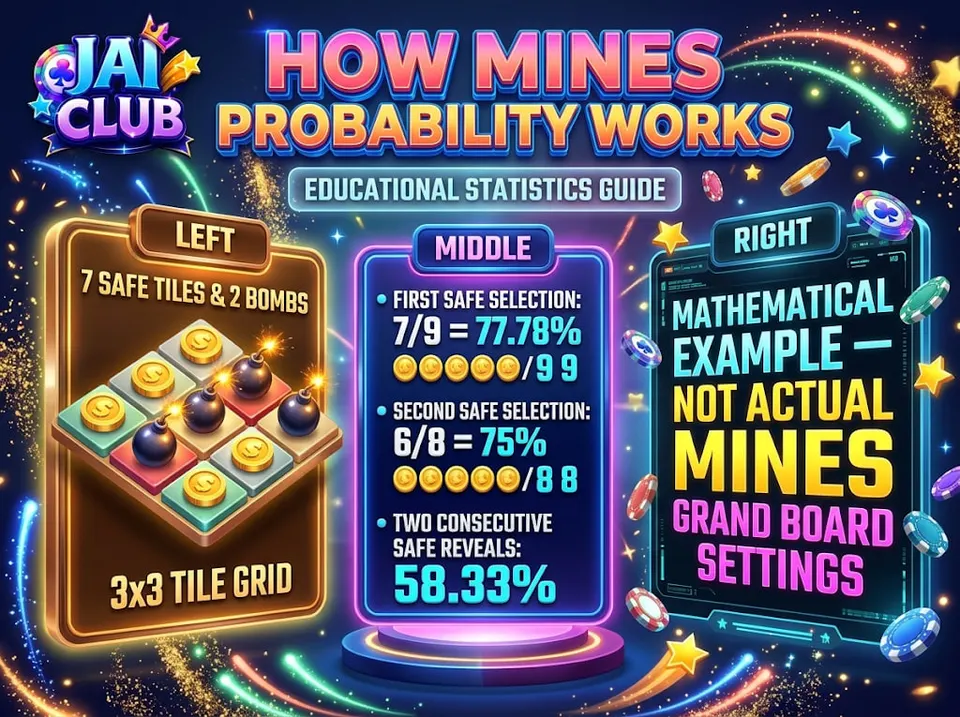
In a simplified grid model, increasing the number of bombs reduces the proportion of safe positions. This is an arithmetic relationship, not a prediction method.
Suppose a fictional demonstration grid contains nine covered tiles, of which two hide bombs. There are seven safe positions at the beginning of the round.
The probability of selecting a safe tile on the first attempt would be 7/9, approximately 77.78%, if every position were equally likely.
After one safe tile is revealed, there would be eight hidden positions, including six safe positions and two bombs. The conditional probability of another safe reveal would then be 6/8, or 75%.
Example: Fictional Nine-Tile Board
| Situation | Hidden positions | Safe positions | Safe probability |
|---|---|---|---|
| Before first reveal | 9 | 7 | 77.78% |
| After one safe reveal | 8 | 6 | 75.00% |
| After two safe reveals | 7 | 5 | 71.43% |
This example is deliberately separate from JILI's published Mines Grand specifications. It illustrates the mathematics of selecting safe positions without replacement.
It should not be used as evidence that the real game has exactly nine tiles or two bombs.
Probability of Two Consecutive Safe Reveals
Using the same fictional nine-tile example, the chance of obtaining two safe reveals consecutively is calculated by multiplying the conditional probabilities.
(7/9) × (6/8) = 7/12
This equals approximately 58.33%.
The calculation demonstrates how risk can accumulate as more hidden positions are selected. Even where the first selection has a relatively high chance of being safe, continuing the sequence introduces additional exposure.
No such example can establish the exact expected return of Mines Grand without the game's complete probability and payout rules.
Mines Grand Fairness Verification Explained
JILI lists Fairness Verification among Mines Grand's special features and states that completed rounds can be verified using information from two seeds.
Seed-based verification systems generally use values associated with the game service and user-side process to generate or reproduce a checkable result. However, the exact cryptographic procedure depends on the game's implementation.
A genuinely useful verification method should provide enough information to independently check a completed outcome under the documented algorithm.
A promotional claim about fairness should not automatically be treated as proof that every reader has personally verified the system.
Server Seed Aur Client Seed Ka Difference
Many provably fair systems use a server-side seed and a client-side seed, sometimes together with a nonce or round identifier. The values are combined through a defined algorithm to produce an outcome that can later be checked.
The server seed is commonly associated with the game operator's system, while the client seed provides a separate input. The specific arrangement varies between implementations.
JILI describes Mines Grand as using both seeds for verification, but the short catalogue does not supply the complete calculation algorithm or verification interface.
Readers should therefore distinguish the general concept of two-seed verification from a confirmed technical audit of Mines Grand itself.
Does Fairness Verification Predict Hidden Bombs?
No. Verification is intended to check a result under the disclosed rules, not provide advance knowledge of hidden bomb locations.
A properly designed commitment system can prevent certain kinds of after-the-fact changes while keeping relevant information concealed before the outcome is finalised.
However, the strength of any particular verification process depends on its actual implementation. Without the complete algorithm and required inputs, a public article cannot independently certify the system's security.
Anyone claiming that a seed calculator guarantees the next safe tile should provide evidence of that claim rather than relying on the term provably fair alone.
Mines Grand vs Original Mines by JILI
Mines Grand belongs to the wider family of JILI mines-style games, but it is a separate product from the original Mines.
The original JILI Mines title was published in May 2023 and highlights hidden coins, bombs, selectable mine counts and jackpot-related features.
Mines Grand was published later and specifically introduces Treasure Pot as a named feature.
| Feature | Mines | Mines Grand |
|---|---|---|
| Developer | JILI | JILI |
| Release | May 2023 | June 2025 |
| Core theme | Hidden coins and bombs | Hidden coins and bombs |
| Special focus | Jackpot features | Treasure Pot |
| Fairness information | Version-specific verification | Two-seed verification advertised |
| Same game? | No | No |
The two titles should not be assumed to share identical board settings, mathematical return or maximum award rules.
Mines Grand vs Traditional Crash Games
Mines Grand is classified as Crash by JILI, but its visual mechanic differs from aircraft-style multiplier games.
A flight-based crash game typically shows a multiplier increasing over time before an ending event. Mines Grand uses a board of concealed positions and decisions associated with revealing them.
Both formats can involve the possibility of ending a round before collecting an eligible amount, but the way that risk appears on screen is different.
For a broader comparison of instant game formats, see the Jai Club Crash Games guide.
Understanding the Advertised 4,910,569x Maximum
JILI's catalogue lists an extremely large maximum multiplier of 4,910,569x for Mines Grand. This is a published upper figure, not evidence that such an outcome is common.
The numerical size of a maximum reward does not tell readers how likely it is to occur. An unusually large upper figure may correspond to conditions that are extremely rare or difficult to reach.
Without the full probability model, it is not possible to derive a reliable frequency for that maximum from the catalogue alone.
The figure should never be presented as an achievable income target or a reason to increase financial exposure.
Does Mines Grand Have RTP?
RTP means Return to Player, a theoretical measure of expected return over a defined mathematical model.
The public JILI catalogue information examined for this guide does not establish a verified universal RTP figure for Mines Grand. It would therefore be inappropriate to publish a specific percentage without a reliable source.
A game's maximum multiplier is not the same as RTP. Its category label and special features also do not allow RTP to be calculated.
Can Mines Grand Be Played on Android?
The game may be offered through mobile-compatible implementations, depending on the operator and supported environment.
The presence of Mines Grand in the JILI catalogue confirms the game's existence, but does not independently establish that every Jai Club branded lobby includes it.
Users should verify the exact provider and title. An unrelated game using the word Mines may have different board settings, symbols and fairness rules.
Frequently Asked Questions
What is Mines Grand by JILI?
It is a grid-based Crash-category game featuring hidden coins, bombs, selectable mine counts and Treasure Pot.
What is Treasure Pot?
It is a special accumulating feature advertised in JILI's Mines Grand description.
Can players change the number of mines?
JILI lists selectable mine settings among the game's features.
Does more mines mean higher risk?
In a comparable grid model, increasing the number of hazardous positions reduces the proportion of safe positions. Exact game calculations depend on the rules.
How does Mines Grand fairness verification work?
JILI states that completed rounds can be verified using two seeds. The complete procedure depends on the game's actual algorithm.
Can fairness seeds reveal future bomb positions?
A verification system should not be treated as a reliable method for predicting hidden positions before a round.
What is the maximum win in Mines Grand?
The official catalogue lists 4,910,569x as the advertised maximum.
Is Mines Grand the same as JILI Mines?
No. They are separate releases with different advertised special features.
Is Mines Grand available on Jai Club?
Availability in a particular Jai Club branded game catalogue has not been independently confirmed.
Conclusion
Mines Grand combines the familiar concept of revealing safe positions with JILI's Treasure Pot feature and two-seed fairness verification. Its selectable mine settings make understanding probability important, but the exact game calculations require the relevant board and payout rules.
The developer's maximum multiplier is an upper advertised specification rather than an expected outcome. Fairness verification also should not be confused with predicting the location of concealed bombs.
This guide is based on the official JILI product description and separate mathematical examples. It does not claim first-hand verification of live game rounds or financial results.
Sources and Methodology
Primary source: JILI Games — Mines Grand.
The nine-tile example is an original illustrative probability model. It is not a reconstruction of JILI's live board or result-generation algorithm.
Related reading: Jai Club Crash Games Explained.