K3 Dice Probability: 216 Outcomes Aur SUM Chart Explained
Explore K3 dice probability with all 216 possible three-dice outcomes, sum frequencies from 3 to 18, triples, doubles, Big Small classification and clearly explained mathematical examples.
In this article
- K3 Dice Probability Kya Hai?
- Why Are There 216 Possible K3 Outcomes?
- Complete K3 SUM Probability Chart: 3 to 18
- K3 SUM 10 Aur 11 Sabse Common Kyun Hain?
- Why SUM 3 and 18 Are Rare
- K3 Big Small Probability Explained
- K3 Triple Probability Kaise Calculate Karein?
- Two Same Dice vs Three Same Dice
- Ordered vs Unordered Dice Combinations
- Does K3 Have 216 Equally Likely Sums?
- Probability vs Payout in K3
- How to Calculate the Probability of a SUM
- Can K3 History Predict the Next Dice Total?
- Is the Online K3 Result Really Equivalent to Fair Dice?
- Frequently Asked Questions
- How many possible outcomes are there in K3?
- Why are there 216 possible results?
- Which K3 SUM is most common?
- What is the probability of SUM 18?
- What is the probability of any triple?
- What is the probability of exactly two matching dice?
- Is K3 Big the same probability as Small?
- Can I predict K3 using recent SUM history?
- Does this chart confirm Jai Club K3 payout rates?
- Conclusion
- Sources and Methodology
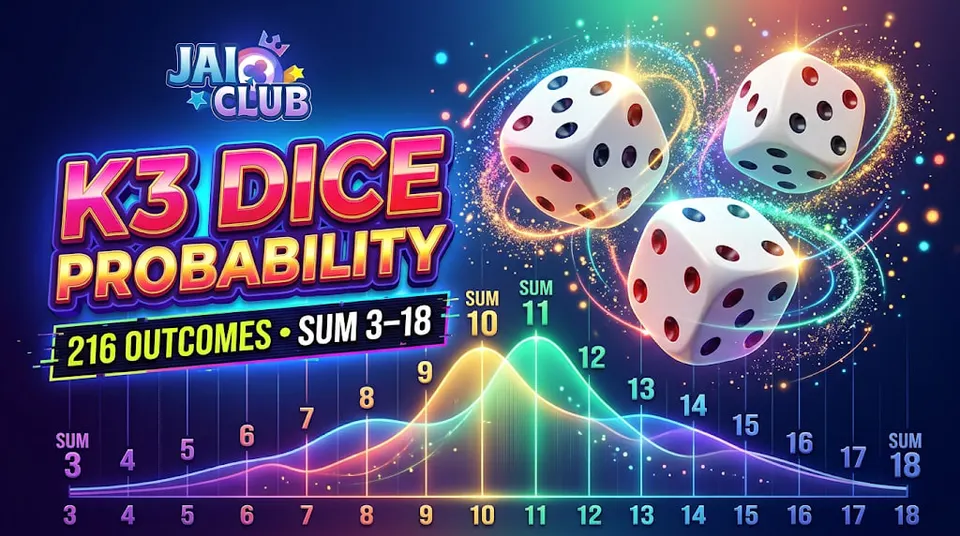
K3 Dice uses three dice to produce a numerical result. When each die has six equally likely faces and the dice are independent, there are exactly 216 possible ordered outcomes. However, the probability of each total is not equal, because some totals can be formed by many different combinations.
For example, a total of 3 can occur only when all three dice show 1. A total of 10 can occur through 27 different ordered outcomes. This means a sum chart is more useful than simply listing the possible totals from 3 to 18.
This guide explains the complete 216-outcome model, the probability of each K3 SUM, doubles, triples, and the mathematical difference between Big and Small classifications. All calculations assume independent, fair six-sided dice. They describe the mathematical model, not a verified prediction of an online game's next result.
K3 Dice Probability Kya Hai?
K3 is a three-dice game format in which a result is represented by three numbers. Each number normally falls between 1 and 6, giving the completed outcome a total between 3 and 18.
The total is calculated by adding the three displayed dice values. For example, a result of 2, 3 and 5 produces a SUM of 10. A result of 6, 6 and 6 produces a SUM of 18.
Although each face has the same probability in an ideal fair-dice model, the different totals do not appear in an equal number of combinations. This is the key idea behind K3 dice probability.
Why Are There 216 Possible K3 Outcomes?
Each die has six possible faces. If the dice are independent, the total number of ordered combinations is found by multiplying six by itself three times.
6 × 6 × 6 = 216
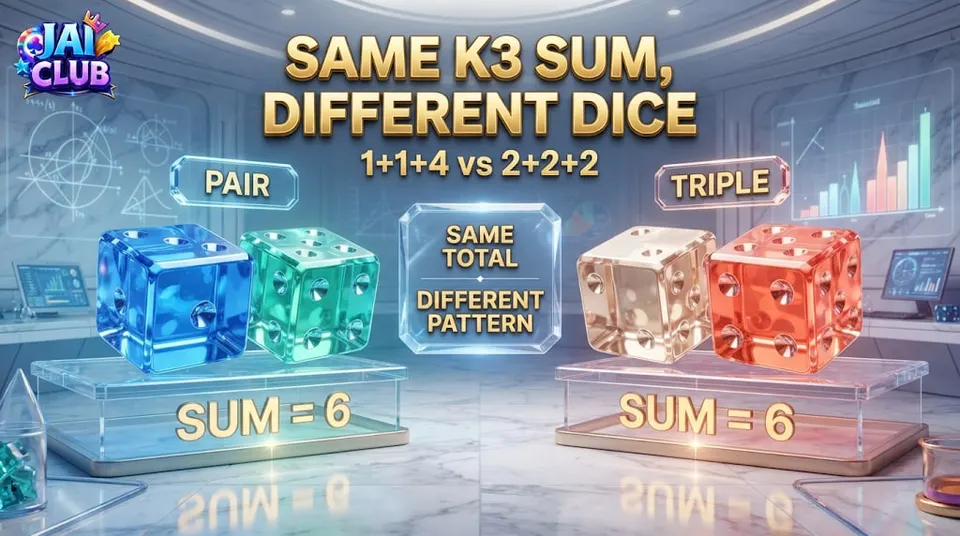
This calculation counts ordered outcomes. The results 1-2-3, 2-1-3 and 3-2-1 are different ordered outcomes even though they all have a SUM of 6.
Order matters when counting the complete mathematical sample space. However, some selection types may treat several arrangements as one category, depending on the game's rules.
Complete K3 SUM Probability Chart: 3 to 18
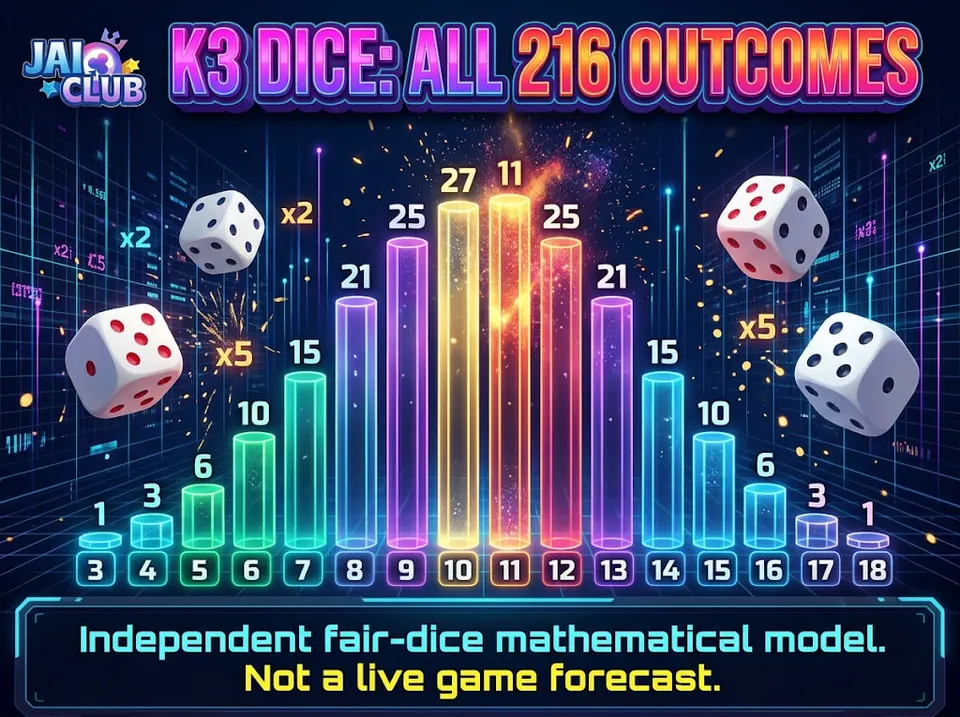
The following table shows every possible three-dice total and the number of ordered outcomes producing that SUM. These counts are exact for three independent fair six-sided dice.
| SUM | Number of outcomes | Probability |
|---|---|---|
| 3 | 1 | 0.46% |
| 4 | 3 | 1.39% |
| 5 | 6 | 2.78% |
| 6 | 10 | 4.63% |
| 7 | 15 | 6.94% |
| 8 | 21 | 9.72% |
| 9 | 25 | 11.57% |
| 10 | 27 | 12.50% |
| 11 | 27 | 12.50% |
| 12 | 25 | 11.57% |
| 13 | 21 | 9.72% |
| 14 | 15 | 6.94% |
| 15 | 10 | 4.63% |
| 16 | 6 | 2.78% |
| 17 | 3 | 1.39% |
| 18 | 1 | 0.46% |
| Total | 216 | 100% |
The percentages are rounded, so their displayed sum may differ slightly from 100%. The underlying counts total exactly 216.
The distribution is symmetrical. For instance, SUM 8 and SUM 13 each have 21 outcomes, while SUM 9 and SUM 12 each have 25 outcomes.
K3 SUM 10 Aur 11 Sabse Common Kyun Hain?
SUM 10 and SUM 11 each have 27 ordered combinations in the fair-dice model. They are the most frequent individual totals because many different dice arrangements produce those values.
This does not mean the next result must be 10 or 11. Each individual total still has a probability well below 50%, and the remaining possibilities collectively account for most outcomes.
For example, the theoretical probability of SUM 10 is 27 divided by 216, or 12.5%. The probability of receiving any other total is therefore 87.5%.
The same is true for SUM 11. A relatively common outcome is not a guaranteed outcome.
Why SUM 3 and 18 Are Rare
SUM 3 occurs only when the dice show 1-1-1. SUM 18 occurs only when the dice show 6-6-6.
Each exact ordered result has one occurrence in the 216-outcome space. Therefore, the probability of SUM 3 is 1/216, and the probability of SUM 18 is also 1/216.
Expressed as a percentage, each is approximately 0.46%.
These rare totals demonstrate why looking only at the range of possible results is misleading. Sixteen different sums exist, but they do not all have a probability of 1/16.
K3 Big Small Probability Explained
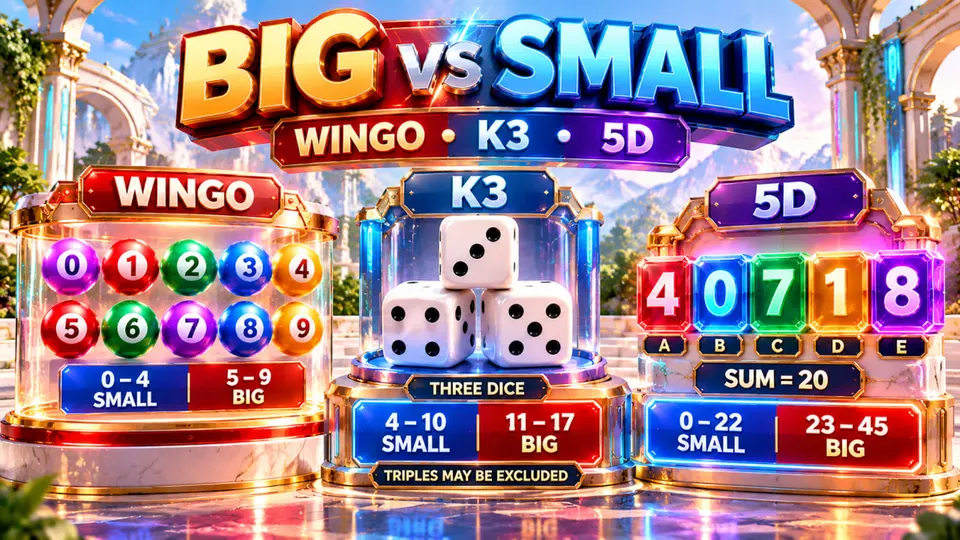
Some K3 game formats classify sums from 4 to 10 as Small and sums from 11 to 17 as Big. Certain rule sets also exclude triple outcomes from ordinary Big/Small settlement.
When using the complete fair-dice distribution, sums 4 through 10 account for 107 ordered outcomes. Sums 11 through 17 also account for 107 outcomes.
If a rule set excludes the two triple results within each group, the eligible count becomes 105 outcomes for Small and 105 for Big.
| Classification | Fair-dice outcomes |
|---|---|
| SUM 4–10 before triple exclusion | 107 |
| SUM 11–17 before triple exclusion | 107 |
| Eligible Small excluding relevant triples | 105 |
| Eligible Big excluding relevant triples | 105 |
| Triple and extreme outcomes excluded from both | 6 |
Under that specific exclusion model, the probability of an eligible Small result is 105/216, approximately 48.61%. The eligible Big probability is the same.
This is an example of one rule structure, not a claim that every Jai Club K3 implementation uses identical settlement conditions.
K3 Triple Probability Kaise Calculate Karein?
A triple occurs when all three dice show the same number. Possible triples are 1-1-1, 2-2-2, 3-3-3, 4-4-4, 5-5-5 and 6-6-6.
There are six such outcomes among 216 possible ordered results. Therefore, the probability of any triple in the fair-dice model is 6/216, which is approximately 2.78%.
The probability of one specific triple is smaller. For example, only one ordered outcome corresponds to 4-4-4, giving that exact result a probability of 1/216.
Some K3 games distinguish a selection covering any triple from a selection covering one particular triple. The mathematical probabilities are different, and the actual rules determine the relevant payout.
Two Same Dice vs Three Same Dice
A result containing exactly two equal dice is different from a triple. For example, 2-2-5 contains exactly two matching values, while 2-2-2 contains three.
To count exactly two matching dice, first choose the repeated value, then a different value, then the position of the different die. This gives 6 × 5 × 3 = 90 ordered outcomes.
The remaining outcomes include all-distinct results and triples.
| Pattern | Ordered outcomes | Probability |
|---|---|---|
| All three dice different | 120 | 55.56% |
| Exactly two dice equal | 90 | 41.67% |
| All three dice equal | 6 | 2.78% |
| Total | 216 | 100% |
These figures are mathematical characteristics of the fair-dice model. They do not describe the payout multiplier for any particular game selection.
Ordered vs Unordered Dice Combinations
The distinction between ordered and unordered combinations is important for understanding K3 results. An ordered outcome records the value in each of the three positions, while an unordered group focuses on the collection of values.
For instance, 1-2-3 can appear in six different orders. All six have the same SUM of 6, but they represent six different outcomes in the ordered 216-result sample space.
A triple such as 4-4-4 has only one distinct ordering because swapping identical numbers does not create a new result.
This explains why some sum categories have more combinations than others. A result containing three different values can contribute several permutations, while an exact triple contributes only one.
Does K3 Have 216 Equally Likely Sums?
No. The 216 figure describes equally likely ordered outcomes under the stated fair-dice assumptions, not 216 different sums.
There are only sixteen possible SUM values, from 3 through 18. Those sixteen values have different probabilities because they are formed by different numbers of ordered combinations.
This distinction is useful when checking claims that every SUM has the same chance. A uniform distribution of the sixteen totals is not the distribution produced by three ordinary fair six-sided dice.
Probability vs Payout in K3
A theoretical probability describes how frequently an outcome is expected under a mathematical model. A payout multiplier describes how a particular service values an eligible result.
These concepts are related in the design of many games, but they are not identical. A rare outcome may be associated with a higher advertised multiplier, yet that does not mean the expected financial return is positive.
For illustration, a 10% chance of receiving a 9x gross return would have a different expected value from a 10% chance of receiving an 11x gross return. Neither hypothetical rate establishes the actual payout terms of Jai Club K3.
Readers should consult the current rules for any operator-specific multiplier. The 216-outcome chart alone cannot determine those values.
How to Calculate the Probability of a SUM
The probability formula is straightforward:
Probability = Number of favourable ordered outcomes ÷ 216
For SUM 8, the chart lists 21 favourable outcomes. Therefore, the probability is 21/216, approximately 9.72%.
For SUM 15, there are 10 favourable outcomes, producing a probability of 10/216, approximately 4.63%.
The calculation can be applied to any total in the table, provided the underlying fair-dice assumptions remain valid.
Can K3 History Predict the Next Dice Total?
A history chart can show the sums that occurred in previous rounds, but it does not guarantee the next outcome. If results are generated independently, the previous sequence does not change the probability distribution of the following round.
For instance, observing SUM 10 several times does not prove that SUM 10 is more likely to appear again immediately. Conversely, a long absence of SUM 18 does not mean that it is due to appear.
Historical frequency can be compared with theoretical probability, but a small difference between the two does not automatically establish manipulation or a predictable pattern.
Our independent K3 Lottery guide explains the broader game format, while this article focuses on the mathematical distribution.
Is the Online K3 Result Really Equivalent to Fair Dice?
The 216-outcome calculation applies to three independent, uniformly distributed six-sided dice. An online game can display dice while using an internal result-generation system.
The visual presence of three dice does not independently prove that the system follows the exact theoretical model. That requires relevant game documentation or a properly supported technical verification process.
Therefore, the calculations in this article are best understood as a mathematical reference. They should not be presented as an independent audit of an operator's random number generator.
Frequently Asked Questions
How many possible outcomes are there in K3?
There are 216 ordered outcomes for three independent six-sided dice.
Why are there 216 possible results?
Because 6 × 6 × 6 equals 216.
Which K3 SUM is most common?
SUM 10 and SUM 11 each have 27 combinations in the fair-dice model.
What is the probability of SUM 18?
One out of 216, approximately 0.46%.
What is the probability of any triple?
Six out of 216, approximately 2.78%.
What is the probability of exactly two matching dice?
There are 90 outcomes, approximately 41.67%.
Is K3 Big the same probability as Small?
The groups are symmetrical in the fair-dice model when defined with matching rules. Exact eligibility depends on the game's treatment of triples and extreme sums.
Can I predict K3 using recent SUM history?
No reliable prediction follows from ordinary historical counts in an independent fair-dice model.
Does this chart confirm Jai Club K3 payout rates?
No. It explains mathematical probabilities, not operator-specific financial terms.
Conclusion
K3 dice probability is based on 216 possible ordered outcomes when three dice are independent and fair. Although every exact ordered outcome has the same probability, the sixteen possible sums have different frequencies.
SUM 10 and SUM 11 each occur in 27 combinations, while the extreme totals of 3 and 18 each occur in only one. Triple, double and all-distinct patterns can also be counted exactly.
Understanding these differences is more useful than assuming all sums are equally likely or treating previous rounds as guaranteed predictions. The mathematical model provides a reference for reading K3 results, not a method for guaranteeing future outcomes.
Sources and Methodology
The calculations in this article come from enumerating all 6 × 6 × 6 ordered outcomes of three independent fair six-sided dice. The counts can be independently reproduced through direct enumeration or a spreadsheet.
The interpretation of Big/Small, triple exclusions and available selection types is operator-dependent. Verify those conditions with the applicable game rules.
Related reading: Jai Club K3 Lottery Guide.