Same K3 SUM, Different Dice: 1+1+4 vs 2+2+2 Explained
Learn why K3 results can share the same SUM but have different dice patterns. Explore pairs, triples, all-distinct results, ten combinations of SUM 6 and their mathematical probabilities.
In this article
- K3 SUM Kya Hai?
- Same SUM, Different Dice Kaise Hota Hai?
- Why 1+1+4 and 2+2+2 Are Different
- K3 Pair vs Triple vs All Different
- All K3 SUM 6 Combinations Explained
- Ordered vs Unordered Dice Combinations
- Why Does 1-1-4 Have Three Arrangements?
- Why Does 2-2-2 Have Only One Arrangement?
- Why Does 1-2-3 Have Six Arrangements?
- How Many Possible K3 Results Exist?
- What Is the Probability of SUM 6?
- SUM 6 Pair vs Triple Probability
- K3 Two Same vs Three Same Explained
- How Many Triple Outcomes Are Possible?
- Probability of Exactly Two Matching Dice
- Probability of Three Different Dice
- K3 SUM vs Dice Pattern in Result History
- Example of Repeated SUM in History
- Can Same SUM Mean the Same Payout?
- Does Repeated K3 SUM Predict the Next Result?
- K3 SUM and Big Small Categories
- Common K3 Reading Mistakes
- Frequently Asked Questions
- Why do 1+1+4 and 2+2+2 have the same SUM?
- Are they the same K3 result?
- How many ordered outcomes produce SUM 6?
- Is 1+2+3 also SUM 6?
- Why does 1-1-4 have three arrangements?
- Why does 2-2-2 have only one arrangement?
- What is the probability of SUM 6?
- What is the probability of any triple?
- Can different dice patterns have different game rules?
- Can K3 history predict the next result?
- Understanding the Complete K3 Result
- Sources and Methodology
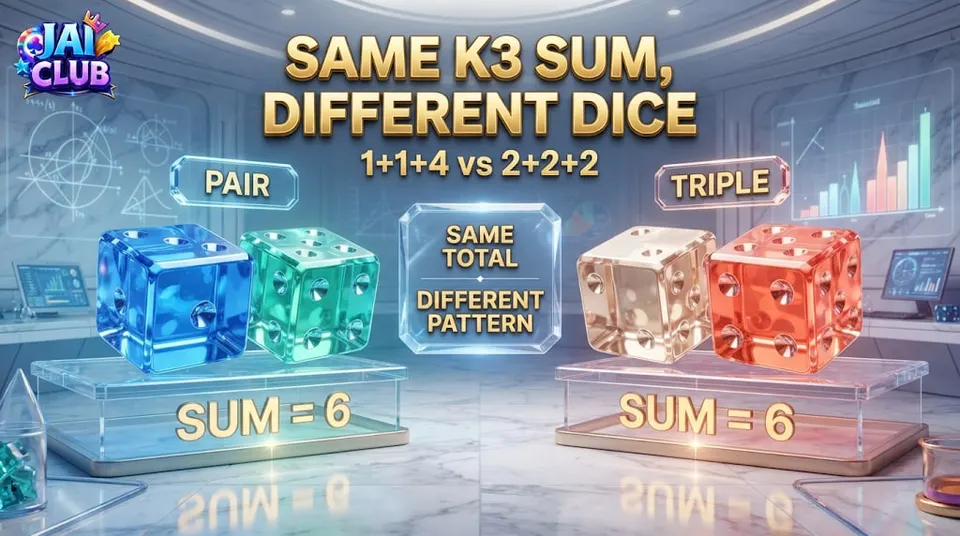
Two K3 dice results can have the same SUM without being the same combination. For example, 1+1+4, 2+2+2 and 1+2+3 all produce SUM 6. However, the first result contains a pair, the second is a triple, and the third has three different values.
This difference matters because K3 results can be classified by both their total and their individual dice patterns. A player looking only at the SUM column may miss important information about how the result was formed.
This article explains the mathematical relationship between K3 SUM and dice combinations, with examples of pairs, triples, ordered outcomes and result-history records. For an introduction to the broader game format, readers can first explore our Jai Club K3 Lottery guide, which covers the main result categories and terminology.
K3 SUM Kya Hai?
K3 SUM is the total obtained by adding the values of three dice. Each die can show a number from 1 to 6, giving a combined total between 3 and 18.
For example, a result of 2-4-5 produces SUM 11, while 3-3-5 also produces SUM 11. The totals are identical, but the underlying dice patterns are different.
This distinction is important because the SUM does not preserve all the information about the original result. A total identifies only the combined value, not the exact sequence or the number of matching dice.
Same SUM, Different Dice Kaise Hota Hai?
Several combinations of three integers can produce the same sum. The only requirement is that each die must show a value from 1 to 6.
Consider SUM 6. It can occur when the dice display 1-1-4, 1-2-3 or 2-2-2, including different arrangements of the first two groups.
These results are mathematically distinct even though their total is equal.
| Dice result | SUM | Pattern |
|---|---|---|
| 1-1-4 | 6 | Exactly two matching dice |
| 1-2-3 | 6 | Three different dice |
| 2-2-2 | 6 | Triple |
This explains why reading a K3 result requires more than checking the total.
A history table displaying only SUM 6 cannot establish which of these combinations appeared unless the individual dice values are also provided.
Why 1+1+4 and 2+2+2 Are Different
The result 1-1-4 contains two matching values and one different value. It belongs to the exactly-two-same pattern group.
The result 2-2-2 contains three matching values. It is classified as a triple.
Although both results produce SUM 6, their patterns are not interchangeable. This becomes important when discussing game rules that distinguish exact totals from matching-dice categories.
A triple is not simply another form of exactly two matching dice when the categories are defined as mutually exclusive. It belongs to a separate group.
K3 Pair vs Triple vs All Different
Every result involving three dice belongs to one of three broad mathematical pattern categories.
A triple contains three equal values. An exact pair contains two equal values and one different value. An all-distinct result contains three different values.
| Pattern | Example | Description |
|---|---|---|
| Triple | 4-4-4 | All three values are equal |
| Exactly two same | 4-4-2 | Two values match |
| All different | 1-3-5 | No values match |
These categories describe dice patterns, not payout rates.
A particular operator may use additional labels or define selections differently. Its actual paytable must be consulted before associating a pattern with a financial settlement.
All K3 SUM 6 Combinations Explained
In the mathematical model of three independent fair six-sided dice, SUM 6 can be formed by ten ordered outcomes.
| First die | Second die | Third die | Pattern |
|---|---|---|---|
| 1 | 1 | 4 | Pair |
| 1 | 4 | 1 | Pair |
| 4 | 1 | 1 | Pair |
| 1 | 2 | 3 | All different |
| 1 | 3 | 2 | All different |
| 2 | 1 | 3 | All different |
| 2 | 3 | 1 | All different |
| 3 | 1 | 2 | All different |
| 3 | 2 | 1 | All different |
| 2 | 2 | 2 | Triple |
These ten results belong to three unordered combination groups.
The pair group contributes three ordered outcomes, the all-distinct group contributes six, and the triple contributes one.
This is an example of why some dice patterns are represented by more ordered outcomes than others.
Ordered vs Unordered Dice Combinations
An ordered result records the value shown at each individual dice position. Under this definition, 1-1-4 and 4-1-1 are different ordered outcomes.
An unordered combination ignores position and considers only which values appear. Under this method, both sequences belong to the same combination group.
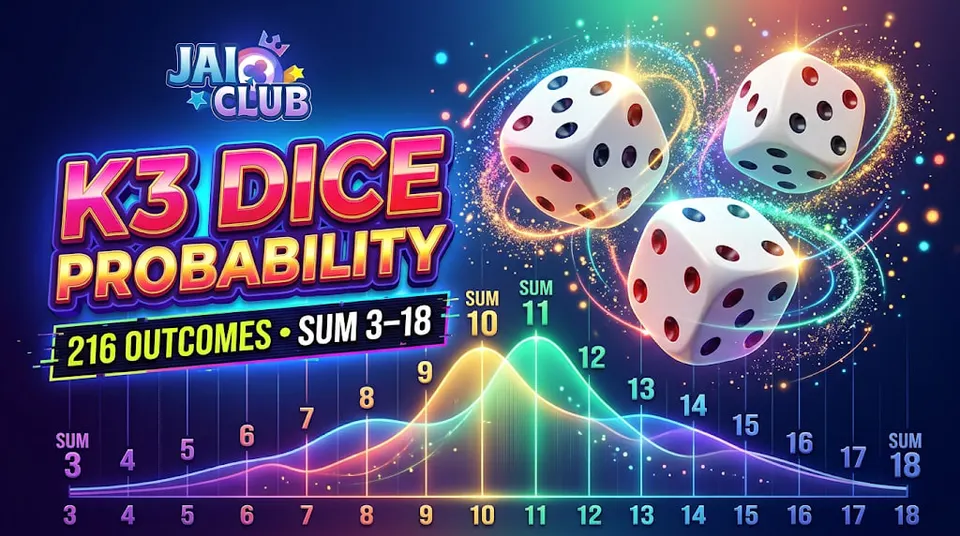
The distinction matters when calculating probability because the standard fair-dice model contains 216 equally likely ordered outcomes.
Why Does 1-1-4 Have Three Arrangements?
The different value, 4, can occupy the first, second or third position.
The possibilities are 4-1-1, 1-4-1 and 1-1-4.
There are three distinct ordered outcomes because the two matching values are interchangeable without creating additional sequences.
Why Does 2-2-2 Have Only One Arrangement?
All three values are identical, so changing their positions does not produce a different numerical sequence.
The result remains 2-2-2 regardless of the order.
Therefore, an exact triple contributes only one ordered outcome.
Why Does 1-2-3 Have Six Arrangements?
All three values are different, so each rearrangement produces another ordered outcome.
The number of arrangements is 3 × 2 × 1 = 6.
This produces six distinct results from the group containing 1, 2 and 3.
How Many Possible K3 Results Exist?
Each die has six possible faces. For three independent dice, the number of ordered outcomes is:
6 × 6 × 6 = 216.
This complete sample space includes every possible arrangement from 1-1-1 through 6-6-6.
Every exact ordered result has a probability of 1/216 under the fair-dice model. However, a category containing several ordered outcomes has a higher total probability.
Our published K3 Dice Probability and 216 Outcomes chart explains the complete distribution of sums from 3 through 18.
What Is the Probability of SUM 6?
SUM 6 has ten ordered outcomes among the 216 possibilities.
Therefore:
Probability = 10 ÷ 216 × 100
This equals approximately 4.63%.
The result is based on three independent fair dice. It does not establish that a particular online K3 implementation has been independently tested for uniform randomness.
The same calculation can be applied to other totals by counting their favourable ordered outcomes.
SUM 6 Pair vs Triple Probability
The three combination groups contributing to SUM 6 have different numbers of arrangements.
| SUM 6 group | Ordered outcomes | Probability among all 216 |
|---|---|---|
| 1-1-4 in any order | 3 | 1.389% |
| 1-2-3 in any order | 6 | 2.778% |
| 2-2-2 | 1 | 0.463% |
| Total SUM 6 | 10 | 4.630% |
The percentages are rounded.
Among outcomes already known to have SUM 6, 30% belong to the pair group, 60% belong to the all-distinct group, and 10% belong to the triple group.
These are conditional mathematical proportions, not game payout multipliers.
K3 Two Same vs Three Same Explained
The distinction between Two Same and Three Same is especially important when interpreting K3 terminology.
Two Same may describe a result in which two dice display the same value. Three Same describes a triple, where all three values match.
Some rule sets distinguish exactly two matching dice from a general matching-pair condition. Readers should check whether the specific game category includes or excludes triples.
For example, a result of 3-3-5 has exactly two matching dice. A result of 3-3-3 is a triple, even though its values also match one another.
The actual settlement conditions depend on the selection category.
How Many Triple Outcomes Are Possible?
There are six exact triples in the three-dice model:
1-1-1, 2-2-2, 3-3-3, 4-4-4, 5-5-5 and 6-6-6.
Therefore, the probability of any triple is:
6 ÷ 216 = approximately 2.78%.
The probability of one specific triple, such as 2-2-2, is 1/216, approximately 0.463%.
This is why a category covering any triple is mathematically different from one covering only a specific triple.
Probability of Exactly Two Matching Dice
An exact pair result contains two matching values and one different value.
To count these outcomes, choose the repeated number in six ways, choose the different number in five ways and choose its position in three ways.
The total is:
6 × 5 × 3 = 90 ordered outcomes.
Therefore, the probability of exactly two matching dice is 90/216, approximately 41.67%.
This calculation excludes triples because the third die must be different from the repeated value.
Probability of Three Different Dice
When all three dice are different, the first die has six possible values. The second has five remaining possibilities, and the third has four.
This gives:
6 × 5 × 4 = 120 ordered outcomes.
The probability is 120/216, approximately 55.56%.
Together, the three pattern groups account for the complete sample space.
| Pattern category | Outcomes | Probability |
|---|---|---|
| All different | 120 | 55.56% |
| Exactly two same | 90 | 41.67% |
| Triple | 6 | 2.78% |
| Total | 216 | 100% |
The displayed percentages are rounded.
K3 SUM vs Dice Pattern in Result History
A K3 result-history table may display the three individual dice and their total. A simplified history might show only the SUM.
When the dice are not displayed, the complete pattern cannot be reconstructed from the total alone.
For example, seeing SUM 6 does not reveal whether the round produced a pair, triple or all-distinct result.
A complete analysis therefore requires both the total and the underlying dice values.
Example of Repeated SUM in History
Consider these fictional records:
| Period | Dice | SUM | Pattern |
|---|---|---|---|
| K3-101 | 1-1-4 | 6 | Pair |
| K3-102 | 2-2-2 | 6 | Triple |
| K3-103 | 1-2-3 | 6 | All different |
| K3-104 | 4-1-1 | 6 | Pair |
| K3-105 | 3-3-4 | 10 | Pair |
The first four entries all produce SUM 6, but they do not represent identical ordered results.
The example also shows that 1-1-4 and 4-1-1 share an unordered combination group while remaining different ordered sequences.
These records are fictional and do not represent live Jai Club results.
Can Same SUM Mean the Same Payout?
Not necessarily. A SUM-based selection and a pattern-based selection describe different conditions.
A result can satisfy a SUM classification and a separate dice-pattern classification at the same time, but that does not automatically mean every entry qualifies for both.
The relevant payout depends on the actual selected category and the operator's published rules.
This guide does not assign operator-specific multipliers to pairs or triples because those figures require separate verification.
Does Repeated K3 SUM Predict the Next Result?
No. Historical records describe completed outcomes and do not guarantee future results.
If the underlying game uses independent fair dice, previous sums do not change the theoretical probability of the next roll.
For example, observing SUM 6 several times does not mean another SUM 6 is more likely or less likely to appear next.
Readers should distinguish the mathematical probability of a category from a prediction claim based on short historical sequences.
K3 SUM and Big Small Categories
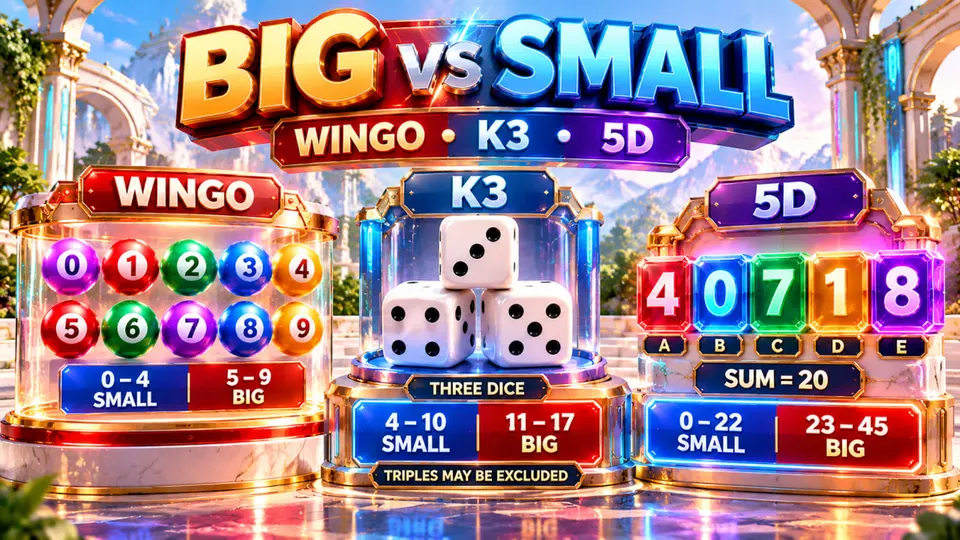
Some K3 rule sets also classify totals into Big and Small groups, with additional conditions concerning triples.
This is another example of one result having multiple mathematical properties. A particular total may belong to a size group while its dice also form a pair or triple.
However, size boundaries and triple exclusions depend on the relevant game rules.
For a comparison of number classifications across different lottery-style formats, see Big vs Small in WinGo, K3 and 5D.
Common K3 Reading Mistakes
One common mistake is treating every SUM 6 as the same complete result. Another is ignoring dice order when counting probability.
A third mistake is treating exactly two matching dice as equivalent to a triple. These categories have different definitions and mathematical frequencies.
Readers should also avoid assuming that a rare combination is due to appear after a long absence.
The appropriate purpose of a result chart is to understand completed data, not guarantee future outcomes.
Frequently Asked Questions
Why do 1+1+4 and 2+2+2 have the same SUM?
Both combinations total 6.
Are they the same K3 result?
No. The first is an exact pair, while the second is a triple.
How many ordered outcomes produce SUM 6?
Ten outcomes.
Is 1+2+3 also SUM 6?
Yes. It is an all-distinct combination with the same total.
Why does 1-1-4 have three arrangements?
The different die can occupy three positions.
Why does 2-2-2 have only one arrangement?
All three values are identical, so rearranging them does not create a new sequence.
What is the probability of SUM 6?
Approximately 4.63% under the independent fair-dice model.
What is the probability of any triple?
Approximately 2.78%.
Can different dice patterns have different game rules?
Yes. The exact selection and settlement conditions depend on the relevant operator.
Can K3 history predict the next result?
No reliable future prediction follows from ordinary historical counts alone.
Understanding the Complete K3 Result
A K3 result should be read through three separate pieces of information: the individual dice values, their total and their matching pattern.
A result of 1-1-4 is SUM 6 with exactly two matching dice. A result of 2-2-2 is SUM 6 with all three matching.
These descriptions are both mathematically valid because SUM and pattern refer to different characteristics.
For readers learning the basics of K3, the Jai Club Lottery overview provides wider context about number-result formats and completed periods.
Sources and Methodology
All mathematical counts are based on enumerating the 216 ordered outcomes of three independent fair six-sided dice.
The figures explain a theoretical model and do not establish the outcome-generation method or payout rules of a particular online service.
Related reading: K3 Dice Probability.