TRX WinGo Explained: How TRON Blockchain Results Work
Understand TRX WinGo, its connection with the TRON blockchain, block IDs, transaction hashes, period numbers, result verification and how it differs from regular WinGo.
In this article
- What Is TRX WinGo?
- What Does TRX Mean?
- Is TRX WinGo an Official TRON Game?
- How Is TRX WinGo Different From Regular WinGo?
- Comparison Table
- What Is the TRON Blockchain?
- What Is a Block?
- What Is a Block Number?
- What Is a Block ID?
- Block ID vs Transaction Hash: What's the Difference?
- Block ID
- Transaction Hash
- Quick Comparison
- How Are TRX WinGo Results Calculated?
- Example: Block-Based Calculation
- Why Must the Rule Be Published?
- Does Every Implementation Use the Last Digit?
- Understanding a TRON Identifier
- Fictional Example
- Why the Algorithm Matters
- How to Verify a TRX WinGo Result
- Step 1: Identify the Exact Game Period
- Step 2: Find the Claimed Blockchain Reference
- Step 3: Open a Public TRON Explorer
- Step 4: Match the Identifier
- Step 5: Apply the Published Calculation
- Step 6: Compare the Result
- Step 7: Review Any Unexplained Differences
- Does a Matching Block ID Prove Fairness?
- What Must Be Checked?
- Why Timing Is Important
- Does Blockchain Guarantee a Profit?
- What Is TRX WinGo Result History?
- Fictional Example
- Why Is the Period ID Important?
- What Do Red, Green and Violet Mean in TRX WinGo?
- Does the Blockchain Determine the Colour Directly?
- Can the Mapping Be Different Between Platforms?
- Does Violet Mean a Special Blockchain Result?
- What Do Big and Small Mean in TRX WinGo?
- Does TRON Define Big and Small?
- Does a Block Number Determine Big or Small?
- How Often Does TRON Produce Blocks?
- Does TRX WinGo Have Three-Second Rounds?
- Why Does This Matter?
- TRX WinGo vs WinGo 30 Seconds and 1 Minute
- Does TRX WinGo Always Have the Same Duration?
- Does a Faster Round Change the Blockchain Formula?
- Can Different Timing Modes Use Different References?
- Is TRX WinGo More Transparent Than Regular WinGo?
- What Would Meaningful Transparency Look Like?
- What Is Not Enough?
- Can TRX WinGo Results Be Predicted?
- Can Someone Predict the Next Block ID?
- Are TRX WinGo Prediction Bots Reliable?
- Does a Blockchain Formula Guarantee a Win?
- What Does Jai Club TRX WinGo Mean?
- Common TRX WinGo Misunderstandings
- Mistake 1: Treating Block IDs and Transaction Hashes as Identical
- Mistake 2: Assuming Every TRX WinGo Uses the Last Digit
- Mistake 3: Believing a Blockchain Logo Proves Fairness
- Mistake 4: Treating a Public Result as a Future Prediction
- Mistake 5: Ignoring the Block Selection Rule
- Mistake 6: Assuming TRX Is Required to Read Blockchain Records
- Mistake 7: Treating a Matching Result as Proof of Guaranteed Profit
- Frequently Asked Questions
- 1. What is TRX WinGo?
- 2. Is TRX WinGo different from regular WinGo?
- 3. Does every TRX WinGo use a TRON block ID?
- 4. What is a TRON block number?
- 5. What is a TRON block ID?
- 6. What is a transaction hash?
- 7. How can TRX WinGo results be verified?
- 8. Is TRX WinGo automatically fair?
- 9. Can TRX WinGo predict the next number?
- 10. Does TRON produce a new block every three seconds?
- 11. Does TRX WinGo require a cryptocurrency wallet?
- 12. Are Red, Green and Violet part of TRON?
- 13. Is a block ID the same as the game period number?
- 14. Can two platforms use different TRX WinGo formulas?
- 15. Is TRX WinGo available on every Jai Club website?
- Final Thoughts
TRX WinGo is a variation of the WinGo number-and-colour game that is frequently described as using information from the TRON blockchain to determine or verify its results.
Traditional WinGo guides usually focus on number outcomes, colour classifications, countdowns and period history. TRX WinGo adds another question: where does the result come from, and can the source data be checked independently?
Some platforms claim to derive their TRX WinGo results from publicly available TRON block information. Others describe transaction-hash methods or alternative verification systems.
However, the name TRX WinGo alone does not establish which method an individual platform actually uses.
This guide explains TRX WinGo, the difference between TRON blocks and transactions, how result verification may work, and what readers should check before trusting a blockchain-related claim.
The article provides educational information about the technology and game terminology. It does not independently certify the result-generation system of any particular gaming operator.
What Is TRX WinGo?
TRX WinGo, also written as TRX Win Go, is a term used for a number-based game associated with the TRON blockchain.
Its interface may resemble ordinary WinGo, with result numbers, colour categories and round identifiers.
The distinguishing feature claimed by many TRX WinGo implementations is the use of blockchain data as an input to the result-generation or verification process.
A platform might use a TRON block identifier, transaction identifier or another published data source.
The precise mechanism depends on its rules.
What Does TRX Mean?
TRX is the native cryptocurrency of the TRON blockchain.
TRON is a blockchain network that records transactions and other information in a publicly inspectable ledger.
The use of TRX in a game's name does not necessarily mean that participants need cryptocurrency to view or understand its results.
Is TRX WinGo an Official TRON Game?
A game mentioning TRON does not automatically mean it is developed, operated or endorsed by the TRON network's maintainers.
Third-party applications can use publicly available blockchain information without being official TRON products.
This distinction is important when evaluating claims about game transparency.
How Is TRX WinGo Different From Regular WinGo?
Ordinary WinGo and TRX WinGo may share similar visual categories.
These can include:
- Numbers from 0 to 9
- Red, Green and Violet classifications
- Big and Small
- Countdown timers
- Period numbers
- Completed result history
The main claimed difference is the source or verification method for the result.
Comparison Table
| Feature | Regular WinGo | TRX WinGo |
|---|---|---|
| Typical outcome | Number-based | Number-based |
| Colour categories | Common | Common |
| Period identifiers | Yes | Usually |
| Countdown | May be available | May be available |
| Result source | Platform-specific | May reference TRON data |
| Blockchain reference | Not necessarily | Claimed by many versions |
| Independent verification | Depends on operator | Depends on published evidence |
| Winning guarantee | No | No |
TRX WinGo should not be described as automatically more transparent merely because its name includes a blockchain reference.
The actual implementation must be examined.
For background on ordinary WinGo terminology, read our WinGo game guide.
What Is the TRON Blockchain?
TRON is a public blockchain that records transactions and organises them into blocks.
A block contains transaction information and metadata associated with its position in the blockchain.
Blocks are linked through identifiers that reference previous blocks.
This provides a public record that can be inspected using blockchain explorers.
What Is a Block?
A block is a collection of information accepted into the blockchain.
TRON blocks include a block header and a list of transactions.
The header contains information such as the block number, timestamp and reference to the previous block.
What Is a Block Number?
A block number, also called block height, identifies the block's position in the blockchain sequence.
For example, a hypothetical reference might be:
Block number: 85000123
This is an illustrative identifier, not a live TRON block selected for a game.
What Is a Block ID?
A TRON block ID is a unique identifier associated with the block.
Importantly, TRON's block ID has a specific composite structure. It is not simply the ordinary SHA-256 hash of the entire block.
That distinction matters when comparing game explanations with official TRON documentation.
Block ID vs Transaction Hash: What's the Difference?
These terms are sometimes used interchangeably in third-party gaming explanations, but they refer to different blockchain objects.
Block ID
A block ID identifies a block containing transactions and related metadata.
A game claiming to use block-based results needs to specify which block is selected for a particular period.
Transaction Hash
A transaction hash, or transaction ID, identifies an individual blockchain transaction.
A single block may contain multiple transactions.
Therefore, selecting a block is not necessarily the same as selecting a transaction.
Quick Comparison
| Term | Meaning | Important Question |
|---|---|---|
| Block number | Position of a block | Which block height? |
| Block ID | Identifier of the block | Which identifier was used? |
| Transaction hash | Identifier of a transaction | Which transaction was selected? |
| Timestamp | Recorded time | Which time reference applies? |
| Game period ID | Identifier of a game round | How is the period linked to blockchain data? |
A trustworthy explanation should distinguish these values rather than calling every long hexadecimal identifier a transaction hash.
How Are TRX WinGo Results Calculated?
There is no single result-calculation method that can safely be assumed for every game using the TRX WinGo name.
Different third-party descriptions refer to different methods.
Some claim to extract a numerical digit from a selected TRON block ID.
Others refer to a transaction hash.
Still others use a separately committed random seed.
Example: Block-Based Calculation
A platform might define a process like this:
- Identify the game period.
- Select the relevant TRON block according to a published rule.
- Retrieve that block's official ID.
- Apply the documented digit-extraction method.
- Record the resulting number.
- Display the related game classification.
This is an example of a possible workflow, not a verified universal rule.
Why Must the Rule Be Published?
Without the exact selection and calculation rule, a reader cannot reliably reproduce the result.
For example, extracting the last numerical digit from a block ID can produce a different outcome from extracting the final hexadecimal character and interpreting it differently.
The method must define which characters count, what happens when letters appear and how the input block is selected.
Does Every Implementation Use the Last Digit?
No universal requirement establishes that.
Some third-party guides describe reading a hash or identifier from right to left until a decimal digit is found.
That method should only be applied when the particular game's rules explicitly define it.
Do not assume that every TRX WinGo version follows the same calculation.
Understanding a TRON Identifier
Blockchain identifiers commonly appear as hexadecimal strings.
Hexadecimal uses sixteen symbols:
0, 1, 2, 3, 4, 5, 6, 7, 8, 9, a, b, c, d, e, f.
The letters a through f represent values from 10 to 15.
Fictional Example
Consider this short illustrative string:
A7C42F
This is not a complete real TRON block ID or transaction hash.
If an application uses the rule "read from the right until the first decimal digit appears", the result would be 2.
But that is only one possible extraction method.
A different algorithm might produce a different value from the same input.
Why the Algorithm Matters
A publicly visible identifier does not, by itself, determine how a gaming platform interprets it.
The platform must define the transformation from blockchain data to an outcome.
Without that rule, an independent comparison is incomplete.
How to Verify a TRX WinGo Result
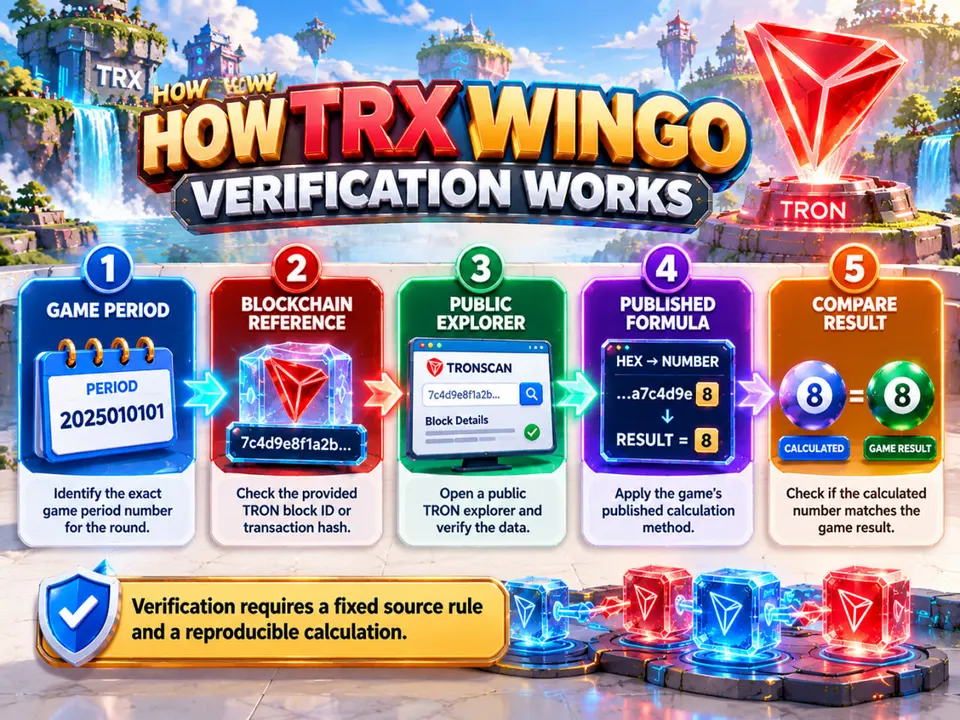
Verifying a blockchain-based result involves more than reading a number shown in the game.
The relevant service must publish enough information to reproduce the process.
Step 1: Identify the Exact Game Period
Record the full period identifier.
Do not rely only on the countdown or result number.
Step 2: Find the Claimed Blockchain Reference
Check whether the game provides a TRON block number, block ID or transaction ID.
A vague statement such as "verified by blockchain" is not sufficient.
Step 3: Open a Public TRON Explorer
A blockchain explorer allows users to inspect publicly recorded TRON information.
Use a trusted explorer and search for the exact reference provided by the game.
Step 4: Match the Identifier
Check that the displayed block or transaction matches the claimed reference.
Step 5: Apply the Published Calculation
Reproduce the exact result-generation formula.
Do not substitute another site's formula merely because it also uses the TRX WinGo name.
Step 6: Compare the Result
Check whether the independently calculated number matches the completed game result for the same period.
Step 7: Review Any Unexplained Differences
A mismatch may involve the wrong period, wrong reference, different algorithm or an error in the displayed data.
A mismatch cannot be diagnosed from the final number alone.
Does a Matching Block ID Prove Fairness?
Not completely.
A matching identifier can establish that a particular piece of blockchain data exists.
But stronger conclusions require more evidence.
What Must Be Checked?
First, was the blockchain reference selected according to a fixed rule?
Second, was the rule published before the relevant result became known?
Third, can the calculation be independently reproduced?
Fourth, does the service consistently use that rule for every relevant period?
Why Timing Is Important
If a platform can choose among several already-known blocks after viewing their identifiers, it may be able to select a favourable result.
Therefore, publishing a hash after a round is not the same as proving that the source was fixed beforehand.
Does Blockchain Guarantee a Profit?
No.
Even a correctly verifiable result-generation method does not imply that participants will receive positive financial returns.
The game's payout and settlement rules are separate from blockchain verification.
What Is TRX WinGo Result History?
A TRX WinGo history screen may display completed game rounds.
Depending on the implementation, the history may include:
- Period ID
- Result number
- Colour classification
- Big or Small
- Blockchain reference
- Result timestamp
Not every platform exposes all of these fields.
Fictional Example
| Period | Result | Blockchain Reference |
|---|---|---|
| DEMO-TRX-101 | 3 | DEMO-BLOCK-501 |
| DEMO-TRX-102 | 7 | DEMO-BLOCK-502 |
| DEMO-TRX-103 | 0 | DEMO-BLOCK-503 |
This is a fictional table created to demonstrate the structure.
It is not an actual TRON or WinGo result history.
Why Is the Period ID Important?
The period identifies the game round.
The blockchain reference identifies the claimed external input.
The result is the outcome produced according to the game's rules.
These three values should not be confused.
For more information about identifiers, read our WinGo period number guide.
What Do Red, Green and Violet Mean in TRX WinGo?
TRX WinGo may use colour categories similar to conventional WinGo.
Some implementations associate numbers from 0 to 9 with Red, Green and Violet classifications.
However, the exact mapping belongs to the applicable game rules.
Does the Blockchain Determine the Colour Directly?
Not necessarily.
A game may derive a number from blockchain data and then map that number to a colour.
The colour may therefore be a secondary classification rather than a separate on-chain value.
Can the Mapping Be Different Between Platforms?
Yes.
Different implementations may define different classification or settlement conditions.
Before interpreting an outcome, check the specific game's published mapping.
Does Violet Mean a Special Blockchain Result?
No general blockchain concept makes Violet a special TRON outcome.
Violet is a game-interface classification, not a native TRON transaction type.
What Do Big and Small Mean in TRX WinGo?
Many WinGo-style games divide numerical outcomes into Big and Small categories.
A common classification is:
Small: 0, 1, 2, 3, 4
Big: 5, 6, 7, 8, 9
This describes a possible game rule rather than a universal blockchain rule.
Does TRON Define Big and Small?
No.
TRON stores blockchain data.
The gaming application defines how its derived numerical outcomes are classified.
Does a Block Number Determine Big or Small?
Not unless the game's published algorithm specifically uses it.
A block number is not automatically the final game result.
How Often Does TRON Produce Blocks?
TRON normally schedules one block-production slot approximately every three seconds.
However, actual block timing can vary because of missed production slots, maintenance or network delays.
Does TRX WinGo Have Three-Second Rounds?
Not necessarily.
Blockchain block production and game round duration are different processes.
A game could use a longer period while referring to a selected TRON block.
Why Does This Matter?
A game with a one-minute round needs a rule for identifying which blockchain data belongs to that round.
The fact that multiple blocks can be produced during a minute makes the selection rule especially important.
A vague claim that results are "based on TRON" does not explain which block was used.
TRX WinGo vs WinGo 30 Seconds and 1 Minute
Some regular WinGo implementations offer 30-second, 1-minute, 3-minute and 5-minute modes.
TRX WinGo may have its own timing options.
Does TRX WinGo Always Have the Same Duration?
No.
Timing depends on the platform.
Does a Faster Round Change the Blockchain Formula?
Not necessarily.
Changing the round duration does not automatically change the calculation used to derive the result.
Can Different Timing Modes Use Different References?
They can, if the platform defines separate round-to-block selection rules.
For a comparison of common timing modes, read our WinGo 30 Seconds vs 1 Minute guide.
Is TRX WinGo More Transparent Than Regular WinGo?
It can provide an additional opportunity for independent checking when the system is implemented properly.
But this depends on what information is actually published.
What Would Meaningful Transparency Look Like?
A transparent implementation should provide:
- A clear result-generation formula.
- A deterministic rule for selecting blockchain data.
- The relevant block or transaction reference.
- Completed results matched to exact periods.
- Sufficient information to independently reproduce the calculation.
What Is Not Enough?
A blockchain logo.
A long hexadecimal string without context.
A screenshot saying "100% verified".
An unexplained result calculator.
A claim that an operator cannot influence any part of the process.
These claims require evidence rather than acceptance based on appearance.
Can TRX WinGo Results Be Predicted?
Public blockchain information can be inspected after it is recorded.
That does not automatically mean future block data or game outcomes can be known in advance.
Can Someone Predict the Next Block ID?
A future block's complete identifier cannot reliably be derived from its block height alone.
Its contents and associated metadata are not fully established beforehand.
Are TRX WinGo Prediction Bots Reliable?
Claims about guaranteed TRX WinGo signals or future-number predictions require independently verified evidence.
An application showing a future digit does not establish that the digit will match the actual result.
Does a Blockchain Formula Guarantee a Win?
No.
Understanding a calculation is not the same as knowing its future input.
Prediction claims should not be confused with verification of completed results.
What Does Jai Club TRX WinGo Mean?
Readers searching for Jai Club TRX WinGo may be looking for information about a TRX-related WinGo section associated with the Jai Club name.
However, a search phrase alone does not confirm that a particular Jai Club platform currently offers a TRON-based version.
It also does not establish which blockchain calculation, if any, that operator uses.
Game availability and implementation must be checked independently.
This guide covers TRX WinGo as a general game and blockchain-information topic.
Common TRX WinGo Misunderstandings
Mistake 1: Treating Block IDs and Transaction Hashes as Identical
A block and a transaction are different blockchain objects.
Mistake 2: Assuming Every TRX WinGo Uses the Last Digit
Extraction algorithms can vary.
Mistake 3: Believing a Blockchain Logo Proves Fairness
A logo does not establish the actual implementation.
Mistake 4: Treating a Public Result as a Future Prediction
Past verification and future forecasting are different tasks.
Mistake 5: Ignoring the Block Selection Rule
A reproducible formula also needs a clearly defined input.
Mistake 6: Assuming TRX Is Required to Read Blockchain Records
Public explorer information can generally be viewed without owning TRX.
Mistake 7: Treating a Matching Result as Proof of Guaranteed Profit
Result integrity and financial outcomes are separate questions.
Frequently Asked Questions
1. What is TRX WinGo?
TRX WinGo is a term used for WinGo-style number games associated with TRON blockchain information or claimed blockchain-based result verification.
2. Is TRX WinGo different from regular WinGo?
The main claimed difference is the result source or verification method. The number and colour interface may be similar.
3. Does every TRX WinGo use a TRON block ID?
No. Different implementations describe different methods, including block IDs, transaction hashes and other verification systems.
4. What is a TRON block number?
It identifies a block's position in the blockchain.
5. What is a TRON block ID?
It is the unique composite identifier of a block.
6. What is a transaction hash?
It is an identifier associated with an individual blockchain transaction.
7. How can TRX WinGo results be verified?
A reader needs the exact game period, source reference and published calculation method, then must compare them with independently retrieved blockchain data.
8. Is TRX WinGo automatically fair?
No. The use of blockchain terminology does not independently prove fairness.
9. Can TRX WinGo predict the next number?
Past blockchain data does not automatically reveal future game results.
10. Does TRON produce a new block every three seconds?
TRON normally schedules production slots approximately every three seconds, but actual block timing can vary.
11. Does TRX WinGo require a cryptocurrency wallet?
Inspecting public blockchain records generally does not require a wallet. Any account requirements depend on the third-party service.
12. Are Red, Green and Violet part of TRON?
No. They are game-specific classifications, not native TRON blockchain categories.
13. Is a block ID the same as the game period number?
No. A game period identifies a round, while a block ID identifies blockchain data.
14. Can two platforms use different TRX WinGo formulas?
Yes. Similar game names do not establish identical implementations.
15. Is TRX WinGo available on every Jai Club website?
Availability and technical implementation have not been independently confirmed for every Jai Club-related platform.
Final Thoughts
TRX WinGo combines familiar number-and-colour game terminology with claims about using TRON blockchain data.
The important distinction is between the existence of public blockchain information and the method a gaming service uses to convert that information into a result.
TRON block numbers, block IDs and transaction hashes are different technical concepts.
A meaningful verification process requires a clearly published calculation, a fixed source-selection rule and sufficient historical records to reproduce the result.
Readers should not assume that every TRX WinGo implementation uses the same method, or that blockchain references guarantee future predictions or financial returns.
For more explanations of game numbers, period IDs and round history, explore our WinGo guides.
This article is an independent educational guide and does not certify any gaming operator or promise successful outcomes.