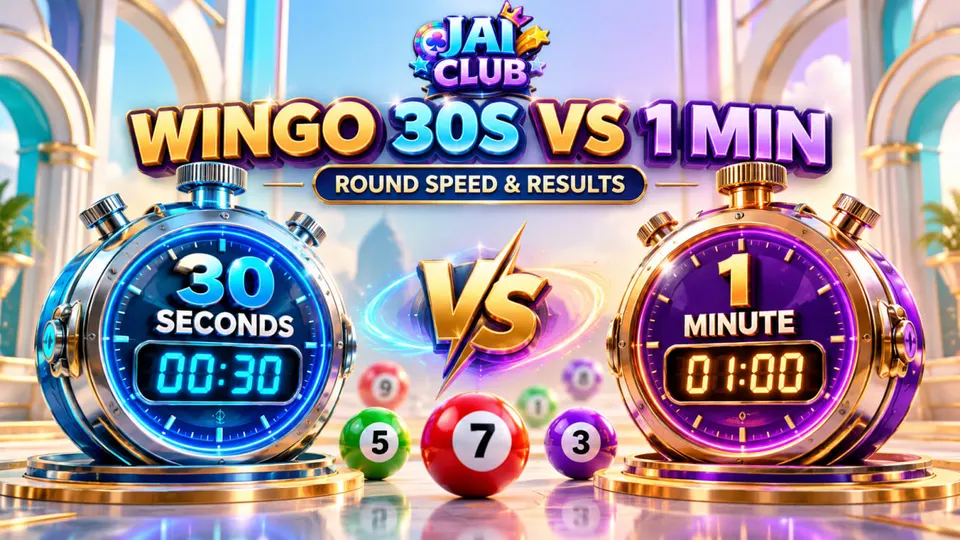
WinGo 30 Seconds vs 1 Minute: Round Speed & Results Explained
Understand the differences between WinGo 30 Seconds and WinGo 1 Minute, including round duration, countdown speed, period numbers, result history, Big Small classifications and comparison with 3-minute and 5-minute modes.
In this article
- What Is WinGo 30 Seconds?
- How Long Is One Round?
- Does the Result Change Every 30 Seconds?
- Is WinGo 30S a Separate Game?
- What Is WinGo 1 Minute?
- How Many Rounds Fit Into One Hour?
- Is WinGo 1 Minute Slower?
- WinGo 30 Seconds vs 1 Minute: Main Differences
- Which Mode Has More Rounds?
- How Does the Countdown Differ?
- Example: 30-Second Countdown
- Example: 1-Minute Countdown
- Does the Countdown Always Start Exactly at 00:30 or 01:00?
- Why Do WinGo 30S and 1Min Show Different Period Numbers?
- Example
- Can the Same Clock Time Have Two Period Numbers?
- Does the Period Number Predict the Result?
- Do Both WinGo Modes Use the Same Numbers?
- What About Big and Small?
- Example
- Does a Faster Countdown Change Big and Small?
- Does WinGo 30 Seconds Have Different Colours?
- Why This Matters
- Are WinGo 30-Second Results the Same as 1-Minute Results?
- Example of Separate Results
- Why Comparing the Wrong Mode Causes Confusion
- How to Read WinGo Result History by Mode
- Check the Mode Label
- Check the Period Identifier
- Check the Result
- Avoid Mixing Histories
- Example
- What About WinGo 3 Minutes and 5 Minutes?
- Complete Round Duration Comparison
- Is 5 Minutes the Same as Five 1-Minute Results?
- Does a Faster WinGo Mode Improve Winning Chances?
- What Does Faster Actually Change?
- Does a Faster Mode Change the Mathematics?
- Can Faster Rounds Increase Financial Exposure?
- Can WinGo 30S History Predict 1Min Results?
- What About Repeating Numbers?
- What About Prediction Applications?
- Why Does WinGo 30S Sometimes Show a Different Countdown on Android?
- Possible Situations
- What Should You Check?
- Why Do Some Users Confuse 30 Seconds and 1 Minute?
- Similar Game Layouts
- Same Number Categories
- Countdown Already in Progress
- Separate Period IDs
- Historical Records
- WinGo 30 Seconds vs 1 Minute on Jai Club
- Common WinGo Round Duration Mistakes
- Mistake 1: Assuming 00:30 Always Means 30S Mode
- Mistake 2: Mixing Results From Different Modes
- Mistake 3: Believing Faster Rounds Are More Predictable
- Mistake 4: Treating Period Numbers as Result Numbers
- Mistake 5: Assuming 3-Minute Results Combine Three 1-Minute Rounds
- Mistake 6: Ignoring the Number of Rounds per Hour
- Mistake 7: Mistaking a Frozen Timer for a Different Mode
- Frequently Asked Questions
- 1. What is the difference between WinGo 30 Seconds and 1 Minute?
- 2. How many WinGo 30-second rounds are there in an hour?
- 3. How many WinGo 1-minute rounds are there in an hour?
- 4. Is WinGo 30 Seconds faster?
- 5. Do 30S and 1Min have the same period number?
- 6. Can both modes show different results?
- 7. Is WinGo 30 Seconds more accurate for predictions?
- 8. Does WinGo 1 Minute use different Big and Small numbers?
- 9. Why does my 1-minute timer show 30 seconds?
- 10. Does WinGo 3 Minutes contain three 1-minute results?
- 11. Can I compare 30S and 1Min result histories?
- 12. Does a faster mode guarantee more wins?
- 13. Which mode has more rounds per day?
- 14. What if the WinGo countdown freezes?
- 15. Are all WinGo timing modes available on Jai Club?
- Final Thoughts
WinGo is a number-based game commonly discussed on online gaming websites serving readers in India. Many WinGo interfaces provide several round-duration modes, including 30 Seconds, 1 Minute, 3 Minutes and 5 Minutes.
Although these modes may look similar, their countdowns and round schedules are different.
A WinGo 30 Seconds round lasts half a minute, while a WinGo 1 Minute round lasts 60 seconds. That means the 30-second version can complete twice as many rounds during the same period.
But does a faster round change the result? Are Big and Small classifications different? Why do the two modes show separate period numbers? And does the shorter duration make a particular number more likely?
This guide compares WinGo 30 Seconds vs 1 Minute, explains how round duration affects the interface, and examines the relationship between countdowns, period identifiers and result history.
The examples are educational. Exact round-closing rules, result-processing times and available modes depend on the particular game implementation.
For a general introduction to number and colour mechanics, explore our WinGo guides.
What Is WinGo 30 Seconds?
WinGo 30 Seconds, sometimes written as WinGo 30S, refers to a round-based format with a nominal duration of 30 seconds.
A new round can begin after the previous 30-second cycle has completed.
This creates a relatively fast-moving interface.
How Long Is One Round?
One nominal round lasts 30 seconds.
Two complete 30-second cycles fit into one minute.
Under a continuous schedule, this produces 120 rounds per hour.
Does the Result Change Every 30 Seconds?
In a continuously running 30-second format, each round has its own result.
However, the result-display time and next-round transition depend on how the particular service is implemented.
A countdown reaching zero does not necessarily mean that every related screen component will update at the exact same instant.
Is WinGo 30S a Separate Game?
It is generally a separate timing mode within the broader WinGo format.
Its rounds can have their own period identifiers and history records.
It should not automatically be treated as the same active round as the 1-minute version.
What Is WinGo 1 Minute?
WinGo 1 Minute, also called WinGo 1Min or WinGo 60 Seconds, uses a nominal round duration of 60 seconds.
It follows the same general concept of completed numbered rounds but at a slower pace than the 30-second version.
How Many Rounds Fit Into One Hour?
An hour contains 3,600 seconds.
Dividing by 60 gives:
3,600 ÷ 60 = 60
Therefore, a continuously running one-minute mode can complete 60 rounds per hour.
Is WinGo 1 Minute Slower?
Yes, in terms of the interval between scheduled rounds.
Each round lasts twice as long as a 30-second round.
This does not establish that the actual website will respond more quickly or slowly.
Website performance and round duration are different issues.
WinGo 30 Seconds vs 1 Minute: Main Differences
The clearest difference is the round schedule.
| Feature | WinGo 30 Seconds | WinGo 1 Minute |
|---|---|---|
| Duration per round | 30 seconds | 60 seconds |
| Nominal rounds per minute | 2 | 1 |
| Nominal rounds per hour | 120 | 60 |
| Nominal rounds per day | 2,880 | 1,440 |
| Countdown pace | Faster | Slower |
| Period identifiers | Mode-specific | Mode-specific |
| Result history | Separate round records | Separate round records |
| Number categories | Depends on rules | Depends on rules |
| Automatic probability advantage | Not established | Not established |
The calculated round counts assume uninterrupted operation over the full period.
Real services may have maintenance windows, interruptions or additional time between rounds.
Which Mode Has More Rounds?
WinGo 30 Seconds has twice the nominal round frequency.
For example, during ten minutes:
30-second mode:
600 ÷ 30 = 20 rounds
1-minute mode:
600 ÷ 60 = 10 rounds
The difference is frequency, not a guaranteed advantage in the results.
How Does the Countdown Differ?
Each timing mode displays the time remaining for its own round.
A 30-second mode begins with a shorter interval.
A 1-minute mode has a longer countdown.
Example: 30-Second Countdown
A fictional timer sequence could be:
00:30
00:20
00:10
00:05
00:00
The countdown reaches zero after the nominal 30-second interval.
Example: 1-Minute Countdown
A fictional timer sequence could be:
01:00
00:45
00:30
00:15
00:00
Both counters reach zero, but they describe different-length cycles.
Does the Countdown Always Start Exactly at 00:30 or 01:00?
Not necessarily when you first open the page.
If a round is already in progress, you may see only its remaining time.
For example, opening a 1-minute mode halfway through the round might show approximately 00:30.
That does not mean you have selected the 30-second version.
Always check the selected mode label rather than relying on the current countdown number alone.
Why Do WinGo 30S and 1Min Show Different Period Numbers?
A period number is an identifier associated with a particular round.
Different timing modes generally operate their own sequences.
This means their period identifiers may differ even when the two games are displayed at the same time.
Example
Imagine the following fictional records:
30-second mode:
Period: DEMO-30S-205
1-minute mode:
Period: DEMO-1M-103
These are illustrative identifiers, not authentic period IDs from a live service.
The point is that each mode identifies its own rounds.
Can the Same Clock Time Have Two Period Numbers?
Yes.
A 30-second round and a 1-minute round can be active during overlapping times.
Their identifiers do not need to be identical.
Does the Period Number Predict the Result?
No.
An identifier is used to distinguish rounds.
It does not independently reveal the next number or colour.
For more information, read our WinGo Period Number guide.
Do Both WinGo Modes Use the Same Numbers?
Many WinGo-style implementations use result numbers from 0 through 9 across their available timing modes.
However, the published game rules should be checked for the specific platform.
What About Big and Small?
A common WinGo classification uses:
Small: 0, 1, 2, 3, 4
Big: 5, 6, 7, 8, 9
The number classification is separate from the round's duration.
Example
If a completed 30-second round displays number 7, it belongs to the Big range under that classification.
If a completed 1-minute round displays number 2, it belongs to the Small range.
These outcomes belong to separate rounds.
They are examples only, not actual results.
Does a Faster Countdown Change Big and Small?
Not by itself.
A different round duration does not mathematically redefine which numbers belong to Big or Small.
Any differences in rules would have to come from the actual implementation.
Does WinGo 30 Seconds Have Different Colours?
Some WinGo formats classify result numbers using Red, Green and Violet.
The colour mapping comes from the game's defined rules.
A shorter or longer timer does not automatically change that mapping.
Why This Matters
If a platform uses the same colour mapping in its 30-second and 1-minute versions, the categories remain consistent even though the timing differs.
However, readers should verify the relevant game's rules rather than assuming that every platform follows one universal mapping.
For a fuller explanation of game terminology, read our WinGo Explained guide.
Are WinGo 30-Second Results the Same as 1-Minute Results?
They should not automatically be assumed identical.
When the two modes operate as separate game rooms, they can have different round histories and results.
Example of Separate Results
| Mode | Fictional Period | Result |
|---|---|---|
| 30 Seconds | DEMO-30S-501 | 3 |
| 1 Minute | DEMO-1M-251 | 8 |
These records are fictional.
They illustrate how two modes can display different results without a contradiction.
Why Comparing the Wrong Mode Causes Confusion
A user may open the 30-second history and then compare it with a number displayed in the 1-minute mode.
The results will not necessarily match.
The correct comparison requires the same game mode and the same period identifier.
How to Read WinGo Result History by Mode
A result-history screen may allow users to review previously completed rounds.
Before interpreting the records, check which timing mode is selected.
Check the Mode Label
Confirm whether the selected tab says 30S, 1Min, 3Min or 5Min.
Check the Period Identifier
Identify the exact completed round.
Check the Result
Read the outcome associated with that round.
Avoid Mixing Histories
Do not compare one mode's period against another mode's result.
Example
A user views:
30S history: DEMO-30S-090
Then switches to:
1Min history: DEMO-1M-045
The change in identifiers is expected when separate modes have separate round sequences.
For additional information, browse our WinGo Results History guide.
What About WinGo 3 Minutes and 5 Minutes?
Many implementations also provide 3-minute and 5-minute rounds.
These use longer intervals.
Complete Round Duration Comparison
| Mode | Seconds per Round | Nominal Rounds per Hour | Nominal Rounds per Day |
|---|---|---|---|
| WinGo 30S | 30 | 120 | 2,880 |
| WinGo 1Min | 60 | 60 | 1,440 |
| WinGo 3Min | 180 | 20 | 480 |
| WinGo 5Min | 300 | 12 | 288 |
The figures are calculated from time alone.
They assume continuous rounds with no additional breaks.
Is 5 Minutes the Same as Five 1-Minute Results?
No.
A single 5-minute round is not automatically the combination of five separate 1-minute rounds.
Different timing modes can represent separate result sequences.
Does a Faster WinGo Mode Improve Winning Chances?
There is no basis for claiming that a shorter countdown automatically increases the probability of a particular number appearing.
Round speed and outcome probability are different concepts.
What Does Faster Actually Change?
It changes how frequently new rounds are scheduled.
Does a Faster Mode Change the Mathematics?
Not necessarily.
If two modes use identical outcome-generation rules, changing the round duration alone does not change the per-round mathematical probabilities.
But actual operator-specific rules must still be verified.
Can Faster Rounds Increase Financial Exposure?
Yes.
More frequent rounds can create more opportunities to make financial decisions within the same time.
If someone repeatedly participates, a faster mode can increase the number of stakes placed during that period.
This can increase overall financial exposure and potential losses.
A shorter game is not inherently safer or more profitable.
Can WinGo 30S History Predict 1Min Results?
No dependable prediction follows from comparing the historical results of two separate timing modes.
Even if their outcomes appear to show similar patterns, a visual resemblance does not establish a predictive relationship.
What About Repeating Numbers?
Repeated results can occur in number-based games.
Their appearance does not prove that the next outcome must be different.
What About Prediction Applications?
Apps or websites claiming guaranteed predictions for the next 30-second or 1-minute result should be treated cautiously.
A chart or confidence percentage is not proof of accuracy.
Historical records can help explain past outcomes, not guarantee future ones.
Why Does WinGo 30S Sometimes Show a Different Countdown on Android?
The countdown displayed in a browser may be affected by when the page was opened, its refresh state or the browser's handling of background activity.
A different countdown does not necessarily mean that the mode has changed.
Possible Situations
- The page opened in the middle of a round.
- The browser resumed an older tab.
- The interface has not received the latest state.
- The internet connection is unstable.
- The browser has reduced background timer activity.
What Should You Check?
First check the selected mode.
Then confirm the current period ID.
Observe whether the page continues updating.
If the counter is completely frozen, that is a different troubleshooting problem from normal round-duration differences.
Read our WinGo Countdown Timer troubleshooting guide.
Why Do Some Users Confuse 30 Seconds and 1 Minute?
Several interface details can make the two modes look similar.
Similar Game Layouts
The same website may use an almost identical visual design for both modes.
Same Number Categories
Both may display the same types of number, colour and Big/Small controls.
Countdown Already in Progress
A 1-minute round can display 00:30 when half of its interval has passed.
Separate Period IDs
Users may not notice that switching modes also changes the period sequence.
Historical Records
Previously completed results can appear different because the selected mode changed.
The simplest way to avoid confusion is to check the mode label, period ID and current status together.
WinGo 30 Seconds vs 1 Minute on Jai Club
Readers may encounter terms such as Jai Club WinGo 30 Seconds or Jai Club WinGo 1 Minute in online searches.
However, those search phrases alone do not establish the current catalogue or exact rules of a particular Jai Club-related platform.
Different services may provide different game modes.
If an interface offers both options, use its published rules to identify the exact timing and settlement conditions.
This article explains the common timing differences without claiming that every Jai Club-branded website has identical implementations.
Common WinGo Round Duration Mistakes
Mistake 1: Assuming 00:30 Always Means 30S Mode
The timer may be displaying the remaining portion of a longer round.
Mistake 2: Mixing Results From Different Modes
Separate round durations may have separate period IDs and histories.
Mistake 3: Believing Faster Rounds Are More Predictable
A shorter countdown does not reveal future outcomes.
Mistake 4: Treating Period Numbers as Result Numbers
Period IDs identify rounds; results describe their outcomes.
Mistake 5: Assuming 3-Minute Results Combine Three 1-Minute Rounds
Each timing mode may operate its own distinct rounds.
Mistake 6: Ignoring the Number of Rounds per Hour
A faster schedule allows more completed rounds during the same time.
Mistake 7: Mistaking a Frozen Timer for a Different Mode
Technical display problems and normal round durations are not the same.
Frequently Asked Questions
1. What is the difference between WinGo 30 Seconds and 1 Minute?
The main difference is the nominal round duration. WinGo 30S lasts 30 seconds, while WinGo 1Min lasts 60 seconds.
2. How many WinGo 30-second rounds are there in an hour?
A continuous 30-second schedule produces 120 rounds per hour.
3. How many WinGo 1-minute rounds are there in an hour?
A continuous one-minute schedule produces 60 rounds per hour.
4. Is WinGo 30 Seconds faster?
Yes. Its nominal round frequency is twice that of the 1-minute version.
5. Do 30S and 1Min have the same period number?
Not necessarily. Separate timing modes commonly maintain different period identifiers.
6. Can both modes show different results?
Yes. Different timing modes can have separate result sequences.
7. Is WinGo 30 Seconds more accurate for predictions?
There is no established basis for claiming that a faster countdown makes future outcomes easier to predict.
8. Does WinGo 1 Minute use different Big and Small numbers?
A timing change does not itself alter the number classification. Check the specific game's rules.
9. Why does my 1-minute timer show 30 seconds?
You may have opened or returned to the round halfway through its countdown.
10. Does WinGo 3 Minutes contain three 1-minute results?
Not necessarily. A 3-minute mode can represent a separate round sequence.
11. Can I compare 30S and 1Min result histories?
You can examine both histories, but do not treat records from different modes as the same round.
12. Does a faster mode guarantee more wins?
No. More frequent rounds do not establish better per-round winning probabilities.
13. Which mode has more rounds per day?
The 30-second version has more nominal rounds: 2,880 compared with 1,440 for a continuous 1-minute version.
14. What if the WinGo countdown freezes?
Check the browser, internet connection, selected mode and current period. A frozen timer is a technical symptom rather than a normal mode difference.
15. Are all WinGo timing modes available on Jai Club?
Availability needs to be verified on the exact platform. Similar branding does not guarantee identical game catalogues.
Final Thoughts
WinGo 30 Seconds and WinGo 1 Minute share the broader concept of timed, number-based rounds, but they operate at different speeds.
A 30-second cycle is half as long as a 1-minute cycle, resulting in twice as many nominal rounds over the same period.
Their period identifiers and histories may also differ because each timing mode can operate its own sequence.
The important distinction is between game speed and outcome probability.
A faster countdown does not automatically make results more predictable or improve an individual's chance of obtaining a favourable result.
For more explanations of WinGo periods, results, numbers and technical problems, explore our WinGo category.
This guide is intended for educational use and does not promise winning outcomes or financial returns.