WinGo Odd or Even? Numbers 0–9 & Result Classification
Learn how odd and even numbers are classified in WinGo-style results, including digits 0–9, why zero is even, Big and Small groups, Red Green Violet colours and common chart-reading mistakes.
In this article
- What Does Odd or Even Mean in WinGo?
- Complete WinGo Odd Even Number Chart
- Which Numbers Are Odd in WinGo?
- Which Numbers Are Even in WinGo?
- Is Zero Odd or Even in WinGo?
- Why Is Number 5 a Special Case?
- WinGo Odd Even vs Big Small
- WinGo Odd Even vs Red Green Violet
- How to Read Odd and Even Result History
- Example of Odd Even History
- Can Odd and Even Numbers Repeat?
- Does Odd Even Mean a 50% Winning Chance?
- Why Odd Even History Cannot Guarantee Future Results
- Common Mistakes in WinGo Odd Even Charts
- Is Odd Even Available as a Jai Club WinGo Option?
- Frequently Asked Questions
- What are the odd numbers in WinGo?
- What are the even numbers in WinGo?
- Is zero even in WinGo?
- Is number 5 odd or even?
- Is Odd the same as Small?
- Is Even the same as Red?
- Can two consecutive WinGo results both be Odd?
- Does an Odd streak mean Even is next?
- Can odd/even be calculated from result history?
- Does Jai Club always offer Odd/Even selection?
- Final Thoughts
WinGo Odd or Even is a search phrase commonly used by readers who want to understand how numerical results are classified. In WinGo-style games that display a single digit from 0 to 9, each completed number belongs to either the odd group or the even group according to ordinary mathematics.
However, the odd/even classification should not be confused with colour labels or Big/Small results. A number can be odd and Big, even and Small, or associated with a special colour such as Violet. Understanding these separate categories makes a result chart easier to read.
This guide explains WinGo odd and even numbers from 0 to 9, why zero belongs to the even group, how the classification relates to Red, Green and Violet, and why an odd/even chart does not establish the result of the next round.
What Does Odd or Even Mean in WinGo?
Odd and even are mathematical classifications of integers. An even number can be divided by two without a remainder, while an odd number leaves a remainder of one when divided by two.
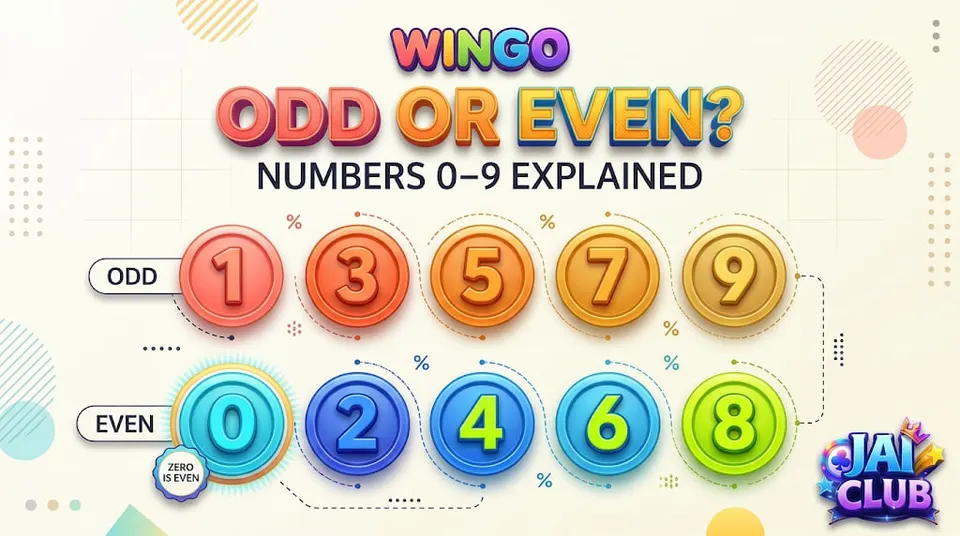
In a common WinGo-style format, completed results are represented by digits from 0 to 9. Five of those digits are even, and five are odd.
This classification can be used to describe a completed number regardless of whether the game actually provides an Odd/Even selection option. The availability of such an option depends on the specific platform and should not be assumed from the result chart alone.
Complete WinGo Odd Even Number Chart
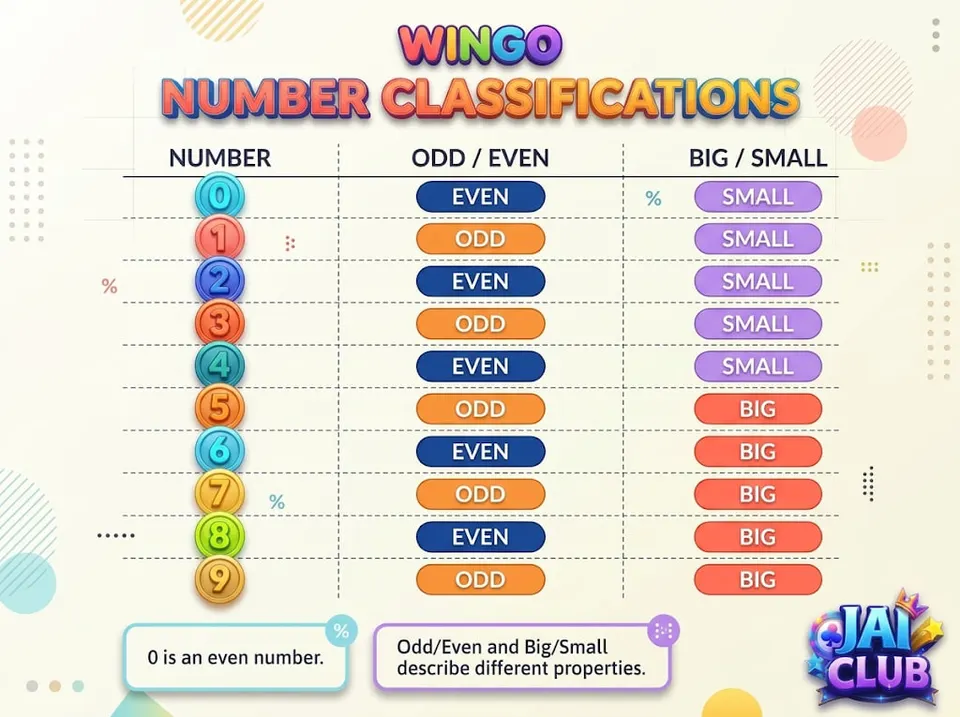
The following table shows the mathematical classification of every digit from 0 to 9. It also includes the common WinGo-style Big/Small and colour labels as additional reference information.
| Number | Odd or Even | Big or Small | Common colour label |
|---|---|---|---|
| 0 | Even | Small | Red + Violet |
| 1 | Odd | Small | Green |
| 2 | Even | Small | Red |
| 3 | Odd | Small | Green |
| 4 | Even | Small | Red |
| 5 | Odd | Big | Green + Violet |
| 6 | Even | Big | Red |
| 7 | Odd | Big | Green |
| 8 | Even | Big | Red |
| 9 | Odd | Big | Green |
The odd/even column is a mathematical fact and does not depend on the game operator. The colour and size columns illustrate a commonly used WinGo-style mapping and must be checked against the actual game's rules.
For example, the number 8 is Even and Big, while 3 is Odd and Small. Both have separate colour labels that should not be mistaken for their odd/even classification.
Which Numbers Are Odd in WinGo?
The odd digits from 0 to 9 are 1, 3, 5, 7 and 9. Each of these numbers produces a remainder of one when divided by two.
The common colour chart labels 1, 3, 7 and 9 as Green, while 5 is a special case associated with Green and Violet. This relationship can make it look as though Green always means Odd, but the exact colour mapping is a separate rule rather than the mathematical definition.
An odd number may also belong to either size group. Numbers 1 and 3 are Small, while 5, 7 and 9 are Big under the common 0–4 and 5–9 classification.
Which Numbers Are Even in WinGo?
The even digits from 0 to 9 are 0, 2, 4, 6 and 8. All five are divisible by two without a remainder.
In the common WinGo-style colour chart, 2, 4, 6 and 8 are Red, while 0 is associated with Red and Violet. Again, this is a relationship between a game label and a mathematical property, not proof that colour and parity are interchangeable concepts.
Even results can be Big or Small. Numbers 0, 2 and 4 belong to Small, while 6 and 8 belong to Big.
Is Zero Odd or Even in WinGo?
Zero is even. This is one of the most common mathematical questions associated with WinGo odd/even charts because some readers incorrectly assume that zero belongs to neither group.
An integer is even if it can be expressed as two multiplied by another integer. Zero satisfies this definition because 0 = 2 × 0.
Therefore, a completed result of 0 is classified as Even in ordinary mathematics. It is also Small in the common WinGo-style size mapping and may carry Red and Violet colour labels.
The special colour treatment of zero does not change its even-number classification.
Why Is Number 5 a Special Case?
Number 5 is an odd integer. Under the common WinGo-style mapping, it belongs to the Big group and can be associated with Green and Violet colour labels.
Its special colour treatment is a feature of the particular result chart rather than an exception to the mathematical odd/even rule. Five remains Odd regardless of how many coloured indicators are displayed.
This distinction becomes important when readers compare charts from different sources. A game-specific colour label can vary between implementations, while the parity of an integer does not.
WinGo Odd Even vs Big Small
Odd/Even and Big/Small describe different properties of a completed number. Odd/Even concerns divisibility by two, while the common Big/Small system divides the 0–9 range into two groups.
Small contains 0, 1, 2, 3 and 4. Big contains 5, 6, 7, 8 and 9.
As a result, Odd does not mean Small, and Even does not mean Big. Both categories contain a mixture of odd and even digits.
| Combination | Numbers |
|---|---|
| Odd + Small | 1, 3 |
| Odd + Big | 5, 7, 9 |
| Even + Small | 0, 2, 4 |
| Even + Big | 6, 8 |
This table shows why different labels can appear together without contradicting one another. A single result can have several valid classifications.
WinGo Odd Even vs Red Green Violet
The common WinGo colour chart is closely related to specific digits, but colour and parity should still be understood separately.
Most regular Green digits happen to be odd, and most regular Red digits happen to be even. However, the special cases of 0 and 5 can also include Violet.
A colour label is assigned through a game's rules, whereas odd/even is determined by arithmetic. This means a chart can change its colour conventions without changing which digits are mathematically odd or even.
Readers comparing different services should always consult the applicable colour legend rather than assuming every platform uses identical rules.
How to Read Odd and Even Result History
A result-history table normally displays completed numerical outcomes together with period identifiers and other labels. Even if the interface does not have a separate Odd/Even column, parity can be determined directly from the result digit.
The first step is to identify the relevant completed period. Next, read its number and classify it using the 0–9 chart. The period number itself should not be confused with the result number.
For example, a period identifier ending in an odd digit does not mean that the actual completed WinGo result must also be odd. The identifier distinguishes a round, while the result digit describes its outcome.
Example of Odd Even History
The following table uses fictional period numbers and results. It illustrates classification only and does not represent a live Jai Club record.
| Period | Result | Classification |
|---|---|---|
| 10481 | 6 | Even |
| 10482 | 3 | Odd |
| 10483 | 0 | Even |
| 10484 | 7 | Odd |
| 10485 | 5 | Odd |
The example contains two Even results and three Odd results. This can be counted descriptively, but it does not reveal whether the next fictional result will be Odd or Even.
Can Odd and Even Numbers Repeat?
Yes. A sequence of completed results can contain several odd numbers or several even numbers in succession.
For example, the results 1, 3, 7 and 9 are all Odd even though the individual numbers differ. Similarly, 0, 2, 6 and 8 are all Even.
A repeated category is not proof that the game is stuck or that a different category must appear next. Sequences can contain repeated classifications without violating ordinary probability principles.
Does Odd Even Mean a 50% Winning Chance?
The 0–9 range contains five odd and five even numbers. If every digit were independently and uniformly distributed, the theoretical probability of an odd result would be 50%, and the same would apply to even results.
However, this mathematical example depends on equal probabilities across all ten digits. A specific game's actual distribution and available selection types must be determined from its verified rules.
Even a theoretical 50% outcome probability does not establish a positive expected financial return. Payout rates and other terms would also matter.
Why Odd Even History Cannot Guarantee Future Results
Historical results can be counted and classified, but their sequence does not automatically provide information about the next independent outcome.
For instance, observing five Odd results in a row does not prove that Even must occur in the following round. That assumption is an example of the gambler's fallacy, in which a previous random sequence is treated as creating an obligation for a different future outcome.
A chart can help readers understand past results, but it should not be presented as a guaranteed prediction method.
Common Mistakes in WinGo Odd Even Charts
A frequent mistake is treating zero as neither odd nor even. In mathematics, zero is definitely even.
Another mistake involves mixing the result digit with the period identifier. A period ending in 7 can have a result of 4; the parity of the period identifier has no necessary relationship to the parity of the recorded game result.
A third misunderstanding is treating Green as a mathematical synonym for Odd and Red as a synonym for Even. Colour labels are game-specific, while parity is an independent numerical property.
Finally, a reader may use a recent streak as evidence that the next category is predictable. A historical sequence alone does not establish that conclusion.
Is Odd Even Available as a Jai Club WinGo Option?
The mathematical classification of results can be explained without establishing that a particular operator offers a separate Odd/Even selection.
Some game interfaces may offer different selection categories, while others focus on colours, exact numbers or Big/Small results. Readers should check the actual game rules to see which options are available.
This guide does not claim that every Jai Club-branded implementation includes Odd/Even as a selectable wager.
Frequently Asked Questions
What are the odd numbers in WinGo?
The odd digits from 0 to 9 are 1, 3, 5, 7 and 9.
What are the even numbers in WinGo?
The even digits are 0, 2, 4, 6 and 8.
Is zero even in WinGo?
Yes. Zero is an even integer.
Is number 5 odd or even?
Five is odd, regardless of its colour classification.
Is Odd the same as Small?
No. Odd includes both Small and Big numbers.
Is Even the same as Red?
Not as a mathematical definition. Red is a game-specific colour label, while Even is a numerical property.
Can two consecutive WinGo results both be Odd?
Yes. Several consecutive results can belong to the same category.
Does an Odd streak mean Even is next?
No. A historical streak does not guarantee the next result.
Can odd/even be calculated from result history?
Yes. Each completed digit can be classified mathematically.
Does Jai Club always offer Odd/Even selection?
Availability depends on the particular game implementation and must be verified.
Final Thoughts
The WinGo Odd or Even chart is straightforward once the numerical categories are separated from colour and size labels. Odd includes 1, 3, 5, 7 and 9, while Even includes 0, 2, 4, 6 and 8.
Zero is even, five is odd, and neither classification should be confused with a particular Red, Green or Violet label. Readers should also distinguish the round identifier from the actual result digit.
For more educational explanations of WinGo terminology, colour charts and completed results, explore the Wingo guides.